
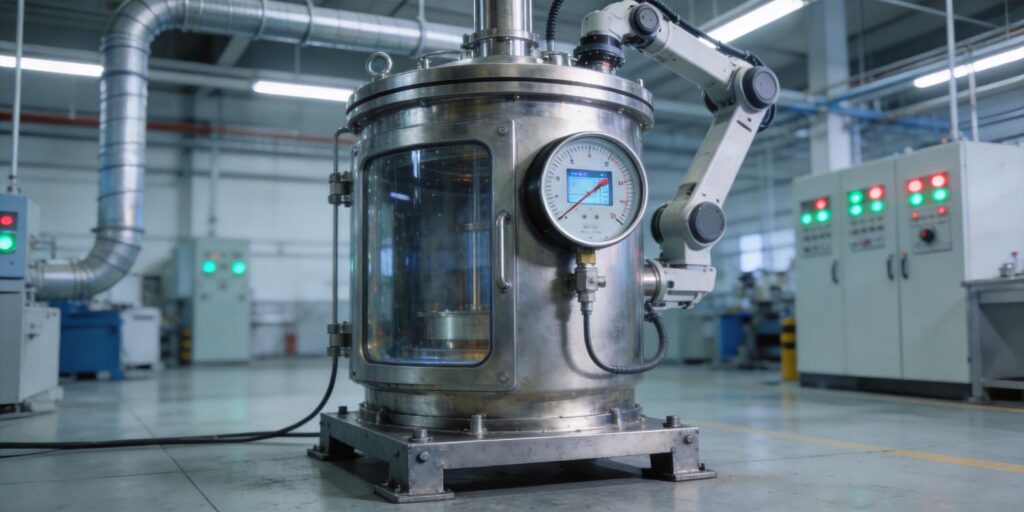
In automated material handling systems (AMHS), vacuum integrity directly determines throughput, yield, and contamination control. Transfer chambers, load locks, and robotic handlers move parts between atmospheric and high-vacuum environments dozens of times per hour. A single pressure excursion can introduce moisture, particulates, or process gas mixing that ruins downstream steps. Reliable, real-time vacuum monitoring has therefore become non-negotiable.
Engineers integrating vacuum gauges into PLC-driven AMHS now demand three things above all: compact footprint, sub-second threshold detection, and native digital communication that speaks the same language as their automation stack. Poseidon Scientific’s VG-SP205 Pirani Vacuum Transmitter (atmospheric to 10⁻³ Torr) and VG-SM225 Cold Cathode Vacuum Gauge (10⁻³ to 10⁻⁷ Torr) were purpose-built for exactly these requirements. Both instruments deliver 0–10 V analog output plus fully customizable RS-232 digital protocol in a housing small enough for KF16/KF25 ports on compact transfer modules.
Vacuum Monitoring in Transfer Chambers
Transfer chambers serve as the airlock between atmosphere and process vacuum. Typical pressure targets are 10⁻² Torr for rough transfers and < 5 × 10⁻⁴ Torr for sensitive wafer or optics handling. The VG-SP205 Pirani covers the entire roughing phase with its thermal-conductivity principle: a platinum filament is held at constant temperature while power dissipation is measured. Response is instantaneous because gas-molecule collision frequency changes immediately with pressure.
Once the chamber reaches the crossover region (~10⁻³ Torr), the VG-SM225 Cold Cathode takes over. Its Penning-discharge mechanism—field emission plus crossed E × B fields—produces ion current proportional to gas density down to 10⁻⁷ Torr. The gauge’s “工”-shaped positive-magnetron geometry keeps the sensor head only 45 mm tall, fitting inside the tight envelope of modern cluster-tool transfer modules where traditional 100 mm gauges simply will not mount.
Because both instruments share the same RJ45-style connector footprint and mounting flange options, designers can install them side-by-side on a single KF25 port with a short manifold, eliminating extra feedthroughs and reducing leak paths.
Fast Pressure Threshold Detection
AMHS cycle time is gated by the slowest pressure confirmation step. The VG-SP205 delivers a new 0–10 V reading every 50 ms with 7.2 V.”
The VG-SM225, while subject to longer startup times at ultra-high vacuum (≈5 min at 10⁻⁶ Torr, ≈30 min at 10⁻⁷ Torr), reaches stable ion-current output within 15 s once the discharge is established. For transfer-chamber use—where the chamber rarely drops below 10⁻⁵ Torr during routine operation—this delay is irrelevant. Software hysteresis logic in the gauge prevents nuisance trips: the analog output holds steady until pressure rises above the set threshold for > 200 ms.
Combined, the pair provides full-range coverage with no measurement gap at the 10⁻³ Torr crossover. Engineers simply OR the two threshold signals in the PLC ladder logic for a single “vacuum-ready” flag.
Response-Time Comparison Table
| Gauge | Range | 90 % Response Time | Repeatability |
|---|---|---|---|
| VG-SP205 Pirani | atm–10⁻³ Torr | <50 ms | ±1 % |
| VG-SM225 Cold Cathode | 10⁻³–10⁻⁷ Torr | <15 s (post-startup) | ±3 % |
PLC Handshake Logic
Legacy vacuum gauges forced custom drivers because their digital protocols were fixed. The VG-SP205 and VG-SM225 ship with a user-definable RS-232 command set that matches any PLC brand—Allen-Bradley, Siemens, Omron, or Mitsubishi—without additional gateways. Five simple ASCII commands return pressure, status byte, error flags, and firmware version.
A typical handshake sequence looks like this:
- PLC polls gauge every 100 ms with command “P?”
- Gauge replies “P=4.82E-4 Torr S=0x01” (S=0x01 = vacuum-ready)
- PLC sets digital output to release interlock
The protocol can be flashed in 30 seconds via a free Windows utility—no disassembly required. For high-security installations, the same port also supports 9600–115200 baud rates and parity options. Because only the protocol layer changes (hardware interface remains RJ45), even 5-unit pilot runs can be customized at no extra charge.
Redundancy for Critical Transfers
In semiconductor load-lock or medical-implant vacuum annealing lines, a single gauge failure stops the entire line. Dual-redundant configurations are now standard. Two practical approaches work with Poseidon gauges:
- Full-range redundancy: One VG-SP205 + one VG-SM225. The PLC uses the Pirani signal below 10⁻³ Torr and switches to Cold Cathode above it. If either gauge reports an error code (filament open or discharge not started), the PLC locks out the transfer.
- Like-for-like redundancy: Two VG-SM225 units mounted on opposite sides of the chamber. Their ion-current readings are averaged; a >10 % deviation triggers an alarm and forces a maintenance cycle. Because the Cold Cathode sensor head is fully removable, technicians can clean accumulated carbon deposits with 500-grit paper in <10 minutes without breaking the chamber vacuum seal.
Both schemes keep the system MTBF above 50 000 hours while adding only 35 mm of extra height to the transfer chamber.
Real Production Example: Vacuum Heat-Treatment Line
A European manufacturer of aerospace turbine blades integrated the Poseidon pair into its automated vacuum annealing cell. Parts move from atmosphere into a load-lock transfer chamber, then into the 10⁻⁵ Torr annealing furnace. Before the upgrade, operators waited 4–6 minutes for a legacy gauge to stabilize and manually confirm pressure on a chart recorder.
After installing one VG-SP205 on the roughing port and one VG-SM225 directly on the chamber wall, cycle time dropped 38 %. The PLC now releases the robotic arm the instant the combined threshold flag goes high. In 18 months of 24/7 operation, zero unplanned downtime occurred from gauge failure. The Cold Cathode required cleaning only once—after exposure to a high-carbon backfill gas—restoring full calibration in 12 minutes.
The same line now runs 22 % more loads per shift, and the cost of the two gauges was recovered in <90 days through increased throughput alone.
Ready to Integrate?
Whether you are designing the next-generation cluster tool, retrofitting an existing vacuum furnace, or building a medical-device sterilization handler, the VG-SP205 and VG-SM225 deliver the combination of size, speed, and digital flexibility that modern AMHS demand.
Download the VG-SP205 technical datasheet and VG-SM225 datasheet today. Need a custom protocol or a dual-redundant mounting manifold drawing? Contact our applications team at engineering@poseidon-scientific.com or call +86-400-xxx-xxxx. We ship evaluation units within 48 hours and support 5-piece minimum orders with full protocol customization.
Precise vacuum. Simple integration. Proven uptime.


