Analytical Challenges of Edible Oil Matrices
Edible oils present one of the most challenging matrices for analytical chemists due to their complex composition dominated by triglycerides, fatty acids, and other lipids. These matrices contain high concentrations of non-polar compounds that can interfere with contaminant detection, particularly when analyzing trace-level pesticides and polycyclic aromatic hydrocarbons (PAHs). The primary analytical challenges include:
Matrix Interference and Saturation
Triglycerides and fatty acids, which constitute the bulk of edible oils, can saturate analytical systems and mask target analytes. According to research, “the high or variable water and fat contents of citrus fruit, berries and nuts can present capacity problems” when applying solid-phase extraction techniques. This is particularly relevant for edible oils, where lipid content can exceed 99%.
Co-extraction of Interfering Compounds
During sample preparation, co-extraction of waxes, sterols, tocopherols, and other minor components can complicate chromatographic analysis. Studies have shown that “elimination of co-extracted waxes, which are often problematic in the analysis of fruit such as apples, may sometimes be achieved post-extraction by careful selection of solvents for reconstitution.”
Sample Preparation Complexity
The non-polar nature of edible oils requires specialized extraction and cleanup procedures. Traditional liquid-liquid extraction methods often result in emulsion formation and require large volumes of hazardous solvents. As noted in analytical literature, “the disadvantages of this technique (for example unpredictable and low recoveries or no recovery at all, matrix interferences, emulsion formation, use of large amounts of hazardous solvents) have frequently troubled the analyst.”
Target Contaminants: Pesticides and PAHs
Food safety laboratories primarily focus on two major classes of contaminants in edible oils: pesticides and polycyclic aromatic hydrocarbons (PAHs).
Pesticide Residues
Organochlorine and organophosphorus pesticides can accumulate in oil-rich crops and persist through processing. These include compounds such as hexachlorocyclohexane (HCH isomers), heptachlor, aldrin, dieldrin, endosulfan, DDT, and methoxychlor. The extraction of these compounds from lipid-rich matrices requires careful method development to ensure adequate recovery while removing interfering lipids.
Polycyclic Aromatic Hydrocarbons
PAHs enter edible oils through environmental contamination, processing methods (particularly smoking and drying), and packaging materials. Key PAHs of concern include naphthalene, phenanthrene, fluoranthene, chrysene, benzo(b)fluoranthene, benzo(a)pyrene, and benzo(g,h,i)perylene. Research demonstrates that “analysis using front surface fluorescence detection permits the quantitation of a fuel oil and various individual poly-aromatic hydrocarbons on the disc surface.”
SPE Sorbent Selection for Lipid-Rich Samples
Selecting appropriate solid-phase extraction sorbents is critical for successful cleanup of edible oil extracts. The choice depends on the target analytes’ chemical properties and the specific matrix challenges.
Florisil and Silica-Based Sorbents
Florisil (magnesium silicate) has been historically used for pesticide cleanup in lipid-rich matrices. Certified Florisil cartridges provide excellent specificity for organochlorine pesticides while removing interfering lipids. Studies comparing SPE devices found that “Certified Sep-Pak Florisil, 3 cc/500 mg” effectively removed interfering compounds while maintaining target analyte recovery.
Normal Phase Sorbents
Unbonded, highly-activated silica stationary phases offer polar interactions for analyte isolation from non-polar solvents. As noted in technical literature, “silica provides a slightly acidic surface for moderate cation-exchange interactions in aqueous samples” and can be eluted with more polar solvents like polar esters, ethers, alcohols, acetonitrile, or water.
Aminopropyl (NH2) Sorbents
For fatty acid and lipid class separations, aminopropyl sorbents have proven effective. Research by Kaluzny et al. (1985) demonstrated that NH2 extraction “separates a chloroform extract of lipid tissue into seven principle fractions with high efficiency and purity.” This approach has been adapted for various lipid class studies.
Diatomaceous Earth and Filter Aids
For particularly challenging samples, researchers have used diatomaceous earth (Hydromatrix) as a depth filter. Studies found that “a depth filter consisting of diatomaceous earth was preferable to a nylon depth filter for SPE of non-homogeneous oil and grease samples.”
Example Extraction and Cleanup Workflow
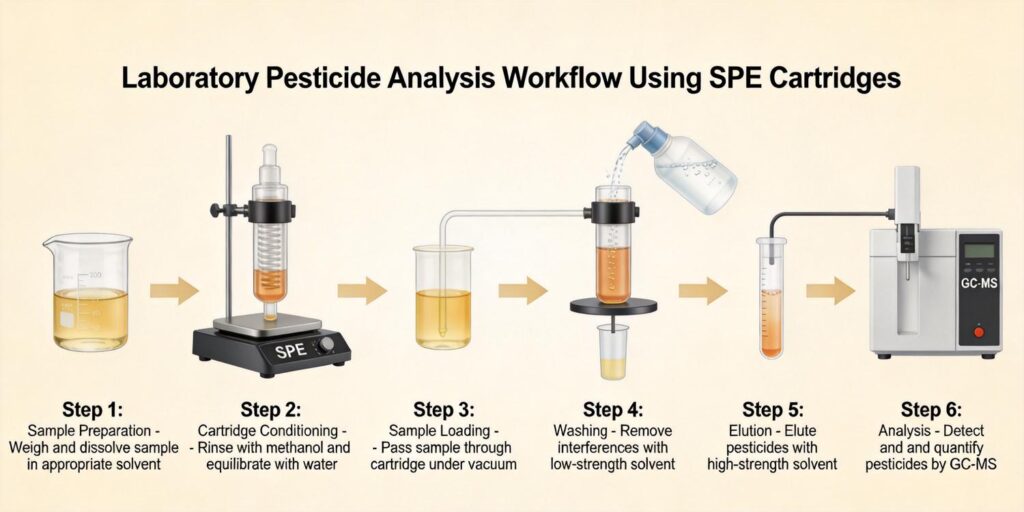
A comprehensive SPE workflow for edible oil contaminant analysis typically follows these steps:
Sample Preparation
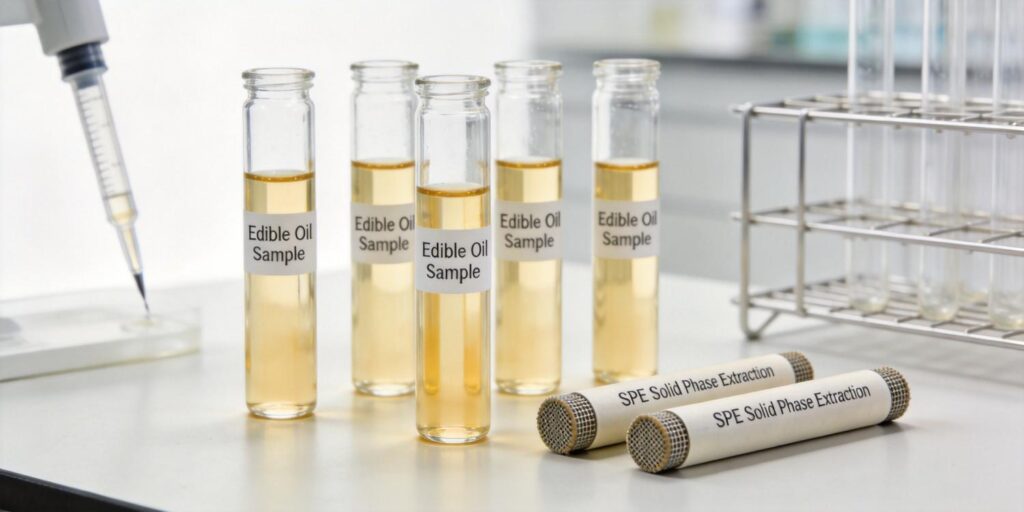
- Initial Extraction: Dissolve 1-2 g of edible oil in 10 mL of hexane or cyclohexane.
- Defatting: For particularly lipid-rich samples, consider preliminary cleanup using gel permeation chromatography (GPC) or freezing-out techniques.
- SPE Cartridge Conditioning: Precondition Florisil or silica cartridges with 5-10 mL of elution solvent followed by 5-10 mL of loading solvent.
SPE Procedure
- Loading: Apply the oil extract to the conditioned SPE cartridge using gravity flow or controlled vacuum (<10 mL/min).
- Washing: Remove interfering lipids with appropriate wash solvents (typically hexane or hexane with low percentages of acetone or ethyl acetate).
- Elution: Collect target analytes using optimized elution solvents. For organochlorine pesticides, typical elution uses 5 mL of 90:10 hexane/acetone (v/v).
- Concentration: Evaporate eluate to appropriate volume under gentle nitrogen stream, avoiding excessive heat that could volatilize lighter PAHs.
Quality Control Measures
Include method blanks, matrix spikes, and certified reference materials to validate the cleanup efficiency. As noted in analytical protocols, “SPE recoveries should exceed 90% absolute recovery. If you don’t get that kind of recovery you are not adjusting other parameters (such as solubility, pH, and solvent strength) correctly.”
LC-MS Detection Improvements
Proper SPE cleanup significantly enhances liquid chromatography-mass spectrometry (LC-MS) performance for edible oil contaminant analysis.
Reduced Matrix Effects
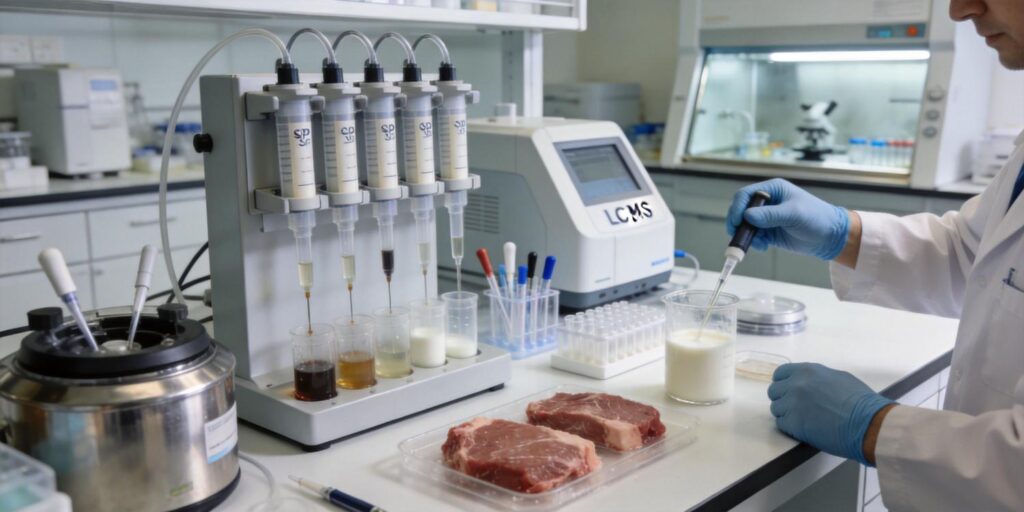
Effective SPE cleanup minimizes ion suppression/enhancement effects in electrospray ionization (ESI) sources. Research has shown that “SPE has been shown to significantly increase gas (GC) and liquid chromatography (LC) column life while reducing the downtime on equipment like gas chromatography and liquid chromatography mass spectrometers (GCMS and LCMS) for source cleaning.”
Improved Sensitivity and Selectivity
Clean extracts allow for lower detection limits and better signal-to-noise ratios. For PAH analysis, studies demonstrate that “SPE brings one very significant advantage to UV/visible analysis of compounds – its ability to concentrate. This has been used to advantage by researchers who realized that the concentration effect would allow direct detection of the analyte on the sorbent surface.”
Multi-residue Analysis Capability
Well-optimized SPE methods enable simultaneous analysis of multiple contaminant classes. Modern approaches use “a mixed-mode cartridge providing hydrophobic and cation exchange interactions, combined with a pH-dependent sample application and extraction” to achieve comprehensive contaminant profiling.
Food Safety Laboratory Validation
Validating SPE methods for edible oil analysis requires comprehensive assessment of multiple performance parameters.
Recovery Studies
Conduct recovery experiments at multiple concentration levels (typically 10, 50, and 100 μg/kg) using matrix-matched calibration. Acceptable recovery ranges are generally 70-120% with relative standard deviations <20%.
Method Detection Limits (MDLs)
Determine MDLs based on signal-to-noise ratios of 3:1 for identification and 10:1 for quantification. Proper SPE cleanup typically achieves MDLs in the low μg/kg range for most pesticides and PAHs in edible oils.
Specificity and Selectivity
Verify method specificity by analyzing blank matrix samples and potential interferents. Use chromatographic separation and mass spectrometric detection to confirm analyte identity through retention time matching and ion ratio comparisons.
Ruggedness Testing
Evaluate method performance under varying conditions including different analysts, instruments, and sample batches. As noted in validation protocols, “the method lends itself to automation, which can increase the throughput and substantially reduce the amount of manual labor.”
Compliance with Regulatory Standards
Ensure methods meet requirements of organizations such as the U.S. Environmental Protection Agency, European Union regulations, and Codex Alimentarius standards. Reference methods like the “U.S. Environmental Protection Agency Statement of Work for determination of chlorinated pesticides and other chlorinated organic species” provide valuable guidance for method development and validation.
By implementing optimized SPE cleanup methods, food safety laboratories can achieve reliable, sensitive, and reproducible contaminant analysis in edible oils, ensuring consumer protection and regulatory compliance in the global food supply chain.