Pressure Fluctuation During Target Replacement in PVD Systems
Physical Vapor Deposition (PVD) processes demand exceptional vacuum stability to achieve uniform film thickness, strong adhesion, and repeatable optical or mechanical properties. Target replacement—whether for sputtering cathodes or evaporation sources—requires venting the chamber to atmosphere, removing the spent target, installing a fresh one, and re-pumping. This sequence inevitably introduces pressure fluctuations that can exceed several orders of magnitude within minutes.
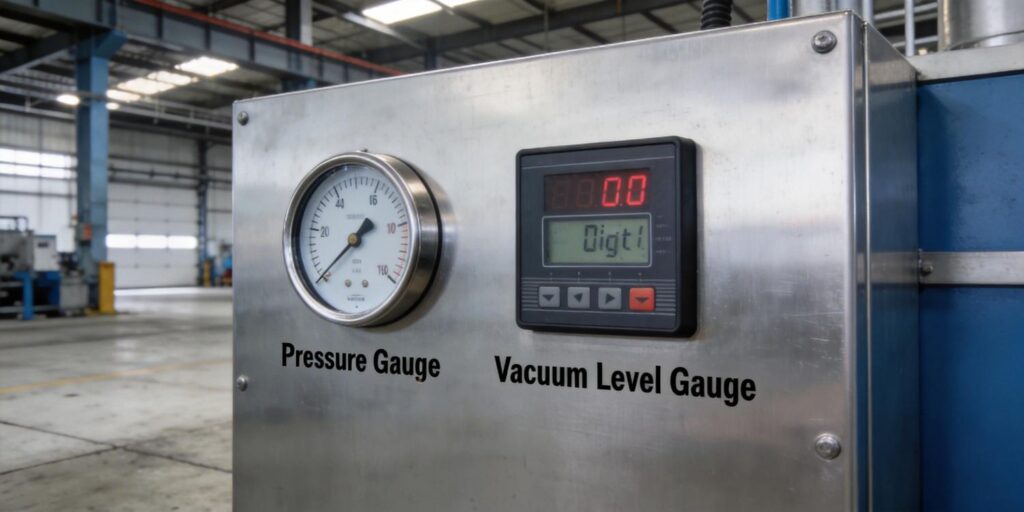
Key contributors include rapid air ingress during venting, desorption of water vapor and hydrocarbons from chamber walls and seals, and outgassing from the new target material itself (especially reactive metals such as titanium or aluminum). Without precise monitoring, these transients can lead to arcing during plasma ignition, incomplete pump-down, or residual gas incorporation into the growing film. Poseidon Scientific’s dual-gauge strategy—VG-SP205 Pirani for the transition regime and VG-SM225 Cold Cathode for high-vacuum confirmation—provides continuous visibility across the entire cycle, enabling engineers to quantify and control these excursions before they affect yield.
Outgassing Spike Detection with Real-Time Vacuum Measurement
Outgassing spikes appear as sudden, localized pressure rises that deviate from the expected exponential pump-down curve. In practice, a freshly installed target can release adsorbed gases at rates orders of magnitude higher than a seasoned surface, producing transient peaks that may reach 10⁻¹ Torr even after the chamber has been pumped below 10⁻³ Torr. Detecting these spikes early prevents them from propagating into the deposition phase, where they cause defects such as pinholes or stoichiometry shifts.
The VG-SP205 Pirani Vacuum Transmitter excels here because its thermal-conductivity principle responds in <50 ms to pressure changes across the atmospheric-to-10⁻³ Torr band. Temperature-compensated circuitry and platinum filament design ensure the output remains monotonic and repeatable, allowing SCADA systems to trigger alarms when the rate of pressure change exceeds a user-defined threshold (typically 0.1 Torr/s). By logging these events via RS232, process engineers can correlate spike magnitude with target preconditioning recipes and optimize bake-out or glow-discharge cleaning cycles for future target changes.
Pirani Monitoring in the Transition Phase
The transition phase—roughly from atmosphere down to 10⁻³ Torr—represents the most dynamic portion of any target-change cycle. Rotary vane or dry pumps rapidly remove bulk air, but thermal conductivity dominates heat transfer in this viscous-to-molecular flow regime. The VG-SP205 Pirani Vacuum Transmitter is purpose-built for exactly this window, delivering linear high-accuracy readings between 10 Torr and 10⁻² Torr where most pump-down time is spent.
Its maintenance-free platinum filament and built-in compensation algorithms keep readings stable across 15–50 °C ambient conditions typical of production floors. Engineers mount the gauge directly on the chamber or manifold using standard KF16/KF25 flanges; the 0–10 V analog output feeds directly into existing PLCs for closed-loop pump control. Real-time Pirani data also informs automated recipes: once pressure stabilizes below 10⁻² Torr for a programmable dwell period, the system can safely transition to high-vacuum monitoring without risking cold-cathode overload.
Cold Cathode Verification Before Process Restart
Once the chamber crosses into the high-vacuum regime, the VG-SM225 Cold Cathode Vacuum Gauge takes over to verify true base pressure before plasma ignition. Its positive-magnetron Penning discharge design measures reliably from 10⁻³ Torr down to 10⁻⁷ Torr, with the best repeatability (±10 %) in the 10⁻⁴ to 10⁻⁶ Torr band critical for PVD. The gauge’s automatic high-voltage sequencing (–2500 V startup, then –2000 V operation) and software protection prevent damage if pressure unexpectedly exceeds 10⁻³ Torr during final outgassing.
Operators wait for stable cold-cathode readings (typically <5 × 10⁻⁶ Torr for most reactive sputtering) and confirm no residual outgassing spikes via the built-in status LEDs and RS232 data stream. This verification step eliminates the guesswork that often leads to aborted runs or contaminated targets. Because the sensor head is field-cleanable, maintenance teams can restore performance on-site without extended chamber downtime.
Alarm and Interlock Configuration for Process Safety
Modern PVD tools rely on layered alarm and interlock logic to protect both hardware and product. The VG-SP205 and VG-SM225 integrate seamlessly via analog 0–10 V and customizable RS232 outputs. Typical configurations include:
- High-rate-of-change alarm on the Pirani channel to flag outgassing spikes during pump-down
- Pressure-threshold interlock on the cold cathode that inhibits magnetron power until base pressure is verified
- Status-code monitoring (filament integrity for Pirani, high-voltage status for cold cathode) routed to the PLC for immediate operator notification
- Redundant digital logging at 10–100 Hz to support batch traceability and post-run analysis
Poseidon Scientific’s engineering team can tailor protocol frames for any PLC brand, ensuring alarms appear in native machine language. These safeguards reduce scrap rates and extend target life by preventing premature plasma strikes on unstable vacuum conditions.
Real-World Case Example: Reactive Sputtering Line Retrofit
A North American optical-coating facility running titanium dioxide layers experienced 8–12 % batch rejection traceable to inconsistent base pressure after target changes. After installing VG-SP205 Pirani transmitters on roughing lines and VG-SM225 Cold Cathode gauges on process chambers, engineers added simple rate-of-change alarms and a 30-minute stable-hold interlock at 5 × 10⁻⁶ Torr.
Outgassing spikes that previously went undetected were now captured and automatically extended the pump-down dwell. First-pass yield rose to 97 %, target utilization improved by 18 %, and unplanned chamber openings dropped by 40 %. Maintenance intervals for the cold-cathode heads extended to 18 months with on-site cleaning, delivering full payback within four months. The same retrofit package has since been standardized across the customer’s global fleet.
Best Practice Checklist for Vacuum Stability During Target Changes
- Install dedicated Pirani gauge (VG-SP205) on the chamber or foreline for continuous transition monitoring
- Position cold-cathode gauge (VG-SM225) in direct line-of-sight to the target area for representative high-vacuum readings
- Configure rate-of-change alarms on Pirani output and base-pressure interlocks on cold-cathode output
- Log both gauges via RS232 at ≥10 Hz during all target-change cycles for trend analysis
- Perform pre-start cold-cathode verification at target operating pressure for a minimum 10-minute dwell
- Schedule electrode cleaning on the VG-SM225 every 12–24 months or after 5,000 hours, whichever comes first
- Document each target change with serial-numbered calibration certificates and pressure logs for ISO compliance
- Validate new recipes with side-by-side gauge data before releasing to production
Conclusion: Achieve Consistent PVD Performance with Purpose-Built Vacuum Monitoring
Target changes will always introduce pressure transients, but with the right measurement architecture these events become predictable, detectable, and controllable rather than yield-limiting surprises. The combination of Poseidon Scientific’s VG-SP205 Pirani Vacuum Transmitter for the dynamic transition phase and VG-SM225 Cold Cathode Vacuum Gauge for high-vacuum verification delivers the stability PVD engineers demand—at a cost structure and serviceability level that legacy suppliers cannot match.
Whether you are retrofitting existing coaters or designing new tools, accurate vacuum monitoring during target replacement directly translates to higher throughput, lower scrap, and extended target life.
Ready to optimize your PVD vacuum stability? Contact Poseidon Scientific today for a no-obligation system review, custom interlock configuration, or sample gauges. Our team—led by the engineers who developed both the VG-SP205 and VG-SM225—will deliver a tailored monitoring package that fits your exact chamber layout and process recipe.
Explore the full specifications of the VG-SP205 Pirani Vacuum Transmitter for transition monitoring or the VG-SM225 Cold Cathode Vacuum Gauge for high-vacuum verification and discover how reliable vacuum data can elevate your PVD process repeatability and profitability.