Importance of Amino Acid Profiling in Clinical Research
Amino acid profiling represents a cornerstone of modern clinical research, providing critical insights into metabolic pathways, nutritional status, and disease biomarkers. As the fundamental building blocks of proteins and key intermediates in numerous biochemical processes, amino acids serve as sensitive indicators of physiological and pathological states. In clinical settings, comprehensive amino acid analysis enables researchers to monitor metabolic disorders, assess nutritional deficiencies, and identify biomarkers for conditions ranging from cardiovascular diseases to neurological disorders.
The clinical significance of amino acid profiling extends across multiple domains. In metabolic research, abnormal amino acid patterns can signal inborn errors of metabolism, such as phenylketonuria or maple syrup urine disease, requiring early detection and intervention. Nutritional studies utilize amino acid profiles to evaluate protein metabolism, assess dietary adequacy, and monitor therapeutic interventions. Furthermore, emerging research links specific amino acid signatures to cancer progression, neurodegenerative diseases, and cardiovascular risk factors, making comprehensive profiling an essential tool for biomarker discovery and personalized medicine approaches.
Challenges Analyzing Polar Metabolites
The analysis of amino acids presents unique challenges due to their polar nature, structural diversity, and low concentrations in biological matrices. Unlike hydrophobic compounds that readily partition into organic solvents, amino acids exhibit high water solubility and limited retention on traditional reversed-phase sorbents. Their zwitterionic character, with both acidic carboxyl groups and basic amino groups, creates complex pH-dependent ionization states that complicate extraction and separation strategies.
Biological matrices introduce additional complexities. Plasma and serum contain high concentrations of proteins, lipids, and salts that can interfere with amino acid analysis. The presence of structurally similar compounds, such as peptides, neurotransmitters, and other polar metabolites, necessitates selective extraction methods to achieve accurate quantification. Furthermore, amino acids exist in biological samples at concentrations spanning several orders of magnitude, from millimolar levels for abundant amino acids like glutamine to nanomolar concentrations for trace amino acids and their derivatives.
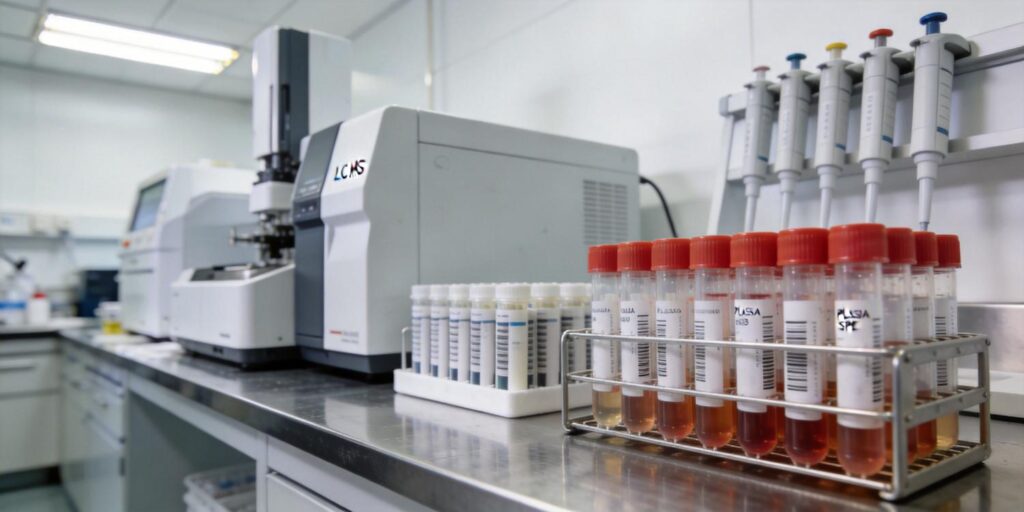
Matrix effects pose significant challenges for downstream analytical techniques, particularly liquid chromatography-mass spectrometry (LC-MS/MS). Co-extracted matrix components can suppress or enhance ionization, leading to inaccurate quantification and reduced method sensitivity. The hydrophilic nature of amino acids also complicates chromatographic separation, often requiring specialized stationary phases or derivatization strategies to achieve adequate retention and resolution.
SPE Sorbent Selection for Amino Acids
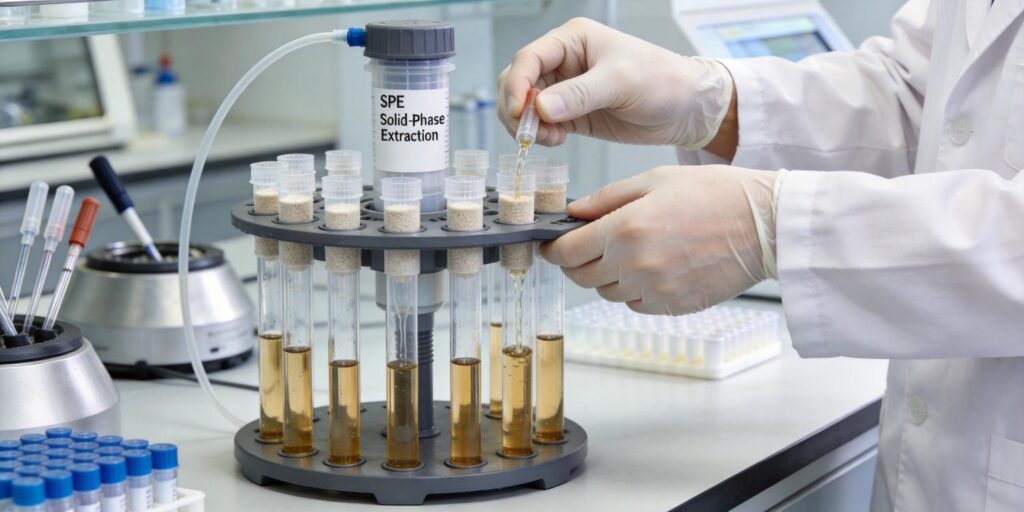
Selecting appropriate solid-phase extraction (SPE) sorbents is critical for successful amino acid analysis. Given the polar and zwitterionic nature of amino acids, traditional reversed-phase sorbents like C18 often provide insufficient retention. Instead, mixed-mode sorbents combining hydrophobic and ion-exchange functionalities have emerged as the preferred choice for comprehensive amino acid profiling.
Mixed-Mode Sorbents
Mixed-mode sorbents employ multiple retention mechanisms simultaneously, typically combining reversed-phase interactions with strong cation exchange (SCX) or strong anion exchange (SAX) functionalities. These sorbents offer superior selectivity for amino acids by leveraging both hydrophobic interactions with alkyl chains and ionic interactions with charged functional groups. As noted in forensic applications, “mixed-mode SPE columns are prevalent in drug extractions because they offer multiple binding mechanisms for improved sensitivity and excellent sample cleanup.”
For amino acid analysis, cation-exchange mixed-mode sorbents (MCX) are particularly effective for basic and zwitterionic amino acids, while anion-exchange mixed-mode sorbents (MAX) excel at capturing acidic amino acids. The dual retention mechanism allows for selective extraction under controlled pH conditions, where amino acids can be retained through ionic interactions while neutral interferences are washed away.
Specialized Amino Acid Sorbents
Several specialized sorbents have been developed specifically for amino acid extraction. Boronic acid-functionalized silica gels enable selective extraction of glycosylated amino acids through covalent interactions, as demonstrated in early SPE research. Similarly, weak cation exchange (WCX) sorbents provide enhanced retention for strong bases and quaternary amines, which can be beneficial for certain amino acid derivatives.
Polymeric Sorbents
Hydrophilic-lipophilic balanced (HLB) polymeric sorbents offer an alternative approach for amino acid extraction. These water-wettable polymers provide both hydrophobic and hydrophilic retention sites, making them suitable for a wide range of polar compounds. Their stability across a broad pH range (0-14) simplifies method development and allows for flexible washing strategies to remove matrix interferences.
Example Plasma Sample Preparation Workflow
A robust plasma sample preparation workflow for amino acid profiling typically involves protein precipitation followed by mixed-mode SPE. The following protocol demonstrates a comprehensive approach suitable for LC-MS/MS analysis:
Sample Pretreatment
- Protein Precipitation: Mix 100 μL of plasma with 300 μL of cold methanol containing internal standards. Vortex thoroughly for 30 seconds and centrifuge at 14,000 × g for 10 minutes at 4°C.
- Supernatant Collection: Transfer 300 μL of supernatant to a clean tube and dilute with 600 μL of 0.1% formic acid in water to adjust pH and ionic strength for optimal SPE retention.
Mixed-Mode SPE Procedure
- Cartridge Conditioning: Condition a 30 mg mixed-mode cation exchange (MCX) cartridge with 1 mL methanol followed by 1 mL of 0.1% formic acid in water.
- Sample Loading: Load the diluted supernatant at a flow rate of 1-2 mL/min. Ensure the sample pH is below the pKa of amino acid carboxyl groups (typically pH 2-3) to protonate acidic groups and enhance cation exchange retention.
- Washing: Wash sequentially with 1 mL of 0.1% formic acid in water, 1 mL of methanol, and 1 mL of 0.1% formic acid in 5% methanol to remove neutral and acidic interferences while retaining amino acids through cation exchange.
- Elution: Elute amino acids with 1 mL of 5% ammonium hydroxide in methanol. The basic elution conditions neutralize the cation exchange sites and disrupt ionic interactions, while the methanol component provides hydrophobic elution.
- Concentration: Evaporate the eluate to dryness under nitrogen at 40°C and reconstitute in 100 μL of 0.1% formic acid in water for LC-MS/MS analysis.
This workflow achieves excellent recovery for most proteinogenic amino acids while effectively removing proteins, lipids, and other matrix components that could interfere with downstream analysis.
LC-MS/MS Detection Strategies
Liquid chromatography-tandem mass spectrometry (LC-MS/MS) has become the gold standard for amino acid analysis due to its superior sensitivity, selectivity, and ability to analyze multiple analytes simultaneously. Several key strategies optimize LC-MS/MS performance for amino acid profiling:
Chromatographic Separation
Hydrophilic interaction liquid chromatography (HILIC) represents the most effective approach for separating underivatized amino acids. HILIC columns, typically packed with bare silica or amide-functionalized stationary phases, provide excellent retention and resolution for polar compounds. Mobile phases typically consist of acetonitrile and aqueous buffers with volatile additives like formic acid or ammonium formate to maintain MS compatibility.
For comprehensive profiling, gradient elution from high organic content (e.g., 90% acetonitrile) to high aqueous content (e.g., 90% water) effectively separates amino acids based on their polarity and charge characteristics. The inclusion of ion-pairing reagents, such as heptafluorobutyric acid (HFBA), can further enhance retention and peak shape for challenging amino acids.
Mass Spectrometric Detection
Multiple reaction monitoring (MRM) provides the specificity and sensitivity required for amino acid quantification in complex biological matrices. Each amino acid is monitored using specific precursor-to-product ion transitions, typically involving the loss of water or ammonia from protonated molecular ions. The use of stable isotope-labeled internal standards for each amino acid corrects for matrix effects and ensures accurate quantification.
Electrospray ionization (ESI) in positive ion mode generally provides optimal sensitivity for most amino acids, though some acidic amino acids may benefit from negative ion mode detection. Source parameters should be optimized to minimize in-source fragmentation and maximize signal intensity while maintaining stable ionization efficiency throughout the chromatographic run.
Derivatization Strategies
While underivatized analysis offers simplicity, derivatization can enhance sensitivity and chromatographic performance. Common derivatization reagents include:
- AccQ-Tag (Waters): Forms stable derivatives with primary and secondary amines, enabling fluorescence detection and improved MS sensitivity
- Dansyl chloride: Creates fluorescent derivatives suitable for both LC-fluorescence and LC-MS/MS analysis
- Phenylisothiocyanate (PITC): Forms phenylthiocarbamyl derivatives with enhanced UV absorption and MS response
Method Validation Considerations
Comprehensive method validation ensures the reliability and robustness of amino acid profiling methods for clinical research applications. Key validation parameters include:
Selectivity and Specificity
Demonstrate the absence of interference from endogenous matrix components at the retention times of target amino acids. Analyze blank matrix samples from at least six different sources to assess potential interferences. For MRM-based methods, monitor at least two transitions per analyte to confirm identity and ensure specificity.
Linearity and Range
Establish linear calibration curves covering the expected physiological concentration ranges for each amino acid. Typical ranges span from low nanomolar to millimolar concentrations, requiring wide dynamic range calibration. Use weighted linear regression (1/x or 1/x²) to account for heteroscedasticity across concentration ranges.
Accuracy and Precision
Evaluate accuracy through recovery experiments using spiked samples at low, medium, and high concentrations. Acceptable recovery typically falls within 85-115% of nominal values. Assess precision through intra-day and inter-day experiments, with coefficients of variation generally below 15% for quantitative applications.
Matrix Effects and Recovery
Quantify matrix effects using post-extraction spiking experiments and calculate absolute recovery by comparing extracted samples with neat standards. As noted in SPE literature, “the consistency with which automated SPE is performed, better analytical data is achieved, and fewer sample reruns are necessary.” Implement stable isotope-labeled internal standards to correct for matrix effects and recovery variations.
Stability
Evaluate analyte stability under various conditions relevant to sample handling and storage, including bench-top stability, freeze-thaw cycles, and long-term storage stability. Amino acids can be susceptible to oxidation, deamination, or conversion to other metabolites, necessitating careful stability assessment.
Carryover and Contamination
Assess carryover by analyzing blank samples following high-concentration standards. Implement adequate washing procedures between samples, particularly when using automated SPE systems. As emphasized in SPE automation literature, “the reagents chosen to clean the fluid path must be compatible with the sample matrix.”
By addressing these validation parameters, researchers can establish robust amino acid profiling methods suitable for clinical research applications, ensuring reliable data for biomarker discovery, metabolic studies, and nutritional assessments.