
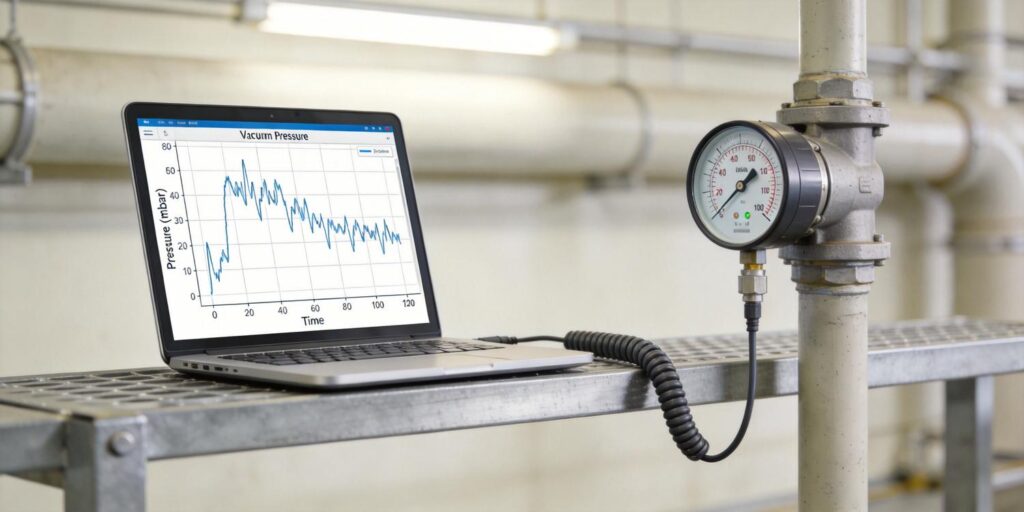
Importance of Historical Pressure Data
In vacuum-dependent manufacturing and scientific processes, real-time pressure readings provide only a snapshot of system health. Historical data logging transforms vacuum gauges from simple measurement devices into powerful predictive-maintenance tools. By continuously recording pressure, temperature, status codes, and discharge current over weeks or months, engineers can establish baseline performance signatures and detect subtle deviations long before they cause unplanned downtime or process scrap.
For Poseidon Scientific’s VG-SP205 Pirani Vacuum Transmitter and VG-SM225 Cold Cathode Vacuum Gauge, the built-in RS232 digital output with fully customizable protocols makes data logging straightforward. Engineers can capture readings at 10–100 Hz without additional hardware, creating a complete time-series record of pump-down curves, outgassing events, and long-term stability. This historical archive directly supports ISO 9001 and IATF 16949 compliance while delivering the foresight needed to schedule maintenance during planned shutdowns rather than after catastrophic failure.
The economic impact is significant. Industry studies show that predictive maintenance programs based on logged vacuum data routinely reduce unplanned downtime by 30–50 % and extend mean time between repairs by a similar margin. In high-value applications such as PVD coating, semiconductor processing, or vacuum heat treatment, even a single avoided production stoppage can justify the modest investment in digital-output gauges.
Trend Analysis Methods
Effective trend analysis begins with simple, robust statistical techniques applied to the high-resolution data streams from the VG-SP205 and VG-SM225. Moving-average filters (typically 5–30 minute windows) smooth short-term noise while revealing gradual pressure drift. Rate-of-change calculations highlight anomalies such as accelerating outgassing or filament aging in the Pirani gauge.
Engineers commonly overlay multiple pump-down cycles on the same chart to visualize repeatability. For the VG-SP205 Pirani, the linear high-accuracy region (10 Torr to 10⁻² Torr) provides especially clean data for exponential-decay fitting, allowing precise quantification of pumping speed degradation over time. For the VG-SM225 Cold Cathode, tracking the time required to reach stable discharge current or the magnitude of current at a fixed pressure reveals electrode contamination trends before they affect process yield.
Advanced users export RS232 logs to standard spreadsheet or historian software for CUSUM (cumulative sum) charts and linear regression on baseline segments. These methods require no specialized vacuum expertise—only consistent data collection and periodic review—making them accessible to both process engineers and maintenance teams.
Detecting Abnormal Drift
Abnormal drift appears in distinct signatures for each gauge technology. In the VG-SP205 Pirani Vacuum Transmitter, filament aging or minor contamination manifests as a slow upward shift in the voltage required to maintain constant temperature at a given pressure. Because the gauge uses a platinum filament with a high temperature-resistance coefficient, even small changes in baseline resistance are detectable months before filament failure. Status codes embedded in the RS232 stream provide immediate filament-integrity alerts, allowing teams to plan replacement during the next scheduled maintenance window.
For the VG-SM225 Cold Cathode Vacuum Gauge, drift is most evident in two indicators: increased startup time at the same base pressure and a downward shift in discharge current at fixed operating voltage. These symptoms precede visible electrode carbon buildup or oxidation. By comparing logged current-versus-pressure curves against the original factory calibration (stored by serial number), technicians can quantify drift in real time. The gauge’s built-in protection circuitry and status LEDs further flag high-voltage shutdown events caused by unexpected pressure excursions, providing early warning of seal degradation or process leaks.
Combining data from both gauges creates a layered early-warning system: the Pirani monitors the rough-to-medium vacuum transition where most contamination enters, while the cold cathode verifies high-vacuum stability where process-critical conditions are established.
Setting Predictive Thresholds
Predictive thresholds convert raw data into actionable alerts. Start by collecting 30–90 days of baseline logs under normal operating conditions. Calculate the mean and standard deviation for key metrics: pump-down time to 10⁻³ Torr (Pirani), stable discharge current at 10⁻⁵ Torr (cold cathode), and daily baseline pressure at idle. Set warning thresholds at ±2σ and critical alerts at ±3σ from the established mean.
Practical examples include:
- Pirani: alert if voltage at 1 Torr drifts more than 5 % from baseline
- Cold cathode: trigger maintenance if startup time exceeds 15 minutes at 10⁻⁶ Torr or current drops 12 % at operating voltage
- Combined: flag any instance where Pirani and cold-cathode readings disagree by more than 15 % during transition, indicating possible contamination or calibration shift
These thresholds are easily programmed into PLCs or SCADA systems using the customizable RS232 protocol. Poseidon Scientific’s engineering team can pre-load threshold logic during protocol customization for orders as small as 5–10 units, further simplifying deployment.
Integration with Cloud Monitoring
Modern vacuum systems increasingly leverage cloud platforms for centralized oversight across multiple production sites. The VG-SP205 and VG-SM225 stream RS232 data that any standard serial-to-Ethernet gateway or IoT edge device can convert to MQTT or OPC UA formats. Once on the cloud, pressure histories become accessible from anywhere, enabling remote trend analysis, automated reporting, and machine-learning models that refine thresholds over time.
Cloud integration also supports fleet-wide benchmarking: a global coating OEM can compare gauge performance across dozens of chambers and identify site-specific contamination sources. Poseidon Scientific does not supply cloud software but designs its gauges with open, well-documented protocols that integrate seamlessly with leading platforms such as AWS IoT, Azure, or Siemens MindSphere. This open architecture ensures data ownership remains with the customer while delivering the scalability required for Industry 4.0 initiatives.
ROI Case Example
A mid-sized PVD coating facility retrofitted 14 chambers with VG-SP205 Pirani and VG-SM225 Cold Cathode gauges equipped for continuous RS232 logging. Within the first quarter, historical data revealed previously undetected 8–12 % upward drift in cold-cathode current over 60-day periods—early signs of electrode contamination that had been causing sporadic arcing and 6 % batch scrap.
By setting predictive thresholds and scheduling electrode cleaning every 14 months instead of waiting for visible failure, the facility reduced unplanned downtime from 42 hours per quarter to 9 hours. Scrap rate fell to 1.8 %, and target life increased 22 % because stable vacuum eliminated premature plasma strikes. Total annual savings exceeded $184,000 against a gauge investment of approximately $6,300. Payback occurred in under five weeks, with ongoing benefits compounding through extended maintenance intervals and reduced spare-parts inventory.
Implementation Roadmap
Transitioning to predictive vacuum monitoring follows a low-risk, phased approach:
- Assessment (1–2 weeks): Map existing gauges, identify critical pressure windows, and select VG-SP205/VG-SM225 combinations for each chamber.
- Hardware Installation (1 weekend shutdown): Replace legacy gauges using standard KF flanges; confirm mechanical and electrical compatibility.
- Protocol Configuration (48 hours): Customize RS232 output to match current PLC/SCADA requirements.
- Baseline Logging (30–60 days): Capture normal operation data and establish statistical thresholds.
- Alert Integration (1 week): Program warnings and interlocks; test with simulated drift conditions.
- Cloud Connection (optional, 1 week): Deploy edge gateways and verify secure data flow.
- Review & Optimize (ongoing): Hold monthly trend reviews and refine thresholds using accumulated data.
Poseidon Scientific supplies all required drawings, sample code, and on-site commissioning support to keep the project on schedule and within budget.
Conclusion: Turn Vacuum Data into Proactive Reliability
Historical pressure data logging elevates vacuum gauges from passive sensors to active guardians of process stability. The combination of the VG-SP205 Pirani Vacuum Transmitter’s rapid-response mid-vacuum data and the VG-SM225 Cold Cathode Vacuum Gauge’s high-vacuum precision creates a complete predictive-maintenance platform that reduces downtime, lowers maintenance costs, and protects product yield.
Engineers and procurement teams no longer need to choose between accuracy and affordability. Poseidon Scientific’s self-developed gauges deliver both, backed by customizable digital outputs that integrate effortlessly into existing or cloud-based monitoring systems.
Ready to implement predictive vacuum monitoring in your facility? Contact Poseidon Scientific today for a no-obligation data-logging assessment, protocol customization, or sample units. Our team—led by the engineers who designed the VG-SP205 and VG-SM225—will deliver a tailored predictive-maintenance solution that fits your exact process requirements and control architecture.
Explore the full specifications of the VG-SP205 Pirani Vacuum Transmitter and the VG-SM225 Cold Cathode Vacuum Gauge and discover how reliable, logged vacuum data can transform your maintenance strategy and bottom line.


