Overview of Vacuum Drying Principles
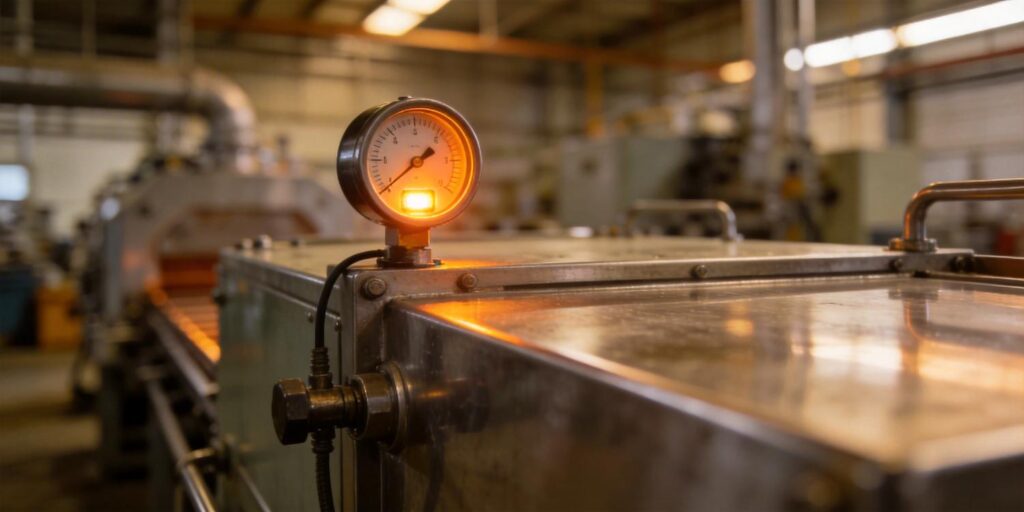
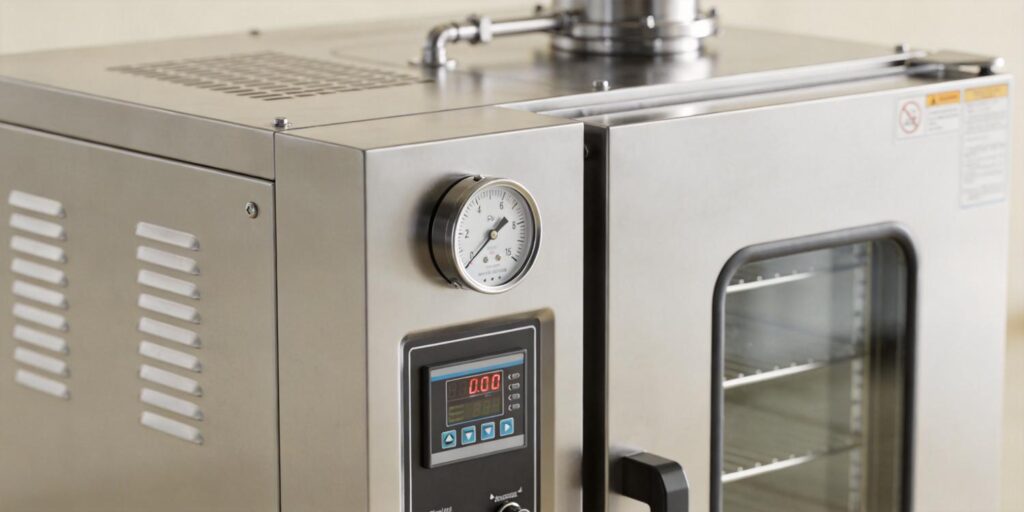
Vacuum drying ovens remove moisture or solvents from heat-sensitive materials by lowering the chamber pressure, which reduces the boiling point of liquids without requiring high temperatures. This gentle process preserves product integrity in pharmaceuticals, food ingredients, electronics, and laboratory samples where conventional hot-air drying would cause degradation, oxidation, or thermal decomposition.
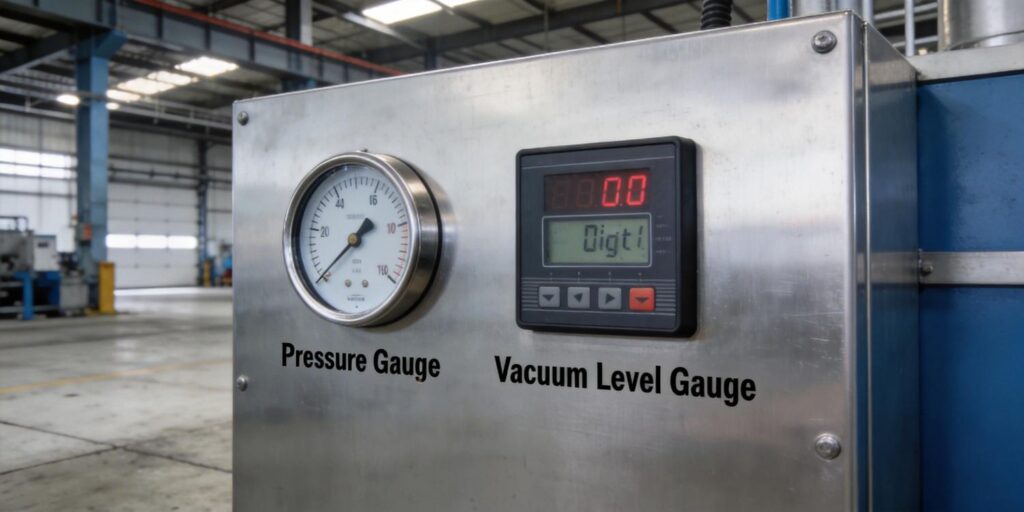
The fundamental principle relies on the relationship between vapor pressure and absolute pressure: as chamber pressure drops below the vapor pressure of the solvent at a given temperature, evaporation accelerates. A typical cycle begins with rough pumping to remove bulk air and solvent vapor, followed by a controlled heat ramp once stable low pressure is confirmed. Precise vacuum measurement is essential at every stage to ensure repeatable drying times, consistent residual moisture levels, and safe operation. Poseidon Scientific’s VG-SP205 Pirani Vacuum Transmitter and VG-SM225 Cold Cathode Vacuum Gauge form an ideal complementary pair for vacuum drying ovens, delivering the accuracy, response speed, and reliability required by both OEM builders and end-user laboratories.
Pressure Requirements for Solvent Evaporation
Different solvents evaporate efficiently at specific pressure ranges. Water, the most common solvent, boils at approximately 20 Torr (27 mbar) at room temperature and reaches rapid evaporation rates below 10 Torr when mild heat (40–60 °C) is applied. Organic solvents such as ethanol, acetone, or isopropyl alcohol exhibit even lower boiling points under vacuum—often 1–50 Torr—making the rough-to-medium vacuum regime the critical operating window for most drying ovens.
In practice, vacuum drying cycles target 10 Torr to 10⁻² Torr for primary solvent removal, with some protocols extending to 10⁻³ Torr to achieve final low residual moisture. Operating too shallow risks incomplete drying and extended cycle times; pulling excessively deep vacuum wastes energy and may cause bumping or foaming. The linear high-precision band of thermal conductivity gauges aligns perfectly with these requirements, while cold-cathode technology provides confirmation that outgassing has stabilized before the heating phase begins. Poseidon gauges are factory-calibrated for air/nitrogen, the dominant residual gases in drying applications, ensuring reliable readings without multi-gas correction curves.
Monitoring the Roughing Stage with Pirani Technology
The roughing stage—from atmosphere down to 10⁻³ Torr—accounts for the majority of cycle time and solvent vapor load. Poseidon Scientific’s VG-SP205 Pirani Vacuum Transmitter is optimized exactly for this phase. Its platinum filament and constant-temperature control deliver fast response (<50 ms) and repeatable readings across the full atmospheric-to-10⁻³ Torr span, with best linearity between 10 Torr and 10⁻² Torr where most evaporation occurs.
Because the Pirani measures heat transfer rather than ionization, it tolerates the high vapor loads and occasional liquid carry-over common during initial pump-down without risk of electrode damage. The 0–10 V analog output feeds directly into oven controllers for closed-loop pump regulation, while the RS232 digital interface (fully customizable at orders as low as 5–10 units) enables precise data logging of pump-down curves. Temperature compensation circuitry maintains accuracy between 15 °C and 50 °C, covering typical laboratory and production-floor environments. Maintenance-free operation with a 3–5 year typical lifespan further reduces total cost of ownership compared with gauges requiring frequent filament or electrode servicing.
High Vacuum Verification Before Heating
Once bulk solvent is removed, many drying protocols require verification of stable high vacuum before applying heat. Residual outgassing or trapped solvent can cause sudden pressure spikes if the oven is heated prematurely, leading to product damage or safety trips. The VG-SM225 Cold Cathode Vacuum Gauge provides this critical confirmation in the 10⁻³ to 10⁻⁷ Torr range.
Its positive-magnetron Penning discharge design with ~100 gauss field and automatic voltage sequencing (–2500 V startup to –2000 V operation) ensures reliable ignition and stable readings. The gauge’s software interlock automatically disables high voltage above 10⁻³ Torr, protecting the sensor during the roughing phase. Engineers use the cold-cathode output to trigger the temperature controller only after pressure has stabilized below a user-defined threshold (typically 5 × 10⁻⁴ Torr) for a programmable dwell period. This layered approach—Pirani for roughing, cold cathode for verification—eliminates guesswork and protects both the oven and the product load.
Preventing Solvent Contamination in Sensors
Solvent vapors and condensates pose a contamination risk to any vacuum gauge, yet Poseidon designs incorporate practical safeguards. The VG-SP205 Pirani uses a chemically inert platinum filament that resists oxidation and corrosion far better than tungsten alternatives. Its sealed construction and smooth internal surfaces minimize vapor entrapment; any minor residue is typically cleared during normal pump-down.
For the VG-SM225 Cold Cathode, the modular sensor head can be removed and cleaned on-site with 500-mesh or 200-mesh abrasive paper to restore electrode surfaces to metallic luster—no factory return required. Both gauges feature standard KF16 or KF25 flanges that allow short isolation tubing when particularly aggressive solvents are present, further reducing direct exposure. In corrosive applications, Kalrez or Chemraz O-rings can be specified. These features ensure long-term stability even in pharmaceutical or chemical laboratories where solvent diversity is high, while keeping maintenance simple for service teams.
Alarm Setup for Safe Operation
Safety in vacuum drying ovens depends on proactive alarms and interlocks. The VG-SP205 and VG-SM225 provide clear status feedback via built-in LEDs and digital outputs. Typical configurations include:
- Pirani high-pressure alarm if pump-down stalls above 10 Torr (indicating pump failure or major leak)
- Cold-cathode interlock that prevents heater activation until pressure is verified below setpoint
- Rate-of-change alert on the Pirani channel to detect sudden outgassing spikes during heat ramp
- Filament-integrity or high-voltage status codes routed directly to the oven controller for immediate operator notification
These alarms integrate seamlessly with existing safety PLCs or temperature controllers, ensuring the system remains within safe operating envelopes. Poseidon’s customizable RS232 protocol allows OEMs to map status codes to native machine language, simplifying validation and reducing training time for end users.
Example Wiring to Temperature Controller
Integration with common laboratory oven controllers is straightforward. A typical wiring schematic for a dual-gauge setup is as follows:
- Connect the VG-SP205 0–10 V analog output (pin 2 on RJ45) to the controller’s analog input channel 1 for roughing monitoring.
- Wire the VG-SM225 0–10 V analog output to channel 2 for high-vacuum verification.
- Use the RS232 TX/RX lines (pins 3 and 5) from both gauges in parallel to a shared serial port or gateway for digital logging and status codes.
- Configure the controller logic: heater enable = (Pirani < 10 Torr AND Cold Cathode < 5 × 10⁻⁴ Torr for > 5 minutes).
- Route gauge status LEDs or digital alarm bits to the controller’s safety interlock input for emergency heater shutdown.
Poseidon supplies detailed pinout diagrams and sample ladder logic snippets with every OEM order, ensuring first-time success. The compact RJ45 interface and optional DB9/DB15 adapters fit existing control panels without additional enclosure modifications.
Conclusion: Selecting the Right Gauges for Reliable Vacuum Drying
Vacuum drying ovens demand accurate, responsive, and contamination-resistant pressure measurement across two distinct regimes. The Poseidon Scientific VG-SP205 Pirani Vacuum Transmitter handles the critical roughing and solvent-evaporation phase with speed and simplicity, while the VG-SM225 Cold Cathode Vacuum Gauge confirms high-vacuum stability before heating. Together they deliver the layered monitoring, alarm capability, and field serviceability that laboratory and production drying systems require—without the high cost or maintenance burden of legacy instrumentation.
Whether specifying new ovens or retrofitting existing units, engineers benefit from gauges engineered specifically for real-world drying applications: low total cost of ownership, customizable communication, and direct compatibility with standard temperature controllers.
Ready to optimize your vacuum drying oven with proven measurement technology? Contact Poseidon Scientific today for a no-obligation application review, custom protocol development, or sample units. Our team—led by the product manager who designed both the VG-SP205 and VG-SM225—will deliver a complete monitoring solution tailored to your solvent types, cycle requirements, and control architecture.
Explore the full specifications of the VG-SP205 Pirani Vacuum Transmitter for roughing-stage monitoring or the VG-SM225 Cold Cathode Vacuum Gauge for high-vacuum verification and take the next step toward safer, more repeatable vacuum drying performance.