Overview of PFAS Contamination and Regulatory Limits
Per- and polyfluoroalkyl substances (PFAS) represent a class of over 4,700 synthetic chemicals characterized by strong carbon-fluorine bonds that make them highly persistent in the environment. These “forever chemicals” have been widely used in industrial applications and consumer products since the 1940s, including firefighting foams, non-stick cookware, water-repellent fabrics, and food packaging materials. Their environmental persistence and bioaccumulative properties have led to widespread contamination of drinking water sources worldwide.
The U.S. Environmental Protection Agency (EPA) has established health advisory levels for several PFAS compounds in drinking water. The current lifetime health advisory levels are 0.004 parts per trillion (ppt) for perfluorooctanoic acid (PFOA) and 0.02 ppt for perfluorooctanesulfonic acid (PFOS). The EPA has also proposed Maximum Contaminant Levels (MCLs) for six PFAS compounds under the Safe Drinking Water Act. In the European Union, the Drinking Water Directive sets a limit of 0.1 μg/L for individual PFAS and 0.5 μg/L for total PFAS. These ultra-low regulatory limits necessitate highly sensitive analytical methods capable of detecting PFAS at parts-per-trillion levels.
Challenges of Ultra-Trace PFAS Detection in Drinking Water
Analyzing PFAS in drinking water presents unique challenges due to their ultra-trace concentration requirements and ubiquitous presence in laboratory environments. The primary analytical difficulties include:
Background Contamination
PFAS are present in numerous laboratory materials, including polytetrafluoroethylene (PTFE) components, certain plastics, and even some SPE cartridges. This background contamination can easily overwhelm the low-level signals from environmental samples, requiring meticulous laboratory practices and specialized equipment.
Matrix Effects
Natural organic matter and dissolved ions in water samples can interfere with PFAS analysis. As noted in environmental SPE literature, “organic pollutants and metals are known to bind to DOM such as humic or fulvic acids” which can affect extraction efficiency and analytical recovery.
Analytical Sensitivity Requirements
Detection limits in the low parts-per-trillion range demand exceptional method sensitivity and precision. This requires not only sophisticated instrumentation like LC-MS/MS but also highly efficient sample preparation techniques that can concentrate analytes while eliminating interferences.
SPE Sorbent Selection for Fluorinated Compounds
Selecting the appropriate SPE sorbent is critical for successful PFAS extraction. The unique chemical properties of fluorinated compounds require specialized sorbent chemistries:
Weak Anion Exchange (WAX) Sorbents
WAX sorbents containing quaternary amine groups are particularly effective for extracting anionic PFAS compounds like PFOA and PFOS. These sorbents operate through both reversed-phase and anion-exchange mechanisms, providing dual retention for improved recovery. The Poseidon WAX SPE cartridges offer excellent capacity for acidic PFAS compounds with pKa values between 2-8.
Mixed-Mode Sorbents
Mixed-mode sorbents combining reversed-phase and ion-exchange functionalities provide enhanced selectivity for PFAS compounds. As documented in SPE literature, “mixed-mode cartridge providing hydrophobic and cation exchange interactions, combined with a pH-dependent sample application and extraction, can give high recoveries of analytes from various matrices.”
Polymeric Sorbents
Hydrophilic-lipophilic balance (HLB) polymeric sorbents offer broad-spectrum extraction capabilities for both ionic and non-ionic PFAS compounds. These sorbents maintain consistent performance across a wide pH range (0-14) and provide high capacity for polar compounds.
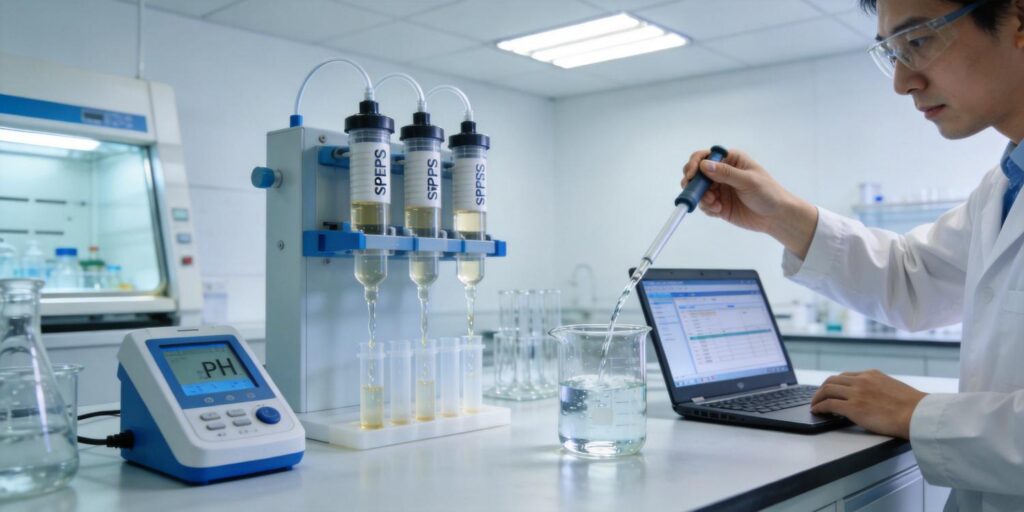
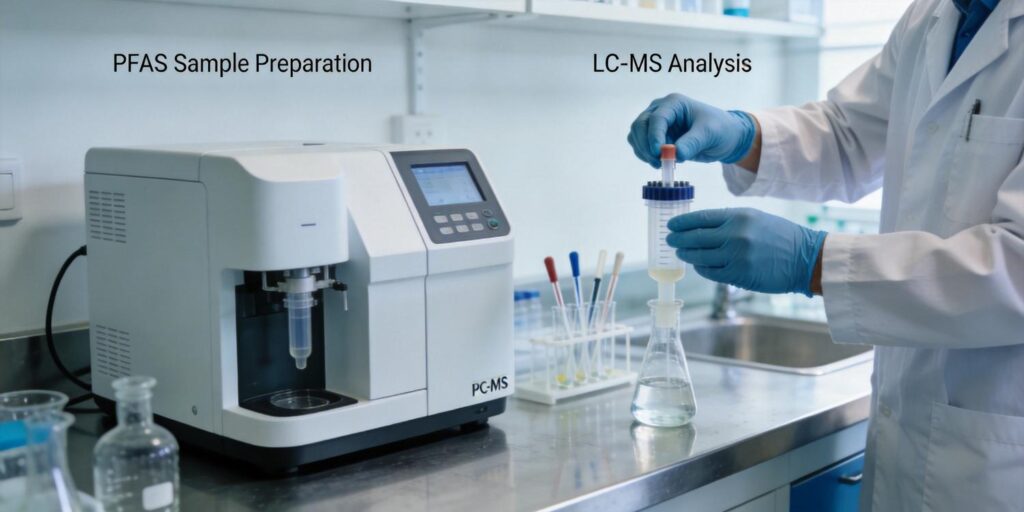
Step-by-Step Protocol for Extracting PFAS from 500 mL–1 L Water Samples
This optimized protocol is designed for ultra-trace PFAS analysis in drinking water samples:
Sample Preparation
- Collect water samples in pre-cleaned polypropylene containers, avoiding any fluoropolymer materials
- Add ammonium acetate buffer (pH 4.0) to achieve a final concentration of 2 mM
- Spike with isotopically labeled PFAS internal standards for quantification
SPE Cartridge Conditioning
- Condition WAX cartridge (500 mg, 6 mL) with 5 mL methanol
- Equilibrate with 5 mL of 2 mM ammonium acetate buffer (pH 4.0)
- Maintain a small layer of liquid above the sorbent bed to prevent drying
Sample Loading
- Attach appropriate reservoir to accommodate 500 mL–1 L sample volume
- Load sample at controlled flow rate of 5-10 mL/min using vacuum manifold
- Maintain consistent flow to ensure optimal analyte-sorbent interaction
Cartridge Washing
- Wash with 5 mL of 2 mM ammonium acetate buffer (pH 4.0)
- Dry cartridge under vacuum for 30 minutes to remove residual water
- Optional: Centrifuge cartridge at 1000-1500 rpm for 5 minutes to remove excess water
Analyte Elution
- Elute with 5 mL methanol containing 2% ammonium hydroxide
- Collect eluent in pre-cleaned polypropylene tubes
- Evaporate to near dryness under gentle nitrogen stream at 40°C
- Reconstitute in 200 μL methanol/water (50:50, v/v) for LC-MS/MS analysis
Minimizing Background Contamination During Sample Preparation
Background contamination represents the most significant challenge in ultra-trace PFAS analysis. Implement these critical measures:
Laboratory Environment Control
Establish dedicated PFAS-free work areas with positive pressure HEPA filtration. Eliminate all fluoropolymer materials from the laboratory, including PTFE-lined caps, tubing, and instrument components. Use only pre-cleaned glass or polypropylene labware that has been verified PFAS-free.
Reagent and Solvent Selection
Use only high-purity solvents specifically tested for PFAS contamination. Methanol and acetonitrile should be LC-MS grade and stored in glass containers. Prepare all aqueous solutions using PFAS-free water generated from a dedicated purification system.
SPE Cartridge Selection and Preparation
Select SPE cartridges specifically designed for PFAS analysis, such as Poseidon WAX cartridges, which undergo rigorous quality control to minimize background contamination. Pre-wash cartridges with methanol before conditioning to remove any potential contaminants from manufacturing or packaging.
Procedural Blanks
Include procedural blanks with every batch of samples to monitor background contamination. Process blanks through the entire analytical procedure, including SPE extraction and LC-MS/MS analysis. Blank values should be consistently below method detection limits.
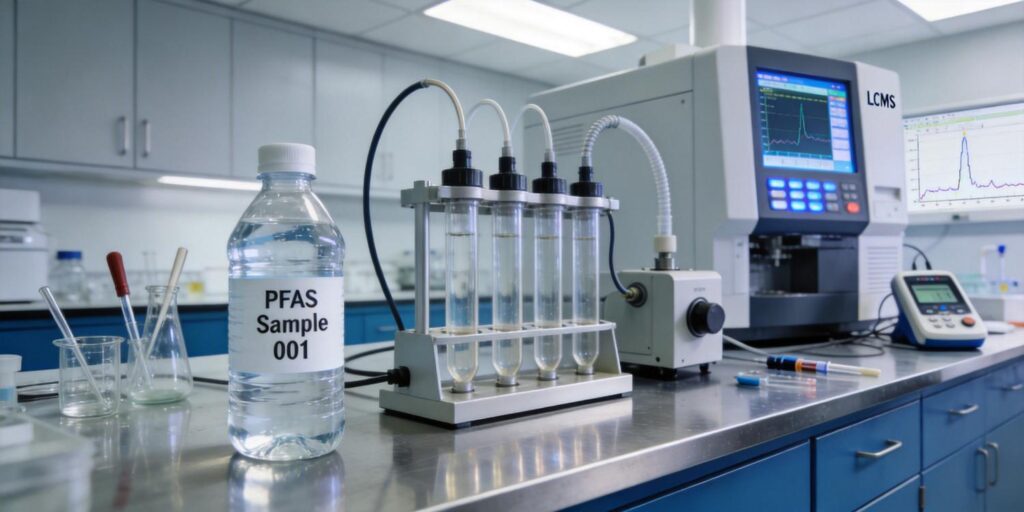
LC-MS/MS Analysis and Method Validation Considerations
Successful PFAS analysis requires optimized LC-MS/MS conditions and comprehensive method validation:
Chromatographic Separation
Use a C18 or equivalent reversed-phase column (100 × 2.1 mm, 1.7 μm particle size) for PFAS separation. Employ a binary gradient with mobile phases consisting of (A) 2 mM ammonium acetate in water and (B) methanol. Optimize gradient conditions to separate critical pairs of PFAS isomers and congeners.
Mass Spectrometric Detection
Operate triple quadrupole MS in negative electrospray ionization mode with multiple reaction monitoring (MRM). Optimize source parameters for maximum sensitivity: capillary voltage 3.0 kV, source temperature 150°C, desolvation temperature 500°C, cone gas flow 150 L/h, desolvation gas flow 1000 L/h.
Method Validation Parameters
Validate the complete SPE-LC-MS/MS method according to EPA Method 537.1 or equivalent guidelines. Key validation parameters include:
- Linearity: Demonstrate linear response over at least three orders of magnitude (typically 0.5-500 ng/L)
- Accuracy and Precision: Achieve recovery of 70-130% with relative standard deviation <20% for most PFAS compounds
- Method Detection Limits: Establish MDLs at or below regulatory limits (typically 0.5-5 ng/L)
- Matrix Effects: Evaluate ion suppression/enhancement using post-extraction addition method
- Carryover: Ensure carryover <1% of the lower limit of quantification
Quality Control Measures
Implement comprehensive QC protocols including laboratory control samples, matrix spikes, duplicate analyses, and continuing calibration verification. Use isotopically labeled PFAS standards as internal standards for quantification and to monitor method performance throughout the analytical sequence.
For laboratories requiring high-throughput analysis, consider implementing 96-well SPE plates that allow simultaneous processing of multiple samples while maintaining the sensitivity and selectivity required for ultra-trace PFAS detection. The Poseidon 96-well SPE plates offer consistent performance across all wells, ensuring reliable results for large-scale monitoring programs.
By following this comprehensive SPE methodology and maintaining rigorous contamination control measures, laboratories can achieve the sensitivity and reliability required for regulatory compliance monitoring of PFAS in drinking water at parts-per-trillion levels.