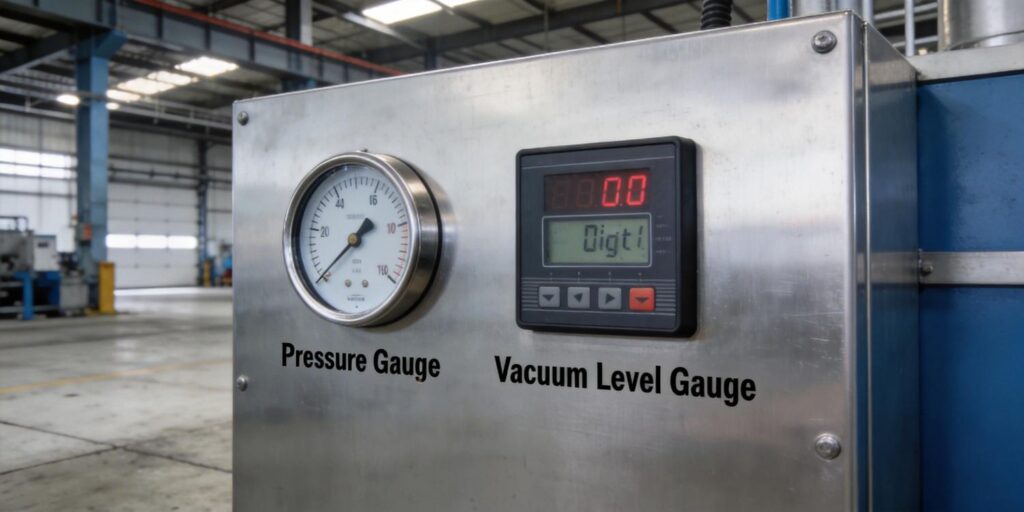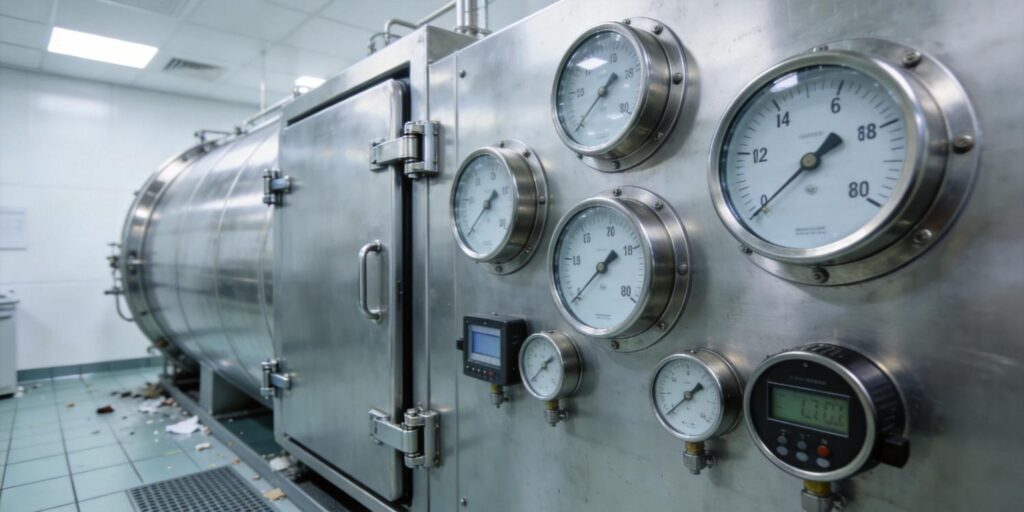
Lithium-ion battery cell production operates under relentless pressure for yield, safety, and cost control. Every trace of moisture must be eliminated before electrolyte filling—otherwise residual water reacts with LiPF₆ to form HF, corroding electrodes, reducing capacity, and creating safety hazards. Vacuum drying of electrode coils and vacuum-assisted electrolyte filling are therefore non-negotiable process steps. Choosing the right vacuum gauge directly affects drying uniformity, cycle time, scrap rates, and overall line uptime.
Poseidon Scientific’s VG-SP205 Pirani Vacuum Transmitter (atmosphere to 10⁻³ Torr) and VG-SM225 Cold Cathode Vacuum Gauge (10⁻³ to 10⁻⁷ Torr) were developed precisely for high-volume, cost-sensitive manufacturing environments such as lithium battery lines. Both deliver 0–10 V analog output, fully customizable RS-232 protocol, compact KF16/KF25 footprints, and 3–5 year service life at a fraction of legacy instrument prices. The sections below guide engineers and procurement teams through the vacuum requirements of electrode drying and electrolyte filling and explain why this specific pair consistently outperforms more expensive alternatives in real production.
Vacuum Stages in Electrode Drying and Electrolyte Filling
Electrode production begins with slurry coating followed by preliminary convective drying. The coated coils then enter vacuum ovens for final moisture removal at 80–150 °C for 12–30 hours. After drying, electrodes move to cell stacking or winding, then to the electrolyte-filling station. Here the cell is evacuated, electrolyte is injected under vacuum, and pressure-swing cycles (evacuate–vent–evacuate) promote capillary wetting of the porous electrodes and separator.
Typical sequences:
- Electrode coil drying: Load coils into vacuum oven → ramp to target temperature → pump to operating pressure → hold 4–24 hours with optional argon purge cycles → cool under vacuum or inert gas.
- Electrolyte filling: Place assembled cell in filling chamber → evacuate to base pressure → dose electrolyte → apply pressure-swing cycles (50 mbar to 0.01 mbar) → seal under vacuum or slight over-pressure.
Both stages demand continuous, real-time pressure monitoring to confirm that moisture desorption has reached target levels and that no air pockets remain in the cell stack.
Required Pressure Windows
Industry data show two overlapping but distinct pressure regimes:
| Stage | Typical Pressure Range | Critical Target | Gauge Coverage |
|---|---|---|---|
| Electrode drying (coil vacuum oven) | 10 mbar to <0.01 mbar (7.5 Torr to 7.5×10⁻³ Torr) | ≤10 mbar hold with purge cycles | VG-SP205 (full range) + VG-SM225 (deep end) |
| Electrolyte filling & wetting | 50 mbar down to ≤0.01 mbar with pressure swings | ≤0.01 mbar for bubble-free impregnation | VG-SP205 primary; VG-SM225 for verification below 10⁻³ Torr |
The VG-SP205 Pirani’s thermal-conductivity principle provides instantaneous response across the entire rough-to-medium vacuum band required for both stages. Its platinum filament and temperature-compensation circuit maintain ±1 % repeatability in the linear 10–10⁻² Torr region where most drying and filling control points sit. Once pressure drops below 10⁻³ Torr (rarely needed but sometimes used for ultra-dry coils), the VG-SM225 Cold Cathode seamlessly takes over with its Penning-discharge ion-current measurement. The pair eliminates any measurement gap at the crossover while keeping total installed height under 100 mm on a shared KF25 port.
Stability Requirements for Moisture Control
Residual moisture targets in lithium battery cells are measured in ppm or even ppb. A 1 °C temperature drift or 5 % pressure reading error can leave enough water to form detectable HF after electrolyte contact, triggering capacity fade or cell swelling. Gauge stability therefore becomes a process safety parameter.
The VG-SP205 holds <2 % annual drift in 24/7 clean-duty lines thanks to dual hardware + firmware compensation. Its status byte reports filament health in real time, eliminating surprise open-circuit failures. The VG-SM225, while subject to slight ion-current baseline shift from electrode sputtering, maintains ±3 % repeatability when cleaned at scheduled intervals. Both instruments log pressure, internal temperature, and error flags via RS-232 every 60 seconds, allowing SCADA systems to trend moisture-equivalent pressure and flag excursions before they reach the cell.
In practice, lines that combine the two gauges with rolling-average alarms achieve consistent dew-point-equivalent performance below –60 °C in the dry room and <10 ppm residual moisture in finished cells.
Redundant Monitoring for Safety
Electrolyte filling involves flammable solvents and reactive lithium salts. A single gauge failure or false high-pressure reading can allow air ingress, creating explosive mixtures or incomplete wetting that leads to internal shorts. Redundancy is now standard on high-volume lines.
Two configurations dominate:
- Full-range redundancy: One VG-SP205 on the roughing port + one VG-SM225 on the chamber wall. The PLC uses the Pirani signal below 10⁻³ Torr and switches to Cold Cathode above it; any >5 % discrepancy triggers an immediate hold and alarm.
- Like-for-like redundancy: Dual VG-SP205 units (or dual VG-SM225 for deeper drying ovens). Readings are averaged; divergence >3 % forces a maintenance cycle while the second gauge keeps the line running.
The removable sensor head on the VG-SM225 makes field cleaning possible in 50 000 hours when redundancy and scheduled cleaning are implemented.
Integration into Automated Lines
Modern battery lines run at 10–30 cells per minute. Gauges must fit inside compact robotic cells, communicate natively with PLCs (Siemens, Allen-Bradley, Omron), and survive thousands of thermal cycles.
Both Poseidon models use the industry-standard RJ45 connector and share identical mounting flanges, allowing side-by-side installation on a single KF25 port with a short manifold. The RS-232 protocol is user-flashable in 30 seconds—no disassembly required—so engineers can match existing command sets without writing new drivers. Analog 0–10 V output provides instant PLC compatibility for threshold logic (“proceed to fill only when both gauges read 10 s”).
Small footprint (45 mm sensor height for VG-SM225) and arbitrary mounting orientation eliminate clearance issues in tight winding and filling stations. Temperature compensation keeps readings stable across the 15–50 °C operating window typical of dry-room environments.
Lifecycle Considerations
Battery production volumes are measured in millions of cells per month; every dollar of gauge cost multiplies across thousands of stations. Poseidon instruments were designed with total ownership cost in mind:
- Initial cost: 40–60 % lower than imported equivalents while delivering equivalent or better repeatability.
- Maintenance: VG-SP205 is fully maintenance-free (3–5 year life); VG-SM225 requires only occasional electrode cleaning with 500-mesh paper—restoring calibration in minutes.
- Replacement planning: Filament-open or discharge-fail status bytes give weeks of warning before end-of-life.
- Customization: 5-unit minimum orders with custom protocol at no extra charge.
Lines that standardize on the VG-SP205 / VG-SM225 pair typically achieve >99.8 % gauge-related uptime and recover the entire investment in <6 months through reduced scrap and faster cycle times.
Choose the Right Vacuum Gauge Pair for Your Battery Line
From electrode drying ovens to electrolyte filling stations, the VG-SP205 Pirani and VG-SM225 Cold Cathode deliver the exact pressure coverage, stability, redundancy, and integration features lithium battery manufacturers need—at the lowest total cost of ownership.
Download the VG-SP205 datasheet and user manual for pressure-response curves and RS-232 protocol examples.
Download the VG-SM225 datasheet and user manual for cleaning procedures and redundancy wiring diagrams.
Need help selecting isolation valves for bake-out compatibility, designing a dual-redundant manifold, or flashing a custom PLC protocol? Contact our applications engineering team at engineering@poseidon-scientific.com or request a 48-hour evaluation kit. We support 5-piece pilot orders with full technical support and deliver production volumes within weeks.
Precise vacuum. Zero moisture surprises. Maximum cell yield.