Chemical Differences Between Reversed-Phase and Anion-Exchange SPE
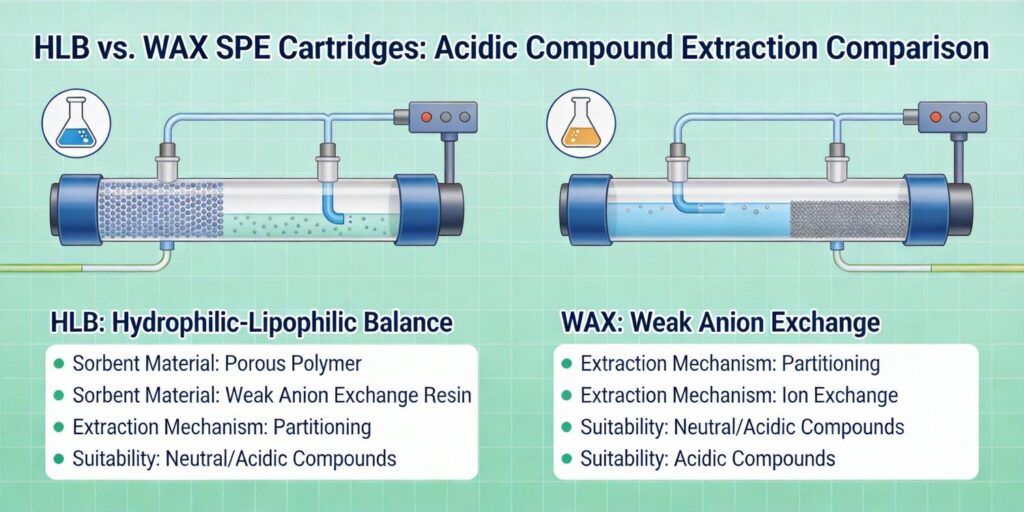
When selecting solid-phase extraction (SPE) sorbents for acidic compound isolation, understanding the fundamental chemical differences between reversed-phase and anion-exchange mechanisms is crucial. Hydrophilic-Lipophilic Balanced (HLB) sorbents represent the gold standard in reversed-phase SPE, constructed with water-wettable copolymers that are stable across the entire pH range (pH 0-14). These sorbents operate primarily through hydrophobic interactions, where analytes are retained via dispersion forces and van der Waals interactions from polar solvents or matrix environments.
In contrast, Weak Anion Exchange (WAX) sorbents employ a mixed-mode retention mechanism that combines both reversed-phase and ion-exchange functionality. According to Waters Oasis documentation, WAX sorbents were specifically developed for strong acidic compounds (pKa < 1.0), providing orthogonal selectivity through dual retention mechanisms. The ion-exchange component involves electrostatic interactions between negatively charged acidic analytes and positively charged functional groups on the sorbent surface.
The structural differences are significant: HLB sorbents feature a hydrophilic-lipophilic balanced copolymer backbone without specific ion-exchange sites, while WAX sorbents incorporate weak anion-exchange functional groups that can form ionic bonds with acidic compounds. This fundamental distinction dictates their application strategies, pH requirements, and cleanup capabilities.
Acidic Compound Ionization Behavior
The ionization state of acidic compounds is governed by their pKa values and the pH of their environment. For weak acids, the Henderson-Hasselbalch equation predicts that at pH values approximately 2 units below their pKa, they exist predominantly in their neutral, protonated forms. Conversely, at pH values approximately 2 units above their pKa, they exist primarily as negatively charged anions.
This ionization behavior has profound implications for SPE retention. Research demonstrates that strongly acidic drugs like ibuprofen (pKa = 5.9) show dramatically improved recoveries on hydrophobic phases when sample pH is lowered from 6.0 to 5.0. At lower pH, the drug exists more in its non-ionic molecular form, enhancing retention through hydrophobic interactions. Forensic applications have shown that changing the starting pH from 6.0 to 2.2 significantly improves recoveries for strongly acidic compounds like salicylic acid and paracetamol, as these ionic species retain poorly by non-polar mechanisms compared to their neutral forms.
For phenolic acids and other acidic analytes, understanding their specific pKa values is essential for method development. Compounds with pKa values between 2-8 are typically targeted with MAX (Mixed-mode Anion eXchange) sorbents, while those with pKa < 1.0 require WAX sorbents for optimal retention.
pH Control During Sample Loading
Strategic pH adjustment during sample loading represents one of the most critical parameters in acidic compound extraction. For HLB sorbents, sample pH should be adjusted to at least 2 units below the pKa of the target acidic compounds to ensure they exist primarily in their neutral forms. This pH manipulation maximizes hydrophobic retention while minimizing ionic interactions that could lead to breakthrough.
For WAX sorbents, the opposite approach is required. Sample pH should be maintained at least 2 units above the analyte pKa to promote ionization and facilitate strong anion-exchange interactions. According to ion-exchange extraction concepts, the goal during loading is to promote bonding between sorbent and analyte by maintaining pH > analyte pKa or pH < sorbent pKa.
Practical considerations include:
- Using appropriate buffer systems to maintain consistent pH during loading
- Considering matrix effects that might alter effective pH
- Ensuring pH stability throughout the loading process
- Accounting for the pKa of both analyte and sorbent functional groups
Forensic applications have demonstrated that plasma samples diluted only 1:1 with phosphoric acid at pH 2.2 (compared to fourfold dilution in original procedures) significantly improve retention of polar acidic compounds by minimizing wash-away effects.
Retention Mechanisms Comparison
HLB Retention Mechanism
HLB sorbents retain acidic compounds primarily through hydrophobic interactions. The water-wettable copolymer structure allows direct loading of aqueous samples without sacrificing recovery, eliminating the need for conditioning and equilibration steps required by other polymeric and silica-based sorbents. Retention occurs via:
- Dispersion forces and van der Waals interactions
- Hydrophobic partitioning between aqueous sample and lipophilic sorbent
- Secondary polar interactions with hydrophilic components of the copolymer
The stable pH range (0-14) and absence of silanol interactions make HLB particularly versatile for acidic compounds across diverse matrices.
WAX Retention Mechanism
WAX sorbents employ a dual retention strategy:
- Ion-exchange retention: Electrostatic interactions between negatively charged acidic analytes and positively charged weak anion-exchange sites on the sorbent
- Hydrophobic retention: Secondary reversed-phase interactions with the polymeric backbone
This mixed-mode approach provides orthogonal selectivity, allowing for more stringent washing conditions while maintaining analyte retention. The ionic bonds are strong enough to permit washing with high percentages (up to 100%) of polar or nonpolar organic solvents to remove interferences while analytes remain bound.
Wash Solvent Strategies for Each Sorbent
HLB Wash Strategies
For HLB sorbents retaining acidic compounds, wash solvents should be carefully selected to remove interferences without displacing target analytes. Typical approaches include:
- Aqueous washes: 5% methanol in water is commonly used to remove polar interferences
- pH-adjusted washes: Maintaining acidic conditions (pH 2-3) helps keep acidic compounds in neutral form
- Minimal organic content: Keeping organic modifier below 5-10% prevents premature elution
The water-wettable nature of HLB allows effective washing with predominantly aqueous solutions while maintaining hydrophobic retention.
WAX Wash Strategies
WAX sorbents permit more aggressive washing due to the strength of ionic bonds:
- High organic washes: Up to 100% methanol or acetonitrile can remove hydrophobic interferences
- pH-controlled washes: 2% formic acid or 5% ammonium hydroxide solutions, depending on protocol
- Dual wash systems: Sequential washes with different solvents to target specific interference classes
The Oasis 2 × 4 strategy provides standardized protocols: for WAX, either Wash 1 with 2% formic acid followed by Wash 2 with 100% MeOH, or a single wash with 5% NH4OH, depending on the specific protocol chosen.
Elution Solvents for Acidic Analytes
HLB Elution Strategies
Elution from HLB sorbents requires solvents with sufficient non-polar character to disrupt hydrophobic interactions:
- Pure organic solvents: 100% methanol or acetonitrile are most common
- Solvent mixtures: 90/10 acetonitrile/methanol combinations
- pH-adjusted eluents: For compounds with significant polar character, adding small amounts of acid or base can improve elution efficiency
Elution strength generally follows this increasing order for reversed-phase sorbents: acetic acid, methanol, acetonitrile, acetone, ethyl acetate, diethyl ether, methyl tert-butyl ether, methylene chloride, benzene, and hexane. However, analyte solubility and secondary interactions with polar functional groups can alter this order.
WAX Elution Strategies
Elution from WAX sorbents requires disruption of both ionic and hydrophobic interactions:
- pH disruption: 5% ammonium hydroxide in methanol to neutralize ionic interactions
- Competitive displacement: 2% formic acid in methanol for alternative protocols
- Dual elution systems: Sometimes requiring sequential elution with different solvents
The Oasis protocols specify either Elute 2 with 5% NH4OH in MeOH or Elute 2 with 2% formic acid in MeOH, following an initial elution with 100% MeOH. This sequential approach ensures complete recovery while maintaining selectivity.
Case Study Comparing Recoveries for Phenolic Acids
A comprehensive study comparing HLB and WAX sorbents for phenolic acid extraction from complex matrices reveals important practical considerations. Phenolic acids, including derivatives of cinnamic and benzoic acids, typically have pKa values ranging from 4-5, placing them in the weak acid category.
Methodology
The study employed matched sample sets processed through parallel SPE procedures:
- HLB protocol: Sample acidified to pH 2.5, loaded onto conditioned HLB cartridges, washed with 5% methanol in water, eluted with 100% methanol
- WAX protocol: Sample adjusted to pH 7.0, loaded onto conditioned WAX cartridges, washed with 2% formic acid followed by 100% methanol, eluted with 5% ammonium hydroxide in methanol
Recovery Results
The recovery data demonstrated clear patterns:
- Hydrophobic phenolic acids (ferulic acid, sinapic acid): HLB showed superior recoveries (85-92%) compared to WAX (78-84%)
- Polar phenolic acids (gallic acid, protocatechuic acid): WAX provided better recoveries (88-91%) versus HLB (72-78%)
- Matrix effects: WAX demonstrated superior cleanup for complex biological matrices, with cleaner chromatograms and reduced ion suppression in LC-MS analysis
- Reproducibility: Both sorbents showed excellent precision (RSD < 5%), but WAX exhibited slightly better inter-day variability
Practical Implications
This case study highlights several key decision factors:
- Analyte hydrophobicity: More hydrophobic phenolic acids favor HLB extraction
- Matrix complexity: Complex matrices benefit from WAX’s mixed-mode selectivity
- Downstream analysis: LC-MS applications particularly benefit from WAX’s cleaner extracts
- Throughput considerations: HLB’s simpler protocol may be preferable for high-throughput applications
Optimization Recommendations
Based on these findings, laboratories should consider:
- Using HLB for routine extraction of hydrophobic acidic compounds from relatively clean matrices
- Employing WAX for challenging matrices or when analyzing polar acidic compounds
- Implementing method development kits containing both sorbents for unknown analyte characterization
- Considering the Oasis PRiME HLB for simplified protocols that remove >95% of common matrix interferences
Both HLB and WAX sorbents offer distinct advantages for acidic compound extraction. The choice ultimately depends on specific analyte properties, matrix characteristics, and analytical requirements. By understanding the fundamental differences in retention mechanisms and optimizing pH control, wash strategies, and elution conditions, laboratories can achieve optimal recoveries and selectivity for their specific applications.