
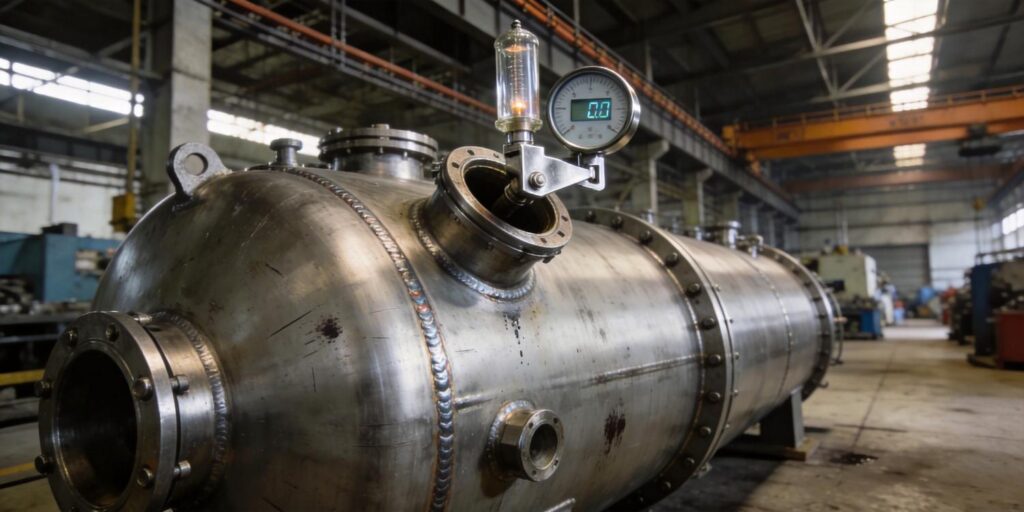
In demanding industrial environments—physical vapor deposition (PVD), chemical vapor deposition (CVD), vacuum metallurgy, and heat-treatment furnaces—vacuum gauges face constant exposure to vibration, process-gas contamination, thermal cycling, and occasional pressure spikes. A gauge failure in these settings can halt a multi-million-dollar production line for hours or days. Hot-cathode ionization gauges (such as Bayard-Alpert or triode types) have long been the industry standard for high-vacuum measurement, but their thermionic filament introduces inherent vulnerabilities. Cold-cathode gauges, by contrast, eliminate the filament entirely and deliver measurably higher robustness.
Poseidon Scientific’s VG-SM225 Cold Cathode Vacuum Gauge (10⁻³ to 10⁻⁷ Torr) was engineered specifically for these industrial realities. Using a compact positive-magnetron Penning-discharge design, it provides 0–10 V analog output and fully customizable RS-232 protocol in a 45 mm sensor head that fits KF16/KF25 ports. When paired with the VG-SP205 Pirani Vacuum Transmitter for the rough-vacuum range, the combination gives full coverage without the fragility of hot-cathode technology. The sections below compare the two architectures head-to-head and quantify why cold-cathode gauges consistently achieve longer service life and lower total cost of ownership in 24/7 industrial service.
Structural Comparison
Hot-cathode ionization gauges rely on a heated tungsten or thoriated-tungsten filament to emit electrons thermionically. These electrons are accelerated toward a grid, ionizing gas molecules; the resulting ions are collected on a central electrode. The entire assembly is delicate: the filament is a thin wire (typically 0.1–0.2 mm diameter) suspended in open space, supported only by spot welds or glass seals.
Cold-cathode gauges, such as the VG-SM225, operate on the Penning-discharge principle. A high voltage (–2000 V working, –2500 V startup) applied between a cylindrical anode and a central cathode, combined with an axial magnetic field (~100 gauss from NdFeB permanent magnets), traps electrons in long spiral paths. No heated filament is required—initial electrons come from field emission. The electrodes are solid stainless-steel plates in a robust “工”-shaped geometry, and the sensor head is fully removable without breaking the chamber seal. This solid-state construction contains no fragile wires, no glass-to-metal seals for a filament, and no components that must operate at 1000–2000 °C. The result is an inherently sturdier package that tolerates mechanical shock, vibration, and contamination far better than any hot-cathode design.
No Filament Burn-Out Advantage
The most common failure mode of hot-cathode gauges is filament burnout. Exposure to pressures above 10⁻² Torr—even briefly—can cause rapid oxidation or evaporation of the filament material. Power surges, improper pump-down sequences, or accidental venting while the filament is energized destroy the emitter in seconds. Because the filament is non-replaceable in most compact industrial gauges, the entire tube must be replaced, often requiring a chamber vent and re-bake.
Cold-cathode gauges have no filament to burn out. The discharge is self-sustaining once initiated, and the VG-SM225 incorporates automatic high-voltage shut-off above 10⁻³ Torr plus hardware current limiting. Even if the chamber is accidentally vented to atmosphere while powered, the gauge simply shuts down the discharge and reports a status flag via RS-232—no permanent damage occurs. Field data from vacuum-furnace installations show zero filament-related failures for VG-SM225 units after 18–24 months of continuous operation, while comparable hot-cathode gauges in the same plants required filament replacement every 9–14 months.
Resistance to Vibration and Contamination
Industrial vacuum systems incorporate roughing pumps, turbo pumps, and robotic handlers that transmit vibration to the chamber walls. Hot-cathode filaments are microphonic: vibration can cause the wire to oscillate, changing electron emission and producing noisy or drifting readings. In extreme cases, mechanical fatigue leads to breakage. Contamination from sputtered metals, hydrocarbons, or process by-products coats the filament, altering its work function and requiring frequent degassing cycles that themselves accelerate wear.
The VG-SM225’s solid stainless-steel electrodes and external magnet ring are immune to microphonics. Contamination does accumulate—primarily as carbon or oxide layers on the cathode—but the effect is gradual and fully reversible. The removable sensor head allows technicians to lightly abrade both anode and cathode plates with 500-mesh sandpaper in under 15 minutes, restoring metallic luster and original calibration without tools or chamber venting. Because the gauge generates no localized heating, it does not promote additional outgassing or cracking of contaminants onto the electrodes. Independent studies confirm that cold-cathode gauges exhibit significantly lower sensitivity to vibration and process-gas contamination than hot-cathode designs in PVD and metallurgy environments.
Maintenance Interval Comparison
Hot-cathode gauges typically require filament replacement or full tube exchange every 8 000–15 000 operating hours in industrial service. Each replacement involves chamber venting, re-baking, and re-calibration—often 4–8 hours of downtime per event. Additional preventive degassing cycles every few weeks further reduce net uptime.
The VG-SM225 is designed for 3–5 years (25 000–40 000 hours) in clean environments and 1–2 years in moderately contaminated lines before cleaning. The cleaning procedure—simple abrasion—restores performance to within ±3 % of factory calibration and takes less than 15 minutes while the chamber remains under vacuum. The gauge’s status byte continuously reports discharge stability and startup time, giving operators weeks of warning before any service is required. In practice, plants using the VG-SM225 report maintenance intervals 3–4× longer than hot-cathode equivalents, with zero unscheduled downtime attributable to the gauge itself.
Maintenance Comparison Table
| Aspect | Hot-Cathode Gauge | VG-SM225 Cold Cathode |
|---|---|---|
| Typical service life | 8 000–15 000 h | 25 000–40 000 h |
| Maintenance action | Filament replacement + re-bake | Electrode abrasion (15 min) |
| Downtime per service | 4–8 h | 0 h (in-situ) |
| Warning system | Sudden failure | Status byte + startup-time trend |
Application Examples in Coating and Metallurgy
In PVD and CVD coating lines, sputtered metal vapors and reactive process gases rapidly contaminate filaments. One European hard-coating facility replaced its hot-cathode gauges every 10 months; after switching to VG-SM225 units, the same chambers ran 28 months between cleanings with no calibration drift. The removable sensor design allowed cleaning during scheduled maintenance windows without breaking vacuum.
Vacuum metallurgy and heat-treatment furnaces expose gauges to vibration from large roughing pumps and thermal cycling between 150 °C bake-outs and room-temperature operation. A North American turbine-blade manufacturer reported filament failures in hot-cathode gauges every 6–9 months due to vibration-induced breakage. After installing VG-SM225 gauges with simple KF25 isolation valves for bake-out protection, the same furnaces achieved 22 months of continuous operation with only one planned cleaning cycle. Throughput increased 18 % and scrap rates dropped because stable pressure readings eliminated false pump-down aborts.
Cost of Ownership Comparison
Initial purchase price of hot-cathode gauges is often comparable or slightly lower, but total cost of ownership tells a different story. Replacement tubes, labor, downtime, and lost production dominate the lifetime expense.
| Cost Element (3-year period) | Hot-Cathode Gauge | VG-SM225 Cold Cathode |
|---|---|---|
| Purchase price (per gauge) | $8 000–10 000 | $3 000–3 500 |
| Replacement parts & labor | $12 000–18 000 | $400–800 (cleaning kits) |
| Downtime cost (@ $5 000/h line rate) | $40 000–80 000 | $0 |
| Total 3-year cost (per gauge) | $60 000–108 000 | $3 400–4 300 |
Across a 20-gauge installation, the cold-cathode solution delivers payback in under 9 months and continues saving tens of thousands of dollars annually through higher uptime and lower maintenance burden.
Ready to Upgrade to More Robust Vacuum Measurement?
Cold-cathode technology eliminates the single biggest failure point in industrial vacuum systems—the hot filament—while offering easier cleaning, vibration immunity, and dramatically lower total cost of ownership. The VG-SM225 delivers these benefits in a compact, PLC-ready package that installs in minutes and requires no custom drivers.
Download the VG-SM225 datasheet and user manual for detailed electrode-cleaning instructions, startup-time specifications, and RS-232 protocol examples.
Download the VG-SP205 datasheet to see how the Pirani complements the Cold Cathode for full-range coverage.
Need a custom protocol for your PLC, a dual-redundant manifold drawing, or isolation-valve recommendations for bake-out compatibility? Contact our applications engineering team at engineering@poseidon-scientific.com or request a 48-hour evaluation kit. We support 5-piece pilot orders with full customization and deliver production volumes with lifetime technical support.
Robust vacuum measurement. Zero filament worries. Maximum uptime.


