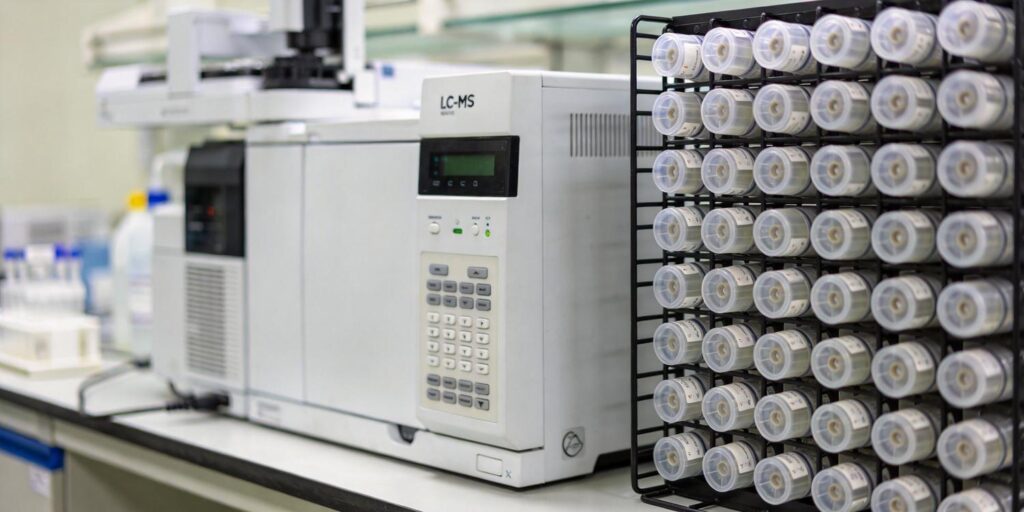
Overview of LC-MS Analytical Workflows
Liquid Chromatography-Mass Spectrometry (LC-MS) has become the gold standard for analytical chemistry across pharmaceutical, environmental, and clinical laboratories. The typical LC-MS workflow involves several critical steps: sample collection, preparation, chromatographic separation, ionization, mass analysis, and data interpretation. While the instrumentation has advanced dramatically, the sample preparation stage remains the most crucial determinant of analytical success.
Biological and environmental samples are notoriously complex matrices containing thousands of chemical components alongside the analytes of interest. As noted in forensic applications, “Biological samples are notoriously dirty; injecting them with minimum cleanup onto very sensitive and expensive instruments makes very little sense.” This fundamental truth underscores why sample preparation cannot be overlooked in any serious analytical workflow.
The Critical Importance of Sample Cleanup
Sample cleanup serves multiple essential functions in LC-MS analysis. First, it protects the expensive instrumentation from damage. Proteins, salts, and other matrix components can foul LC columns, clog transfer lines, and contaminate ionization sources. Research has shown that SPE “significantly increases gas (GC) and liquid chromatography (LC) column life while reducing the downtime on equipment like gas chromatography and liquid chromatography mass spectrometers (GCMS and LCMS) for source cleaning.”
Second, proper cleanup improves analytical performance. Cleaner extracts yield better chromatographic separation, sharper peaks, and more reproducible retention times. This is particularly important in high-throughput environments where consistent performance is essential for reliable results.
Third, effective sample preparation enables analyte concentration. Many analytes exist at trace levels in complex matrices, requiring concentration factors of 100-1000x to reach detectable levels. As noted in environmental monitoring applications, “the high level of concentration effected by the SPE step” permits “ultra-trace levels of pollutants to be identified positively.”
Matrix Effects and Ion Suppression
One of the most significant challenges in LC-MS analysis is matrix effects, particularly ion suppression. When co-extracted compounds enter the ionization source alongside target analytes, they can interfere with the ionization process, reducing signal intensity and compromising quantitative accuracy. This phenomenon is especially problematic in atmospheric pressure ionization techniques like electrospray ionization (ESI).
As research has documented, “An undesirable feature of atmospheric pressure ionization-MS analysis is suppression of ionization by co-extracted endogenous interferences from biofluids. To avoid false negatives, selective SPE extraction applications are required.” These interfering compounds may not be directly observable in the mass spectrometer but can dramatically affect the ionization efficiency of target analytes.
Matrix effects manifest in several ways:
- Ion suppression: Co-eluting compounds reduce the ionization efficiency of target analytes
- Ion enhancement: Less common but equally problematic, where matrix components increase analyte signals
- Source contamination: Non-volatile compounds accumulate in the ion source, requiring frequent cleaning and maintenance
- Signal instability: Variable matrix effects lead to poor reproducibility and inaccurate quantification
The Essential Role of SPE in Improving Sensitivity
Solid Phase Extraction (SPE) addresses these challenges through selective retention and elution of target analytes. Unlike traditional liquid-liquid extraction (LLE), which provides broad, non-selective extraction, SPE offers tunable selectivity through careful choice of sorbent chemistry and elution conditions. As documented in comparative studies, “SPE recoveries should exceed 90% absolute recovery. If you don’t get that kind of recovery you are not adjusting other parameters (such as solubility, pH, and solvent strength) correctly.”
SPE improves LC-MS sensitivity through several mechanisms:
1. Matrix Removal and Cleanup
SPE selectively removes proteins, salts, lipids, and other interfering compounds that cause ion suppression. By eliminating these matrix components before analysis, SPE ensures that analytes reach the mass spectrometer in a clean environment conducive to efficient ionization.
2. Analyte Concentration
SPE allows for significant volume reduction, concentrating analytes from large sample volumes (often 1-100 mL) into small elution volumes (typically 0.5-2 mL). This concentration factor is essential for detecting trace-level analytes in environmental, clinical, and pharmaceutical applications.
3. Solvent Exchange
SPE enables transfer of analytes from aqueous or complex matrices into volatile organic solvents compatible with LC-MS analysis. This solvent exchange is critical for optimal chromatographic performance and ionization efficiency.
4. Selective Extraction
Modern SPE sorbents offer remarkable selectivity through various interaction mechanisms:
- Reversed-phase SPE: For non-polar to moderately polar compounds (C18, C8, HLB)
- Normal-phase SPE: For polar compounds (silica, cyano, amino phases)
- Ion-exchange SPE: For charged compounds (WCX, WAX, SCX, SAX)
- Mixed-mode SPE: Combining multiple interaction mechanisms for enhanced selectivity
The evolution of SPE technology has been remarkable. Early comparisons show dramatic improvements: “Figures 1–5 show a progression of chromatograms from extractions, which will demonstrate the improvements made in extractions over the past 10 years.” Modern polymeric sorbents and mixed-mode phases offer superior performance compared to traditional silica-based materials.
Workflow Examples and Applications
Pharmaceutical Bioanalysis
In drug development, SPE-LC-MS has become indispensable for pharmacokinetic studies and therapeutic drug monitoring. The 96-well plate format has revolutionized high-throughput analysis, with systems capable of processing “between 320 and 960 samples per day for a broad-range pharmaceutical screen in human plasma.” Automated SPE systems integrated with LC-MS provide cycle times of “5 to 7 minutes per sample, which yielded sensitivities of 50 pg/mL for sample sizes of only 200 μL.”
Environmental Monitoring
For environmental water analysis, SPE enables detection of pesticides, pharmaceuticals, and industrial chemicals at parts-per-trillion levels. On-line SPE-LC-MS systems provide continuous monitoring capabilities with minimal manual intervention. As researchers have demonstrated, “the HPLC separation can be eliminated entirely. The SPE cartridge alone is used to provide clean-up and solvent exchange with, perhaps, a little elution chromatography down its short length.”
Clinical Toxicology
In forensic and clinical laboratories, SPE provides the selectivity needed for accurate drug screening and confirmation. Mixed-mode SPE cartridges can simultaneously extract acidic, basic, and neutral compounds from complex biological matrices like urine, blood, and tissue. The technology has evolved from simple C18 extractions to sophisticated mixed-mode phases that provide cleaner extracts and higher recoveries.
Food Safety Analysis
SPE is essential for detecting contaminants, pesticides, and veterinary drugs in food matrices. The technique’s ability to handle complex, fatty matrices makes it ideal for food analysis applications where matrix effects can be particularly severe.
Choosing the Right SPE Approach
The selection of SPE methodology depends on several factors:
Format Selection
- Cartridges: Traditional format for manual or semi-automated processing
- 96-well plates: Ideal for high-throughput automation and integration with robotic systems
- On-line SPE: Direct coupling to LC-MS for automated sample preparation and analysis
- Disks: Suitable for large volume samples or samples with high particulate content
Sorbent Selection
Proper sorbent selection is critical for successful SPE-LC-MS applications:
- HLB (Hydrophilic-Lipophilic Balance): Waters Oasis HLB or equivalent for broad-spectrum extraction
- Mixed-mode phases: Combining reversed-phase and ion-exchange mechanisms for enhanced selectivity
- Polymeric sorbents: Superior stability and capacity compared to silica-based materials
- Specialty phases: Molecularly imprinted polymers, restricted access materials, and other advanced sorbents
Method Optimization
Successful SPE method development requires systematic optimization of several parameters:
- Conditioning: Proper wetting of the sorbent bed
- Loading: Sample application at optimal pH and flow rate
- Washing: Selective removal of interferences while retaining analytes
- Elution: Efficient recovery of analytes in minimal volume
Conclusion
Solid Phase Extraction is not merely an optional step in LC-MS analysis—it is an essential component that determines the success or failure of the entire analytical process. By addressing matrix effects, improving sensitivity, protecting instrumentation, and enabling trace-level detection, SPE transforms challenging samples into analyzable extracts. As LC-MS technology continues to advance toward higher sensitivity and faster analysis times, the importance of effective sample preparation only increases.
The future of SPE in LC-MS analysis looks bright, with ongoing developments in sorbent chemistry, automation, and integration. Miniaturization, new housing designs, and advanced polymeric materials promise even better performance for tomorrow’s analytical challenges. As one researcher beautifully captured, “I am still amazed at how well this relatively simple procedure can fractionate and concentrate complex chemical mixtures into more manageable subsamples.”
For laboratories seeking to optimize their LC-MS workflows, investing in proper SPE methodology and equipment represents one of the highest-return investments available. The improvements in data quality, instrument uptime, and analytical confidence far outweigh the costs of implementation, making SPE an indispensable tool in modern analytical chemistry.