
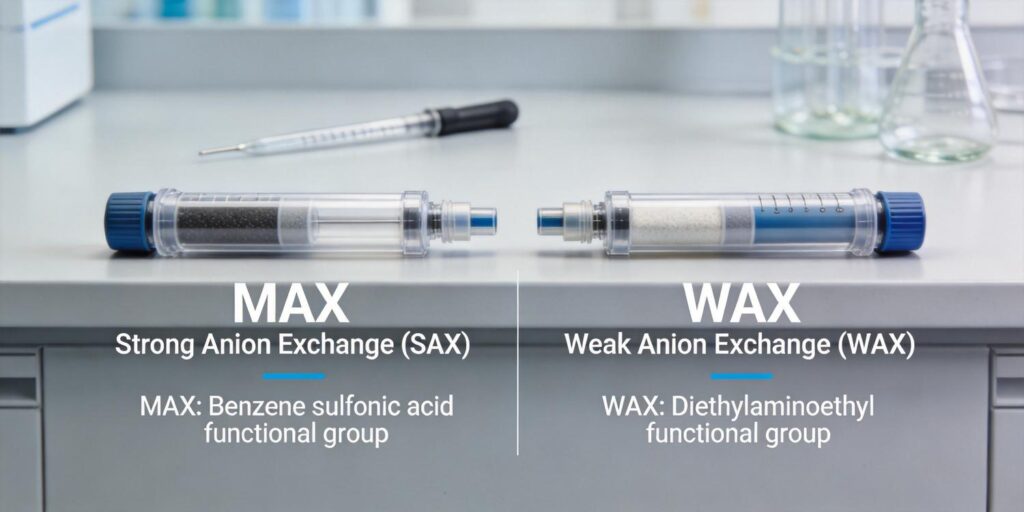
Strong vs Weak Anion Exchange: The Fundamental Distinction
When selecting between MAX (Mixed-mode Anion eXchange) and WAX (Weak Anion eXchange) SPE cartridges, the primary distinction lies in their ion-exchange strength and retention mechanisms. MAX cartridges feature strong anion exchange functionality with a tightly controlled ion-exchange capacity of 0.25 meq/g, designed specifically for acidic compounds with pKa values between 2-8. In contrast, WAX cartridges utilize weak anion exchange mechanisms with a 0.6 meq/g capacity, optimized for strong acidic compounds with pKa values less than 1.0.
The mixed-mode nature of both sorbents combines both ion-exchange and reversed-phase retention mechanisms, but their pH-dependent behavior differs significantly. MAX’s strong anion exchange groups maintain their charge across a wide pH range, while WAX’s weak anion exchange groups are more pH-sensitive, allowing for selective elution under specific conditions.
Sorbent Functional Groups: Chemical Architecture
MAX Functional Groups
MAX sorbents contain quaternary ammonium groups that provide strong anion exchange capability. These positively charged functional groups interact with negatively charged acidic analytes through ionic interactions. The polymeric backbone is water-wettable and stable across pH 0-14, with no interfering silanol groups that could complicate retention modes or method development.
WAX Functional Groups
WAX sorbents feature tertiary amine groups that function as weak anion exchangers. These groups can be protonated or deprotonated depending on pH conditions, offering more flexibility in method development. Like MAX, WAX utilizes a polymeric matrix that’s stable across the entire pH range and free from silanol interference.
Application Differences: When to Choose Which
MAX Applications
MAX cartridges excel in extracting acidic compounds and their metabolites from biological fluids. They’re particularly effective for:
- Organic acids with pKa values between 2-8
- Pharmaceutical acidic compounds
- Acidic metabolites in biological matrices
- Compounds requiring reproducible SPE protocols
WAX Applications
WAX cartridges are specifically designed for strong acidic compounds, including:
- Sulfonic acids and other strong acids (pKa < 1.0)
- Highly acidic pharmaceutical compounds
- Compounds requiring selective retention of strong acids
- Applications where pH manipulation is critical for elution
Method Development Tips
Conditioning and Loading
Both MAX and WAX cartridges require proper conditioning before use. For MAX, condition with methanol followed by water or buffer. For WAX, similar conditioning applies, but pay special attention to pH conditions during loading to ensure proper ionization of both the sorbent and analytes.
Wash Optimization
Develop wash steps that remove interferences while retaining target analytes. For MAX, consider using 2% formic acid as a wash solution. For WAX, 5% NH4OH can be effective. Always include a methanol wash step to remove hydrophobic interferences.
Elution Strategies
MAX typically elutes with 5% NH4OH in methanol, while WAX may require 2% formic acid in methanol for optimal recovery. Consider sequential elution steps when dealing with complex mixtures or when fractionation is desired.
pH Considerations
For MAX, maintain pH conditions that keep acidic analytes ionized during loading and washing, then switch to basic conditions for elution. For WAX, the weak anion exchange nature allows for more subtle pH manipulation to achieve selective retention and elution.
Method Development Tools
Consider using 96-well SPE plates for rapid method development. The Oasis Sorbent Selection Plate containing MCX, MAX, WCX, and WAX sorbents in a single plate format enables convenient scouting of the best methods for unknown analytes or mixtures with different retention properties.
Practical Considerations for Engineers and Purchasing
Particle Size Selection
Both MAX and WAX cartridges are available in 30 μm and 60 μm particle sizes. For most plasma, serum, and human urine applications, choose 30 μm sorbents. For more viscous samples like animal urine, 60 μm sorbents provide better flow characteristics.
Format Options
Available formats include 1 cc, 3 cc, and 6 cc cartridges, plus 96-well plates for high-throughput applications. Consider your sample volume, throughput requirements, and automation compatibility when selecting formats.
Quality Considerations
Look for sorbents with tightly controlled ion-exchange capacities and absence of silanol groups. These features ensure reproducible results and simplified method development. The polymeric nature of both MAX and WAX sorbents provides pH stability from 0-14, making them suitable for a wide range of applications.
Conclusion
Choosing between MAX and WAX SPE cartridges depends on your specific analytical needs. MAX offers strong anion exchange for general acidic compounds (pKa 2-8), while WAX provides weak anion exchange for strong acidic compounds (pKa < 1.0). Both utilize mixed-mode retention mechanisms combining ion-exchange and reversed-phase interactions, but their different functional groups and pH sensitivities make them suitable for distinct applications.
For method development, consider starting with the MAX cartridges for general acidic compounds or the WAX cartridges for strong acids. Always validate your methods with appropriate standards and matrix-matched samples to ensure optimal recovery and selectivity for your specific application.


