Therapeutic Drug Monitoring Overview
Therapeutic drug monitoring (TDM) represents a critical component of modern clinical pharmacology, enabling healthcare professionals to optimize medication efficacy while minimizing adverse effects. At its core, TDM involves measuring drug concentrations in biological fluids—typically plasma or serum—to ensure they remain within a therapeutic range. This practice has become particularly vital for medications with narrow therapeutic indices, where small variations in concentration can lead to either therapeutic failure or toxicity.
According to established literature, SPE has emerged as a cornerstone technology in TDM laboratories worldwide. The technique’s ability to selectively isolate target analytes from complex biological matrices makes it indispensable for accurate quantification. As noted in forensic and clinical applications, “SPE is a very useful tool for sample workup, isolation and concentration” in systematic toxicological analysis, with mixed-mode cartridges providing both hydrophobic and cation exchange interactions for high recoveries from plasma, urine, whole blood, and tissues.
Key Applications in Pharmaceutical Monitoring
SPE finds extensive application across multiple drug classes requiring therapeutic monitoring:
- Cardiovascular Drugs: Monitoring of antiarrhythmics like amiodarone and its metabolite desethylamiodarone using solid-phase extraction techniques
- Antiepileptic Agents: Quantification of drugs such as gabapentin in serum using specialized extraction columns
- Psychiatric Medications: Analysis of antidepressants including fluoxetine, sertraline, and their metabolites
- Antimicrobials: Sensitive assays for antibiotics like amoxicillin in plasma and biological fluids
- Immunosuppressants: Monitoring of drugs with narrow therapeutic windows requiring precise concentration control
The evolution of SPE technology has paralleled advances in TDM, with modern drug candidates often being “very potent substances” requiring high assay sensitivity to estimate terminal plasma half-lives accurately. Clean plasma extracts are essential for achieving the necessary sensitivity in pharmacokinetic studies during drug development.
Sample Preparation Challenges in Pharmaceutical Drug Monitoring
Complex Biological Matrices
Biological samples present unique challenges that SPE must overcome. As detailed in technical literature, extraction of biological samples before HPLC analysis serves multiple objectives: concentration, clean-up, prevention of column clogging, and elimination of protein binding. The complexity of matrices like plasma, urine, and whole blood requires sophisticated sample preparation strategies.
Plasma samples contain approximately 7% proteins (primarily albumin and globulins) that can bind drugs, potentially interfering with accurate quantification. SPE addresses this through several mechanisms:
- Protein Precipitation Prevention: Proper SPE conditions prevent analytical column clogging by removing proteinaceous material
- Protein Binding Disruption: Appropriate pH adjustment and solvent selection disrupt drug-protein complexes
- Endogenous Compound Removal: Elimination of interfering substances like lipids, salts, and metabolites
Technical Challenges and SPE Solutions
1. Low Concentration Analytes
Modern pharmaceuticals often exhibit high potency, resulting in low plasma concentrations. SPE provides the necessary concentration factor through analyte adsorption mode, where “analyte(s) retained (k >> 1)” while matrix components are removed. This preconcentration capability is crucial for detecting drugs at picogram levels, as demonstrated in automated SPE and tandem MS applications without HPLC columns.
2. Metabolite Interference
Drug metabolites can interfere with parent drug quantification, particularly when they share similar chemical properties. Mixed-mode SPE cartridges offer superior selectivity by combining multiple interaction mechanisms. As research indicates, “The strategy of a mixed-mode cartridge providing hydrophobic and cation exchange interactions, combined with a pH-dependent sample application and extraction, can give high recoveries of analytes” while minimizing metabolite interference.
3. Matrix Variability
Biological samples exhibit significant variability in composition. SPE method development must account for factors including:
- pH variations in urine samples (typically 4.5-8.0)
- Ionic strength differences in plasma and serum
- Lipid content variations in different patient populations
- Presence of concomitant medications and their metabolites
4. Automation and High-Throughput Requirements
Clinical laboratories face increasing pressure to process large sample volumes efficiently. SPE technology has evolved to meet these demands through:
- 96-Well Plate Formats: Enabling parallel processing of multiple samples
- Automated Workstations: Reducing manual labor and improving reproducibility
- Reduced Bed Mass Devices: Accommodating smaller sample volumes (as low as 100 μL)
- Solvent Minimization: Addressing environmental and cost concerns
SPE Method Development Strategy
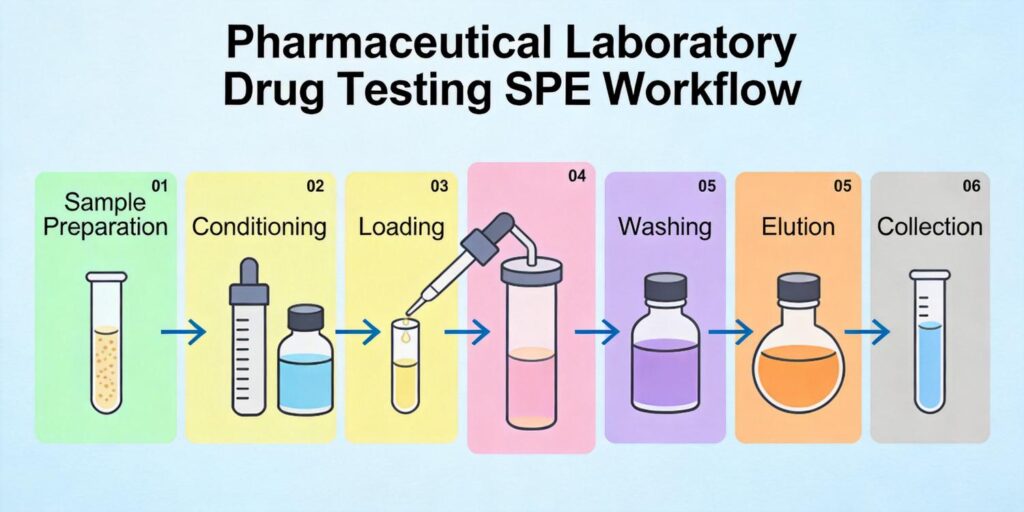
Effective SPE method development for pharmaceutical monitoring follows a systematic approach:
- Analyte Characterization: Determine structure, pKa, polarity, functional groups, and stability
- Matrix Analysis: Identify potential interferences and matrix composition
- Sorbent Selection: Choose appropriate phase based on analyte properties (reversed-phase, normal-phase, ion-exchange, or mixed-mode)
- Conditioning Optimization: Prepare cartridge with appropriate solvents
- Loading Conditions: Control flow rates (typically 1-3 drops/second for optimal recovery)
- Wash Step Development: Remove interferences without eluting analytes
- Elution Optimization: Recover analytes in smallest possible volume
Advantages Over Traditional Methods
SPE offers significant advantages over liquid-liquid extraction (LLE) for pharmaceutical monitoring:
| Parameter | Solid Phase Extraction | Liquid-Liquid Extraction |
|---|---|---|
| Throughput | Parallel processing capability | Serial processing |
| Solvent Usage | Reduced volumes (environmentally friendly) | Higher volumes |
| Recoveries | Higher and more reproducible | Variable |
| Emulsion Formation | None | Common problem |
| Selectivity | Tunable through phase selection | Limited by solvent polarity |
| Automation | Readily automated | Challenging |
Future Directions and Innovations
The future of SPE in pharmaceutical monitoring includes several promising developments:
- Miniaturization: Smaller bed mass devices for micro-volume samples
- Novel Sorbents: Broad-spectrum and high-throughput materials
- On-line Integration: Direct coupling with analytical instruments
- Specialized Phases: Covalent bonding mechanisms like immobilized phenylboronic acid
- High-Throughput Formats: 384-well plates and automated systems
As pharmaceutical research continues to develop increasingly potent drugs with complex pharmacokinetic profiles, SPE will remain essential for accurate therapeutic drug monitoring. The technique’s ability to provide clean, concentrated extracts from complex biological matrices ensures reliable quantification, ultimately contributing to improved patient outcomes through optimized drug therapy.
For laboratories seeking reliable SPE solutions for pharmaceutical monitoring, HLB SPE cartridges offer excellent performance for a wide range of pharmaceutical compounds. For basic drug applications, MCX cartridges provide mixed-mode cation exchange capabilities, while WAX cartridges are ideal for acidic compounds. High-throughput laboratories can benefit from 96-well SPE plates for efficient parallel processing.