
Importance of pKa in SPE
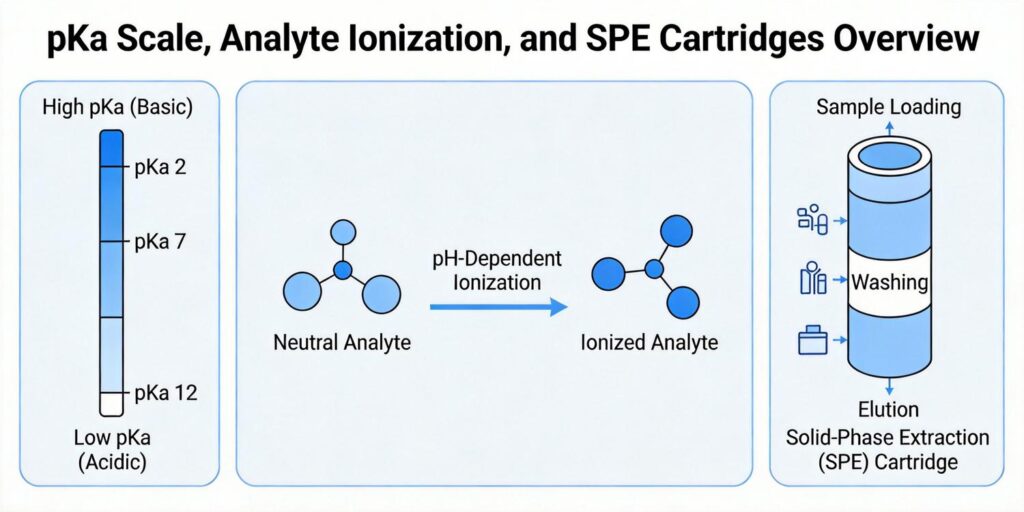
In solid-phase extraction (SPE), the acid dissociation constant (pKa) serves as the fundamental parameter governing analyte retention and selectivity. As defined in forensic SPE literature, pKa represents “the pH where half of the compound present is ionized and half non-ionized (neutral).” This seemingly simple value determines whether your extraction will achieve optimal recovery or result in breakthrough and poor cleanup.
The critical importance of pKa stems from its direct relationship to ionization state. For acidic compounds, the percentage in ionic state increases dramatically above their pKa, while basic compounds become predominantly ionized below their pKa. According to established SPE principles, “to ensure 99% or more ionization, the pH should be at least two pH units below the pKa of the cation and two pH units above the pKa of the anion.” This 2-pH-unit rule forms the cornerstone of successful ion-exchange SPE methods.
Understanding pKa values enables analytical chemists to predict analyte behavior across different pH conditions, select appropriate sorbents, and design efficient wash and elution protocols. Without this knowledge, SPE method development becomes a trial-and-error process with unpredictable results.
Ionization Principles
The foundation of pKa-based SPE lies in acid-base chemistry principles. As described in SPE literature, “an acid is a substance that donates a hydrogen ion to an acceptor substance, called a base.” The extent of dissociation for weak acids and bases is quantified by their acid dissociation constant (Ka), with pKa representing the negative logarithm of this value.
For weak acids like acetic acid (pKa 4.8), the equilibrium between protonated and deprotonated forms shifts dramatically with pH changes. At pH values 2 units above the pKa (pH 6.8 for acetic acid), approximately 99% of the molecules exist in the deprotonated, anionic form. Conversely, at pH values 2 units below the pKa (pH 2.8), about 99% remain protonated and neutral.
The titration curves for acidic and basic drugs clearly illustrate these relationships. For acidic compounds, the curve shows increasing ionization as pH rises above pKa, while basic compounds demonstrate increasing ionization as pH drops below pKa. These predictable patterns allow precise control over analyte charge state during SPE procedures.
Matching Analyte Charge with Sorbent Chemistry
Successful ion-exchange SPE requires precise alignment between analyte charge state and sorbent functionality. The fundamental principle is straightforward: “Ionic interactions occur between charged sorbent and analyte of opposite charge.” However, achieving this requires careful pH manipulation based on pKa values.
For cation-exchange extractions, negatively charged sorbents (like benzenesulfonic acid or carboxylic acid) bind positively charged analytes. Basic compounds must be protonated to carry positive charges, which occurs when the pH is at least 2 units below their pKa. Typical applications include “basic drugs, catecholamines, pharmaceuticals, herbicides, and the like.”
For anion-exchange extractions, positively charged sorbents bind negatively charged analytes. Acidic compounds must be deprotonated to carry negative charges, achieved when pH is at least 2 units above their pKa. Common applications encompass “phosphates, acidic drugs, organic acids, vitamins, and the like.”
The selection guide in Table 9 of forensic SPE literature summarizes these relationships concisely: for anion-exchange, bonding occurs at pH > analyte pKa or < sorbent pKa; for cation-exchange, bonding requires pH sorbent pKa. Elution reverses these conditions to disrupt ionic bonds.
Weak vs Strong Ion Exchange
Understanding the distinction between weak and strong ion exchangers is crucial for method optimization. As detailed in SPE references, “in the case of weak ion-exchangers, neutralization can occur on either the sorbent or the analyte of interest. Either will disrupt the bond of the desired compound. In the case of strong ion-exchangers, neutralization can occur only on the analyte.”
Strong ion exchangers maintain their charge across a wide pH range. Examples include:
- Quaternary amine (SAX): Always positively charged
- Benzenesulfonic acid (SCX): Always negatively charged
- Propylsulfonic acid (PRS): pKa < 1, effectively always charged
These sorbents provide consistent performance but require analyte neutralization for elution.
Weak ion exchangers have pKa values within the operational pH range, allowing charge modulation:
- Aminopropyl (NH2): pKa 9.8
- Diethylamino (DEA): pKa 10.6
- Carboxylic acid (CBA): pKa 4.8
Weak exchangers offer flexibility since elution can occur through either sorbent or analyte neutralization. However, they require more precise pH control during method development.
The choice between weak and strong exchangers depends on analyte properties, matrix composition, and desired selectivity. Strong exchangers often provide cleaner extracts due to their ability to withstand aggressive wash conditions.
Practical Selection Workflow
Developing an effective pKa-based SPE method follows a systematic workflow:
- Determine Analyte pKa Values: Consult reference tables (like Appendix G in forensic SPE texts) or calculate using software. For compounds with multiple ionizable groups, identify the extreme values that will dominate retention behavior.
- Assess Charge State at Sample pH: Calculate the percentage ionization at your sample matrix pH. Remember the 2-pH-unit rule for near-complete ionization.
- Select Appropriate Sorbent Chemistry:
- For acidic analytes (pKa < 7): Choose anion-exchange sorbents (SAX, WAX, NH2, DEA)
- For basic analytes (pKa > 7): Choose cation-exchange sorbents (SCX, WCX, PRS, CBA)
- For amphoteric compounds: Consider mixed-mode sorbents or pH optimization
- Optimize Loading Conditions: Adjust sample pH to ensure analyte ionization opposite to sorbent charge. For acids, set pH > pKa + 2; for bases, set pH < pKa – 2.
- Design Wash Steps: Utilize high organic content washes (up to 100% methanol or acetonitrile) to remove hydrophobic interferences while maintaining ionic bonds. “Ionic bonds are strong enough to allow the analyte to remain bound while interferences are washed away with high percentages of polar or nonpolar organic solvents.”
- Develop Elution Strategy: For strong ion exchangers, neutralize the analyte by moving pH across its pKa. For weak exchangers, either neutralize the analyte or the sorbent. Include sufficient organic modifier to overcome secondary hydrophobic interactions.
- Validate Method Performance: Assess recovery, selectivity, and reproducibility across expected concentration ranges and matrix variations.
Throughout this workflow, maintain awareness of both analyte and sorbent pKa values, as both influence retention and elution efficiency.
Example Case Studies
Case Study 1: Basic Drug Extraction from Biological Fluids
A forensic laboratory needed to extract amphetamine (pKa 9.8) from urine samples. Following the pKa-based workflow:
- Analyte classification: Basic compound (pKa > 7)
- Target charge state: Positive (cation)
- Sorbent selection: Strong cation exchanger (SCX or MCX)
- Loading pH: pH 7.8 (2 units below pKa ensures >99% protonation)
- Wash conditions: 2 mL methanol/water (50:50) to remove neutral interferences
- Elution: 2 mL ammoniated methanol (pH > 11) to neutralize amphetamine
This approach yielded >95% recovery with excellent sample cleanup, demonstrating the effectiveness of pKa-guided method development.
Case Study 2: Acidic Pharmaceutical Analysis
A pharmaceutical QC laboratory required extraction of acetylsalicylic acid (aspirin, pKa 3.5) from tablet formulations:
- Analyte classification: Acidic compound (pKa < 7)
- Target charge state: Negative (anion)
- Sorbent selection: Weak anion exchanger (WAX or NH2)
- Loading pH: pH 5.5 (2 units above pKa ensures >99% deprotonation)
- Wash conditions: 2 mL 2% formic acid in methanol to remove basic impurities
- Elution: 2 mL 5% acetic acid in methanol (pH < 2.5) to neutralize sorbent
The method provided consistent >90% recovery with minimal matrix interference, validating the pKa-based approach for acidic analytes.
Case Study 3: Mixed-Mode Extraction of Amphoteric Compound
An environmental laboratory faced challenges extracting glyphosate (pKa values: 2.0, 2.6, 5.6, 10.6) from water samples. The multiple pKa values created complex charge behavior across pH ranges:
- Strategy: Mixed-mode sorbent (combination of reversed-phase and ion-exchange)
- Loading pH: pH 3.0 (ensures net positive charge for cation-exchange retention)
- Sorbent: Mixed-mode cation exchanger (MCX)
- Wash: Sequential washes with water, methanol, and 2% formic acid in water
- Elution: 5% ammonia in methanol to disrupt both ionic and hydrophobic interactions
This comprehensive approach addressed the compound’s complex ionization profile, achieving >85% recovery with excellent selectivity against common water matrix interferences.
Conclusion
The systematic application of pKa principles transforms SPE from an empirical art to a predictable science. By understanding ionization behavior, matching analyte charge with appropriate sorbent chemistry, and implementing the 2-pH-unit rule, analytical chemists can develop robust, efficient extraction methods. Whether working with Poseidon Scientific’s MCX cartridges for basic compounds, WAX cartridges for acidic analytes, or 96-well plates for high-throughput applications, pKa-based selection ensures optimal performance across diverse analytical challenges.
Remember that successful SPE extends beyond initial sorbent selection to include proper conditioning, controlled flow rates, and appropriate wash/elution solvent selection. By integrating pKa knowledge with these practical considerations, laboratories can achieve consistent, reliable results that meet today’s demanding analytical standards.


