
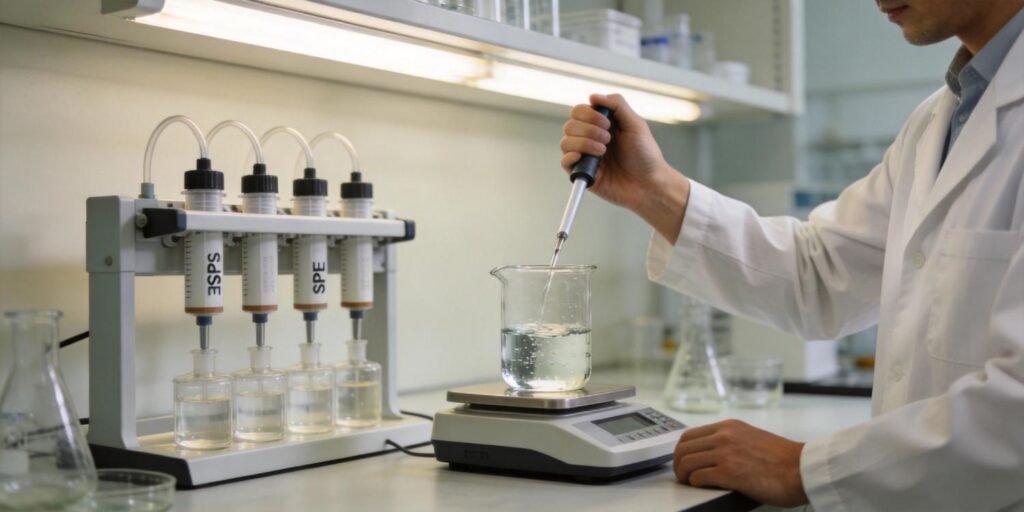
Typical Environmental Contaminants in Water Testing
Environmental water testing requires comprehensive analysis of diverse contaminants that pose risks to human health and ecosystems. The primary categories include:
Pesticides and Herbicides
Triazine herbicides (atrazine, simazine), organophosphorus pesticides, carbamates, and chlorinated pesticides are routinely monitored. Research demonstrates that solid-phase extraction enables detection at sub-parts-per-trillion levels for compounds like atrazine in water samples.
Pharmaceuticals and Personal Care Products
Emerging contaminants including antibiotics, analgesics, and endocrine disruptors require specialized extraction approaches due to their polar nature and low environmental concentrations.
Industrial Chemicals
Polychlorinated biphenyls (PCBs), polycyclic aromatic hydrocarbons (PAHs), benzene- and naphthalene-sulfonates, and phthalate esters represent persistent organic pollutants that accumulate in aquatic systems.
Heavy Metals and Inorganic Species
While not typically extracted via SPE, certain metal complexes and inorganic species can be preconcentrated using specialized sorbents or ion-exchange mechanisms.
Matrix Challenges in Water Samples
Environmental water matrices present unique analytical challenges that directly impact SPE method development:
Particulate Matter
River water, wastewater, and surface water samples often contain suspended solids that can clog SPE cartridges. Studies by Dirksen et al. (1993) demonstrated that particulate-containing water samples require careful pretreatment to prevent sorbent fouling and ensure reproducible extractions.
Dissolved Organic Matter
Humic and fulvic acids represent significant interferences in environmental water analysis. These complex organic molecules can compete with target analytes for sorbent binding sites and co-elute during extraction. Research by Senseman et al. (1995) showed that dissolved humic acid can reduce pesticide extraction efficiency by up to 30% depending on concentration and sample conditions.
Salinity and Ionic Strength
Seawater and brackish water samples contain high salt concentrations that can affect analyte retention through ionic strength effects and competition for binding sites. Albanis et al. (1997) documented how salinity influences pesticide extraction from water using SPE disks.
pH Variability
Natural water pH ranges from acidic (rainwater) to alkaline (hard water) can significantly impact the ionization state of acidic and basic compounds, affecting their retention on various sorbents.
HLB vs Ion Exchange Options for Water Analysis
Hydrophilic-Lipophilic Balance (HLB) Sorbents
HLB sorbents, such as those offered by Poseidon Scientific, represent a versatile solution for environmental water testing. These polymeric materials combine hydrophilic N-vinylpyrrolidone with lipophilic divinylbenzene, creating a balanced extraction medium suitable for a wide range of compound polarities.
Advantages for Water Testing:
- Excellent recovery for both polar and non-polar compounds
- No conditioning required for water samples
- High capacity for humic acid removal
- Suitable for large volume sampling (up to several liters)
Mixed-Mode Ion Exchange Sorbents
For targeted analysis of ionic compounds, mixed-mode sorbents provide superior selectivity:
MCX (Mixed-Mode Cation Exchange)
Combines reversed-phase retention with strong cation exchange functionality. Ideal for basic compounds including certain pharmaceuticals, amines, and cationic pesticides.
MAX (Mixed-Mode Anion Exchange)
Incorporates reversed-phase and strong anion exchange mechanisms. Excellent for acidic herbicides, phenoxy acids, and anionic pharmaceuticals.
WCX (Weak Cation Exchange) and WAX (Weak Anion Exchange)
Provide pH-dependent retention for compounds with pKa values near environmental pH ranges, offering tunable selectivity through pH adjustment.
Selection Criteria
When choosing between HLB and ion exchange options, consider:
- Analyte Polarity: HLB for broad-spectrum extraction; ion exchange for targeted ionic compounds
- Matrix Complexity: HLB for samples with high dissolved organic content; mixed-mode for cleaner matrices
- Method Requirements: Regulatory methods often specify particular sorbent chemistries
- Throughput Needs: HLB typically requires fewer conditioning steps
Workflow for Water SPE Extraction
1. Sample Preparation
Begin with filtration through 0.45-μm glass fiber filters to remove particulates. Adjust pH according to analyte characteristics—typically pH 2-3 for acidic compounds and pH 7-8 for basic compounds. For samples with high organic content, consider acidification to protonate humic acids and reduce interference.
2. Cartridge Conditioning
For traditional reversed-phase sorbents: precondition with 3-5 mL methanol followed by 3-5 mL deionized water or buffer matching sample pH. For HLB sorbents: precondition with methanol and water, though some applications may proceed without conditioning for water samples.
3. Sample Loading
Load sample at controlled flow rates of 5-10 mL/min for 6 mL cartridges, or 10-20 mL/min for larger cartridges. For large volume samples (>500 mL), consider using disk formats or multiple cartridges in series. Monitor breakthrough volumes using breakthrough curves or by analyzing sequential fractions.
4. Washing
Remove weakly retained interferences with 3-5 mL of 5-10% methanol in water. For ion exchange cartridges, use appropriate buffer solutions to remove neutral and oppositely charged interferences while retaining target analytes.
5. Drying
Apply vacuum or positive pressure for 5-10 minutes to remove residual water. For analytes prone to oxidation or degradation, consider nitrogen purge instead of vacuum drying.
6. Elution
Elute with appropriate solvent volumes (typically 2-5 mL) based on analyte solubility and sorbent characteristics. Common eluents include methanol, acetonitrile, or mixtures with acid/base modifiers for ion exchange sorbents. Collect eluate in concentrator tubes for subsequent evaporation.
7. Concentration and Reconstitution
Evaporate eluate to dryness under gentle nitrogen stream at 30-40°C. Reconstitute in mobile phase compatible solvent (typically 100-500 μL) for instrumental analysis.
Method Optimization Tips
1. Breakthrough Volume Determination
Establish breakthrough volumes for each analyte under your specific conditions. Load sequential fractions of sample and analyze each to determine when analytes begin to elute. This ensures you don’t exceed cartridge capacity and lose target compounds.
2. pH Optimization
For ionizable compounds, optimize sample pH to maximize retention. For acidic compounds (pKa 3-5), adjust to pH 2-3 to ensure protonation. For basic compounds (pKa 8-10), adjust to pH 9-10 to ensure neutral form. Use buffer systems rather than simple acid/base addition to maintain consistent pH.
3. Flow Rate Control
Maintain consistent flow rates during loading and elution. Higher flow rates can reduce recovery due to insufficient contact time, while excessively slow rates may cause channeling. Automated systems provide superior reproducibility compared to manual vacuum manifolds.
4. Solvent Selection
Choose elution solvents based on analyte polarity and subsequent analytical technique. For GC analysis, consider ethyl acetate or hexane-based mixtures. For LC analysis, methanol or acetonitrile with appropriate modifiers often works best. Include acid or base in elution solvents for ion exchange cartridges to disrupt ionic interactions.
5. Matrix Effect Evaluation
Evaluate matrix effects by comparing calibration curves prepared in solvent versus matrix-matched standards. Use standard addition or isotope-labeled internal standards to compensate for suppression/enhancement effects in mass spectrometry.
6. Cartridge Format Selection
Choose appropriate cartridge sizes based on sample volume and analyte concentration. For high-throughput applications, consider 96-well SPE plates from Poseidon Scientific, which offer excellent reproducibility and compatibility with automated systems.
7. Quality Control Implementation
Include procedural blanks, matrix spikes, and duplicate samples in each batch. Use surrogate standards (compounds similar to target analytes but not found in environmental samples) to monitor extraction efficiency throughout the process.
8. Method Validation
Validate optimized methods according to relevant guidelines (EPA, ISO, etc.). Determine method detection limits, precision, accuracy, and robustness under varying sample conditions. Document all optimization parameters for future reference and regulatory compliance.
By understanding the specific challenges of environmental water matrices and selecting appropriate SPE technologies, laboratories can achieve reliable, sensitive detection of contaminants at environmentally relevant concentrations. The combination of HLB sorbents for broad-spectrum extraction and mixed-mode ion exchange cartridges for targeted analysis provides a comprehensive toolkit for modern environmental monitoring programs.


