The Critical Role of Conditioning in Solid-Phase Extraction
Solid-phase extraction (SPE) represents one of the most powerful sample preparation techniques in analytical chemistry, enabling scientists to reduce chromatographic complexity, increase signal-to-noise ratios, improve detection limits, minimize matrix effects, concentrate analytes of interest, and enhance analytical robustness. At the heart of every successful SPE protocol lies a seemingly simple yet profoundly important step: conditioning. This initial preparation of the sorbent bed determines the success or failure of the entire extraction process, making solvent selection for conditioning a critical decision point for analytical chemists.
Why Conditioning Matters: More Than Just Wetting
Conditioning serves multiple essential functions that extend far beyond simply wetting the sorbent. When SPE columns are shipped dry for stability and packaging reasons, the bonded functional groups exist in a collapsed, aggregated state that minimizes their exposure to the environment. For hydrophobic phases like C18, this creates a situation where the hydrocarbon moieties cluster together, much like oil droplets in water, resulting in minimal surface area available for analyte interaction.
The conditioning process fundamentally changes this configuration. By applying an appropriate solvent, the functional carbon chains extend away from the solid surface, creating a receptive stationary phase on the silica or polymer backbone. This expansion exposes binding sites to the diffusive flow of samples and reagents, dramatically increasing the available surface area for analyte retention. Without proper conditioning, sample capacity can be severely reduced, leading to poor recoveries and inconsistent results.
Solvent Compatibility with Different Sorbent Types
Reversed-Phase Sorbents (C18, C8, HLB)
For traditional silica-based reversed-phase sorbents like C18, conditioning is absolutely essential. These materials become “waterproof” when silica particles are bonded with hydrophobic phases and must be conditioned to interact efficiently with aqueous samples. The standard approach involves passing methanol or a similar solvent through the sorbent bed, which penetrates into the bonded layer and permits water molecules and analytes to diffuse into the bonded phase.
However, a significant advancement came with the introduction of water-wettable polymeric sorbents like Oasis HLB in 1996. Constructed with a water-wettable copolymer stable from pH 0-14, Oasis HLB created new possibilities by eliminating the conditioning and equilibration steps required by other polymeric and silica-based sorbents. This water-wettable nature allows direct loading of aqueous samples without sacrificing recovery, representing a breakthrough in SPE technology.
Mixed-Mode Sorbents (MCX, MAX, WCX, WAX)
Mixed-mode sorbents that combine reversed-phase and ion-exchange functionality require more nuanced conditioning approaches. For these materials, conditioning typically involves both organic solvent and appropriate buffer solutions to ensure optimal pH conditions for the desired ionic interactions. The Oasis family of mixed-mode sorbents includes:
- Oasis MCX: Mixed-mode Cation eXchange for bases (pKa ~6)
- Oasis MAX: Mixed-mode Anion eXchange for acids (pKa ~5)
- Oasis WCX: Mixed-mode Weak Cation eXchange for strong bases and quaternary amines (pKa >10)
- Oasis WAX: Mixed-mode Weak Anion eXchange for strong acids (pKa <1)
For ion-exchange columns, it’s crucial to apply buffer after the initial organic solvent flush to ensure the sorbent pH is optimal for the desired sorbent-analyte interaction.
Common Conditioning Solvents and Their Properties
The choice of conditioning solvent depends on several key characteristics that determine its effectiveness:
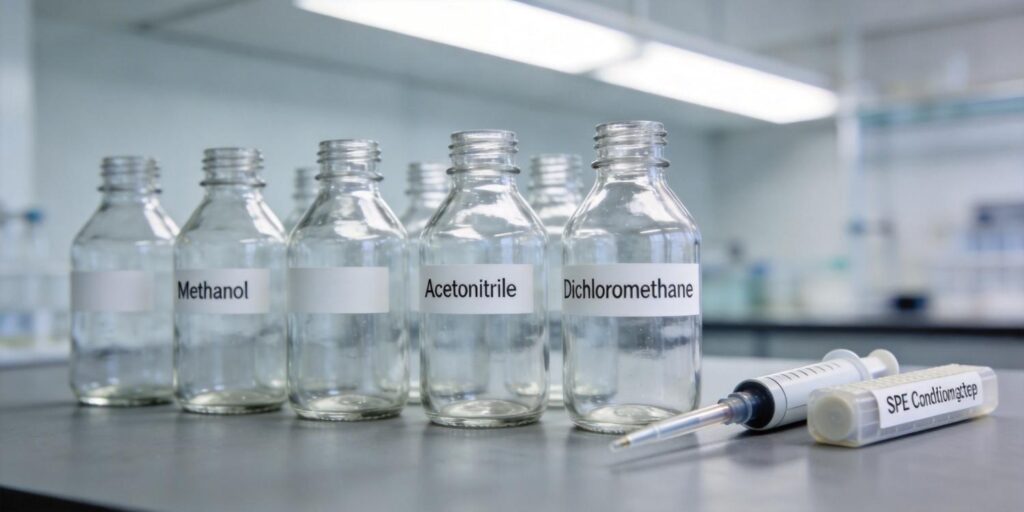
Methanol: The Workhorse Solvent
Methanol is frequently used in reversed-phase procedures because it meets all the conditions for an effective conditioning solvent:
- Complete miscibility with aqueous matrices: Essential for subsequent sample loading
- Low surface tension (0.6 cp at 20°C): Allows easy diffusion into sorbent pores
- High mass transfer with sorbent alkyl chains: Effectively expands the functional groups
- Universal elution capability: Removes polar and nonpolar contaminants from improperly purified sorbents
Methanol wets the surface of the sorbent and penetrates bonded alkyl phases, allowing water to wet the silica surface efficiently. Its relatively low viscosity (0.6 centipoise at 20°C) compared to other alcohols like ethanol (1.2 cp) and isopropanol (2.37 cp) means it flows faster through the sorbent bed, improving processing efficiency.
Acetonitrile: The Alternative Choice
Acetonitrile (E₀ = 0.65) offers different solvation properties that can be advantageous in certain applications. While methanol has an elutropic value of 0.95 relative to alumina, acetonitrile’s different polarity profile makes it particularly useful for conditioning when dealing with specific analyte classes. Research has shown that methanol and acetonitrile can have remarkably different abilities to elute compounds from conventional C18 sorbents, suggesting the presence of analyte-sorbent polar interactions that are interrupted more effectively by methanol.
Isopropanol: The Surface Tension Match
Isopropanol presents an interesting case for conditioning hydrocarbon-like C18 silica sorbents. With a surface tension of 20.93 mN/m, it’s the closest of commonly used alcohols to that of hexane (19.65 mN/m), which resembles the sorbent surface in some respects. Isopropanol is completely miscible with hexane, whereas methanol is only partially miscible, making it potentially more effective for certain sorbent types.
Other Conditioning Solvents
Additional solvents that can serve as conditioning agents include:
- Tetrahydrofuran (E₀ = 0.45): Useful for more polar bonded phases
- Acetone (E₀ = 0.56): Effective for preliminary cleanup of sorbents
- Methylene chloride (E₀ = 0.42): Can extract impurities from improperly purified sorbents
Effects on Analyte Retention and Recovery
The conditioning solvent plays a crucial role in determining the extraction properties of a sorbent. In thermodynamic terms, the interfacial surface tension must be reduced using a solvent having solubility in both the solid surface and the bulk sample liquid. This allows penetration of the sorbent pores by the aqueous sample and improves the kinetics of partitioning.
Research has demonstrated that different conditioning solvents can lead to significantly different recovery rates. For example, studies have shown that methanol can give recoveries of up to 98% for certain tertiary nitrogen bases, while acetonitrile may show no elution power at all for the same compounds. This difference suggests the presence of polar regions in C18 sorbents capable of binding basic compounds, which are more effectively disrupted by methanol’s proton-donating properties.
The extent of conditioning—the opening of the clustered structure—depends on both the polarity of the conditioning solvent and the bonded organic group. The ideal situation occurs when the sorbent is completely open so maximum interaction can take place between the solute and the bonded organic moiety. This configuration can result from using less polar conditioning solvents than methanol, such as acetonitrile or even tetrahydrofuran, provided they maintain water miscibility.
Practical Troubleshooting Tips for Conditioning
Volume and Flow Rate Considerations
Proper conditioning requires attention to both solvent volume and flow rate. At low vacuum (approximately 3 in. Hg), add 1.5 mL of methanol or acetonitrile per 100 mg of sorbent. Release the vacuum or begin flushing immediately on completion, as the more air that passes through the column before sample loading, the less solvated the sorbent will be.
Apply deionized or distilled water to remove excess solvent, which would otherwise interfere with hydrophobic binding. Use 1 mL of water per 100 mg of sorbent. Momentary high vacuum (5-8 in. Hg) may be necessary to restart flow, but generally, flow rates between 0.5 and 3.0 mL/min are acceptable to allow sufficient solvent-sorbent contact without causing channeling.
Avoiding Channeling and Sorbent Drying
Channeling occurs when excessive vacuum or pressure causes liquids to take the path of least resistance, forming tunnels in the sorbent bed. This significantly reduces available surface area for sample contact and recovery. To prevent channeling:
- Maintain moderate flow rates (0.5-3.0 mL/min)
- Avoid excessive vacuum or pressure
- Don’t allow the sorbent to dry between conditioning and sample loading
If you suspect the sorbent has dried or too much time has passed between conditioning steps, simply start over to resolvate. However, if channels have formed due to high flows or excessive drying, reconditioning will not correct the problem.
Special Considerations for Different Applications
For ion-exchange procedures: After the initial organic solvent flush, apply 1 mL of buffer to ensure optimal pH for sorbent-analyte interactions.
For disk-type columns: These have evolved in part to overcome channeling problems and may require different conditioning approaches.
When converting methods: When switching from silica-based sorbents to water-wettable polymers like Oasis HLB, remember that you can eliminate conditioning steps entirely, reducing solvent consumption by up to 70% and saving 40% in sample preparation time.
Quality Control Indicators
Proper conditioning should result in:
- Consistent, even flow through the sorbent bed
- No air bubbles or dry spots visible in the sorbent
- Reproducible recovery rates across multiple extractions
- Minimal variability in analytical results
The Future of Conditioning: Water-Wettable Technologies
The development of water-wettable sorbents like Oasis HLB and Oasis PRiME HLB represents a significant advancement in SPE technology. These materials eliminate the need for conditioning and equilibration steps while maintaining high capacity for extremely polar compounds and compatibility with solvents across the entire pH range (0-14).
Oasis PRiME HLB was specifically designed to make solid-phase extraction easy to implement into routine laboratory use by providing generic, simple methods that remove 95% of common matrix interferences such as phospholipids, fats, salts, and proteins. It produces clean sample eluates with a simple, two- or three-step protocol without requiring conditioning steps.
Conclusion
Conditioning solvents play a fundamental role in determining the success of solid-phase extraction procedures. The choice between methanol, acetonitrile, isopropanol, or other solvents depends on the sorbent type, analyte characteristics, and specific application requirements. While traditional silica-based sorbents require careful conditioning to achieve optimal performance, modern water-wettable polymeric sorbents offer simplified protocols that eliminate these steps without sacrificing recovery or cleanliness.
Understanding the principles behind conditioning—from solvent-sorbent interactions to flow rate optimization—empowers analytical chemists to troubleshoot problems, optimize methods, and achieve consistent, reliable results. Whether working with traditional reversed-phase materials or advanced mixed-mode sorbents, proper conditioning remains a cornerstone of effective sample preparation in analytical chemistry.
For laboratories looking to streamline their SPE workflows, exploring water-wettable technologies like those offered in our HLB SPE cartridges and 96-well SPE plates can provide significant time and solvent savings while maintaining excellent analytical performance.