Purpose of Wash Step in SPE
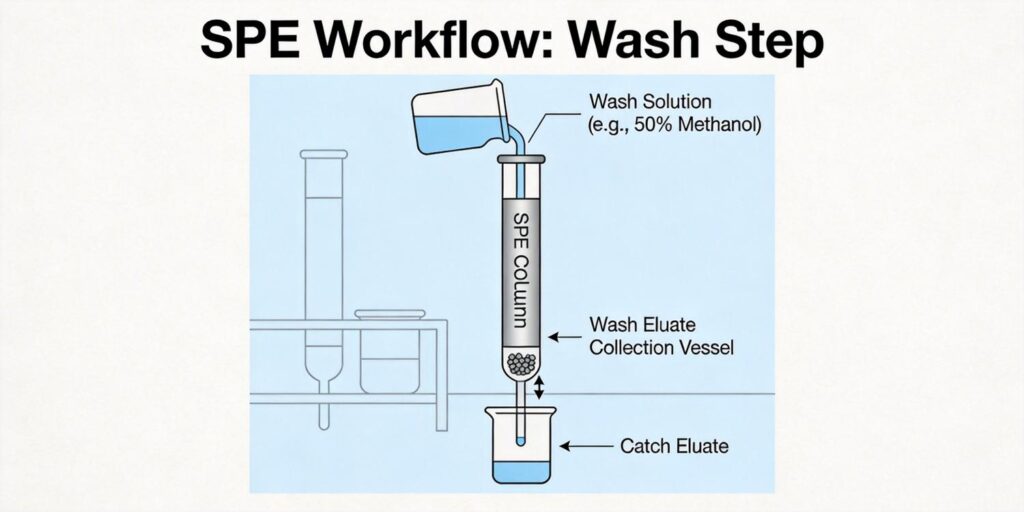
The wash step in solid-phase extraction (SPE) serves as a critical purification phase that bridges sample loading and analyte elution. According to established SPE principles, this step “removes excess sample matrix and unretained compounds” while selectively eliminating weakly bound interferences without displacing target analytes. The wash solvent acts as a displacer for unwanted materials while preserving the desired compounds on the sorbent bed.
In practical terms, the wash step accomplishes three primary objectives:
- Matrix Component Removal: Eliminates salts, proteins, carbohydrates, and other sample matrix constituents that could interfere with downstream analysis
- Selective Cleanup: Removes compounds with similar chemical properties to the analyte but weaker retention characteristics
- Preparation for Elution: Creates optimal conditions for subsequent analyte recovery by removing solvents incompatible with the elution step
As noted in forensic applications, “ideal washing removes as many interferences as possible while retaining the analyte(s)” – a balance that requires careful optimization to achieve both high recovery and clean extracts.
Solvent Strength Considerations
Solvent strength represents the most critical parameter in wash step optimization. The fundamental principle states that wash solvents should be “stronger than the sample matrix, but weaker than needed to remove compounds of interest.” This delicate balance ensures that interferences are eliminated while analytes remain bound to the sorbent.
Eluotropic Series and Solvent Selection
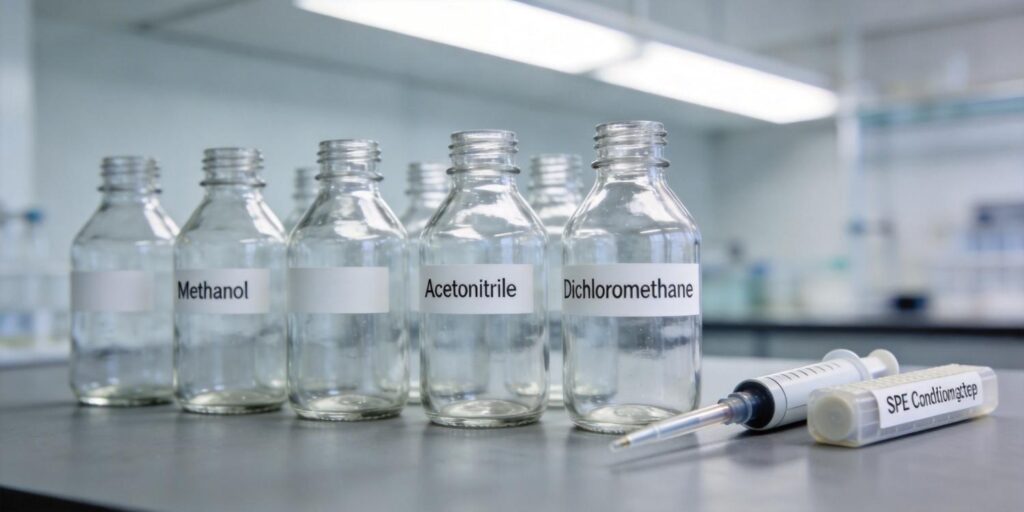
For reversed-phase SPE applications, solvents follow an approximate eluotropic strength order: water (weakest) < methanol < acetonitrile < acetone < ethyl acetate < methylene chloride < hexane (strongest). However, practical considerations often limit choices to water-miscible solvents like methanol and acetonitrile for aqueous sample cleanup.
Gradient Approach to Optimization
Research demonstrates that systematic testing of solvent mixtures yields optimal results. A recommended approach involves “increasing concentrations of methanol or acetonitrile in water” typically in 10% increments from 100% water through to 100% methanol. This gradient method allows identification of the maximum solvent strength that doesn’t cause analyte breakthrough.
Special Considerations for Different SPE Modes
- Reversed Phase: Use aqueous-organic mixtures with increasing organic content
- Ion Exchange: Can tolerate high percentages (up to 100%) of polar or nonpolar organic solvents while maintaining ionic retention
- Mixed-Mode: May require sequential washes targeting different retention mechanisms
As documented in method development literature, “pure acetonitrile or even pure methanol as washing solutions” can sometimes provide dramatic purity improvements when analytes are completely insoluble in these solvents.
Removing Matrix Interference
Matrix interference removal represents the core challenge in SPE wash optimization. Interferences are defined as “components from your sample that inhibit the ability to accurately quantitate the component(s) of interest.” These can include endogenous compounds, sample additives, degradation products, or co-extracted substances with similar chemical properties.
Strategies for Persistent Interferences
When standard wash protocols fail to eliminate persistent interferences, several advanced strategies have proven effective:
- Solvent Insolubility Approach: Test solvents in which the analyte is completely insoluble as wash candidates. As noted in optimization literature, “If the analyte is completely insoluble in a solvent, then that solvent should be tested as a wash solvent if improved clean-up is required.”
- pH Manipulation: Adjust wash pH to selectively remove ionizable interferences while maintaining analyte retention. For ion exchange applications, maintain conditions “2 pH units from the relevant pKa of your analyte and sorbent” to preserve ionic interactions.
- Sequential Washes: Implement multiple wash steps with different solvent compositions targeting specific interference classes. However, researchers caution that “complicated washing regimes rarely result in dramatic purity improvements” and should be simplified where possible.
- Alternative Sorbents: Consider different sorbent chemistries or manufacturers when interference patterns persist. Different sorbents may exhibit varying selectivity toward specific interference classes.
Flow Rate Considerations
Wash flow rate significantly impacts interference removal efficiency. “Diffusion between the packing material and the rinse reagent may be enhanced at slower flow rates.” Optimization experiments should test flow rates to identify the optimal balance between thorough washing and practical processing times.
Example Optimization Strategies
Case Study: Pharmaceutical Compound from Plasma
A documented optimization experiment for drug extraction from plasma illustrates systematic wash optimization. Researchers mixed 0.5 mL plasma with aqueous diluent, applied to preconditioned C8 extraction discs, then tested wash solvents with increasing methanol concentrations (0-100% in 10% increments). The sorbent was washed twice with 2 mL water followed by 0.5 mL of the methanol-water mixture being tested.
Results showed that methanol concentrations up to 30% removed interferences without significant analyte loss, while higher concentrations began to elute the target compound. This approach identified the optimal wash composition that maximized cleanup while maintaining >90% recovery.
Systematic Optimization Protocol
For method developers, the following systematic approach ensures comprehensive wash optimization:
- Initial Screening: Test water-only wash to establish baseline recovery and interference profile
- Solvent Strength Gradient: Evaluate methanol-water or acetonitrile-water mixtures in 10% increments
- pH Variation: For ionizable compounds, test wash pH variations while maintaining ionic retention conditions
- Volume Optimization: Determine minimum effective wash volume (typically 1-5 mL depending on cartridge size)
- Flow Rate Testing: Evaluate impact of flow rate on interference removal and recovery
- Validation: Test optimized conditions with multiple sample replicates and matrix variations
Practical Tips for Efficient Optimization
- Use Matrix-Containing Samples: “Optimization experiments may begin with either aqueous solution or the matrix of interest. The latter is highly recommended” as matrix components dramatically influence retention properties
- Monitor Multiple Parameters: Assess both recovery (via spiked samples) and interference removal (via blank samples)
- Consider Final Analysis Requirements: Ensure wash solvents are compatible with downstream analytical techniques
- Document Systematically: Maintain detailed records of all optimization experiments for method validation and troubleshooting
Advanced Techniques for Challenging Applications
For particularly complex samples, additional strategies may be necessary:
- Selective Desorption: Use sequential washes with carefully controlled solvent strengths to fractionate interference classes
- Back-Extraction: Implement liquid-liquid extraction steps before or after SPE for additional cleanup
- Dual-Cartridge Approaches: Use tandem SPE cartridges with complementary selectivities
- Temperature Control: Moderate temperature variations can enhance selectivity in some applications
Successful wash optimization ultimately balances multiple factors: achieving sufficient interference removal for accurate quantitation, maintaining acceptable analyte recovery, ensuring method robustness, and meeting practical constraints of time and cost. As emphasized in forensic applications, “recovery is a balance between sensitivity and selectivity” – the optimal wash protocol achieves this balance for each specific application.
For comprehensive SPE solutions including HLB, MAX, MCX, WAX, and WCX cartridges, visit our SPE products page. Our 96-well SPE plates offer high-throughput options for automated applications requiring consistent wash optimization across multiple samples.