What is Channeling in SPE Cartridges?
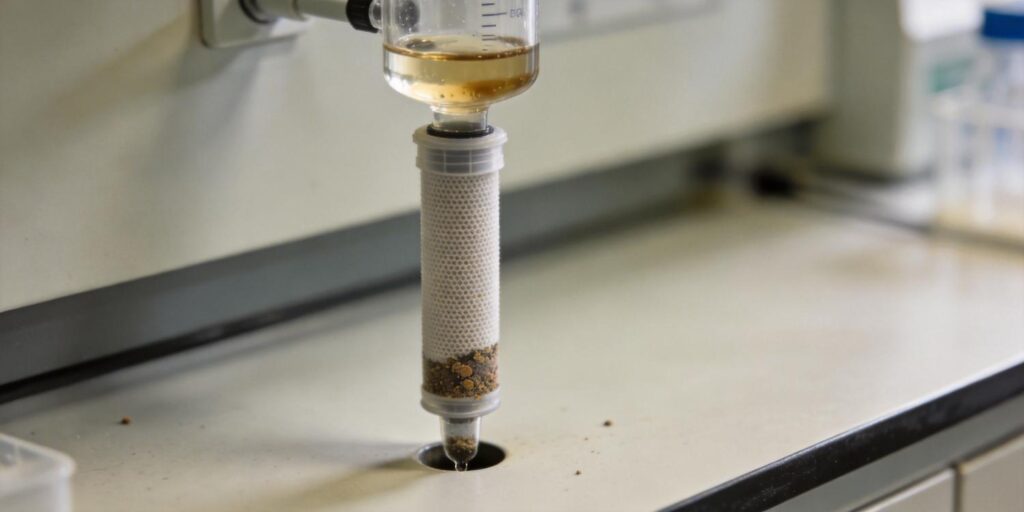
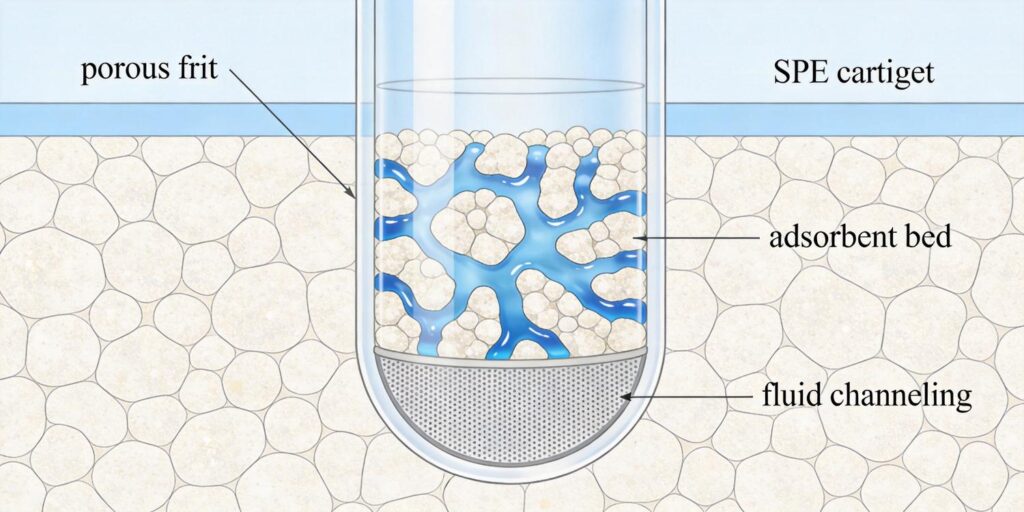
Channeling in solid phase extraction (SPE) cartridges refers to the formation of tunnels or pathways through the sorbent bed where liquids flow preferentially, bypassing the majority of the stationary phase. This phenomenon occurs when excessive vacuum or pressure is applied during conditioning or sample loading steps, causing liquids to take the path of least resistance through the sorbent bed.
According to forensic and clinical SPE literature, channeling is detrimental to extraction efficiency and recovery because it significantly reduces the available surface area for sample contact. In essence, sorbent capacity is dramatically reduced since only a portion of the sorbent is effectively solvated and utilized. Recovery suffers further because successive liquid steps will also flow faster through these channels, reducing contact time for effective mass transfer between the sample and sorbent.
While channeling is undesirable, it’s important to note that it’s “not likely to occur in properly packed columns provided moderate care is taken during conditioning steps.” The key is maintaining appropriate flow rates between 0.5 and 3.0 mL/min to allow sufficient solvent-sorbent contact for solvation without causing channeling.
Packing Issues Leading to Channeling
Manufacturing and Assembly Variations
SPE cartridge manufacturing processes can significantly influence channeling susceptibility. Procedures for assembly of SPE cartridges vary considerably between manufacturers. While machine or automated packing processes tend to be more uniform, variations can still occur from day to day. Many SPE columns, particularly specialty phases, are frequently hand-packed, introducing operator variation into the equation.
Quality assurance departments typically rely on spot-checking assembled cartridges at various intervals, but not all manufacturers routinely check flow parameters. This variability in manufacturing quality can lead to inconsistent performance across different lots of cartridges.
Sorbent Particle Distribution
The particle size distribution of sorbent materials plays a crucial role in flow characteristics. Histograms of particle size distribution can reveal evidence of “fines”—particles significantly smaller than the average particle size for a given batch. If the particle distribution is too wide (resulting in a higher number of fines), restricted or irregular flows may result.
Fines that are actually smaller than the frit pore diameter can escape the columns and contaminate eluates, appearing as a white crystalline residue in elution tubes after drydown. This indicates excessive fines in the column and potential flow problems.
Frit Quality and Design
Frits hold the sorbent in place at the top and bottom of the sorbent bed and are critical components in preventing channeling. The pore sizes of frits should be carefully selected based on both the sample matrix and the size of molecules being extracted. If frit pore diameter is not uniform or is inappropriate for the application, restricted flow can occur.
Frits cut from sheets of polyethylene can have rough or unevenly cut edges that allow liquids to channel down the sides of the column rather than through the sorbent bed. This can also allow sorbent itself to leak out during shipping or handling, reducing expected column capacity.
The type of frit used affects flow properties significantly. Polyethylene frits are characteristically hydrophobic and naturally resistant to aqueous phases. Glass-weave frits are available that are hydrophilic and subsequently less resistant to aqueous samples, though they come at higher cost.
Packing Density Issues
Columns that are packed too tightly will produce more restrictive flows, while columns not packed tightly enough can experience flows that are too fast. The packing density determines measured capacity, recovery, and flow rate of an SPE device. Automatic machines that pack and assemble SPE cartridges can achieve high precision (<1% relative standard deviation) in sorbent mass and packing density, but column-to-column variability can still occur due to machinery variability and particle segregation tendencies.
Flow Rate Problems and Channeling
Excessive Flow Rates During Conditioning
Channeling most commonly occurs during the conditioning step when excessive vacuum or pressure is applied. The conditioning or solvation process facilitates extension of functional carbon chains, creating a receptive stationary phase on the silica or resin backbone. Insufficient solvation can occur if too little solvent is applied, or more often if the solvent is swept too quickly through the sorbent bed.
Excessive flow creates insufficient contact for adequate H-C interaction to occur. When excessive vacuum or pressure is applied to SPE columns, liquids will take the path of least resistance, forming channels or tunnels in the sorbent bed. This reduces available surface area for sample contact and significantly diminishes sorbent capacity.
Flow Source Problems
Flow problems may also occur from insufficient force to initiate and maintain flow necessary for the particular matrix or column configuration. Insufficient or poorly regulated vacuum is a typical cause of flow problems. Reasons for insufficient vacuum can include weak vacuum sources—sink-type aspirator sources usually don’t have sufficient vacuum force to pull and hold a seal on most vacuum chambers.
Electrical vacuum pumps can also lack sufficient torr force, depending on tube length (from source to chamber), the size of the vacuum chamber, the number of samples being processed, and the matrix viscosity. Conversely, too much vacuum can collapse tubing and impede flow. Bad seals or warped heads on the manifold can allow leaks to occur and result in low vacuum.
Matrix-Related Flow Issues
Flow problems are more often a factor of the matrix being analyzed. Extremely viscous samples, or samples with high amounts of particulates, can clog both frits and sorbent pores. There are generally two ways to alter flow characteristics of “difficult” samples: either change the matrix or change the column.
If the matrix is viscous or contains particulates, fibrin, mucus, proteins, or other cellular components, you can alter the matrix by diluting, filtering, centrifuging, and sonicating the sample, or by precipitating proteins. You can also alter column characteristics by going to a larger sorbent particle and/or pore size, increasing the sorbent surface area (larger diameter column), decreasing the sorbent bed depth, or increasing the frit pore diameter or changing the frit type (hydrophobicity).
How to Avoid Channeling in SPE Cartridges
Optimal Flow Rate Control
The most effective way to prevent channeling is to maintain appropriate flow rates throughout the SPE process. Generally, flow rates between 0.5 and 3.0 mL/min are acceptable to allow sufficient solvent-sorbent contact for solvation without causing channeling. It’s not necessary to keep solvent continually on the sorbent provided low flow rates are maintained.
Drying of sorbent beds requires elevated flows for at least 5-10 minutes, but judicious attention to conditioning steps will prevent channeling and ensure effective solvation of the sorbent. If you’ve walked away from the manifold and feel too much time has passed between conditioning steps, simply start over to resolvate. However, if channels have formed due to high flows or excessive drying, reconditioning will not correct the problem.
Proper Conditioning Techniques
Conditioning of solid phase sorbents serves several functions, including activating sorbent functional groups by applying a suitable wetting agent. The purpose is to expand the functional binding sites away from the solid surface, exposing them to the diffusive flow of the sample and reagents. Characteristics of a good wetting or solvation solvent include:
- Miscibility with aqueous matrices (sample and buffers)
- Easy diffusion into sorbent pores (low surface tension)
- High mass transfer of HCl bonds with sorbent alkyl chains (expands chains)
- Universal elution of polar and nonpolar contaminants on sorbent (also fines)
Methanol is frequently used in reversed phase procedures because it meets all these conditions.
Consider Alternative SPE Formats
Disk-type columns have evolved in part to overcome channeling problems. Because of reduced bed depths and rigid supports, channeling does not occur even at higher flow rates. This makes disks ideal for larger sample volumes by allowing higher flows and reducing the time to draw the sample through the column.
Environmental applications have used disk sorbents for processing liter volumes of water. Disk cartridges are finding their way into pharmaceutical and drug testing because they also offer the advantages of using less solvents for processing. While capacity can be an issue, the solid, porous nature of disc-based sorbents prevents the channeling problems common in conventional packed beds.
Positive Pressure Systems
Positive pressure sources, in which the sample is pushed through from the top of the cartridge rather than pulled from the bottom, can provide more precise flow control and appear less prone to flow difficulties. Positive pressure manifolds are available on the market, and most automated SPE systems utilize positive pressure.
Studies have shown that sorbent bed compression by plungers in high-quality cartridges with sorbents of narrow particle size ranges results in less channeling of fluids through the sorbent bed and therefore more reliable stationary phase-mobile phase interactions.
Sample Preparation and Matrix Modification
Often the easiest solution to matrix flow problems is to dilute the sample. Dilution of dense or viscous samples with water or an appropriate buffer will very often improve flow characteristics. Changing the surface area will also affect flow characteristics—spreading the sample over a larger surface by using a wider-diameter cartridge will sometimes improve flow. Conversely, a narrower column may improve deficiencies in the flow source and facilitate better flow.
Changing the depth of the sorbent bed may also impart different flow dynamics. Similar to HPLC, the packing diameter and length relates to the amount of backpressure present in the system. A good guideline is to use the least amount of sorbent that provides sufficient capacity for your target compounds and matrix, packed in a cartridge suitable for your sample volume.
Quality Cartridge Selection
When selecting SPE cartridges, consider products from manufacturers with rigorous quality control processes. Certified SPE products manufactured under strict performance and cleanliness specifications ensure that detection limits and performance of analytical methods won’t be compromised by interfering substances commonly found in SPE hardware.
Look for manufacturers that test for contaminants including hydrocarbons and other environmental contaminants, sorbent functionality (ligand density, particle size distribution, surface activity), chromatographic performance, frit and barrel dimensional tolerance, and consistent sample flow characteristics.
By understanding the causes of channeling and implementing these preventive measures, laboratories can significantly improve SPE recovery rates, reproducibility, and overall analytical performance. Proper technique combined with quality SPE products from reputable manufacturers like Poseidon Scientific ensures reliable extractions without the channeling problems that compromise analytical results.