Define Pump-Down Curve
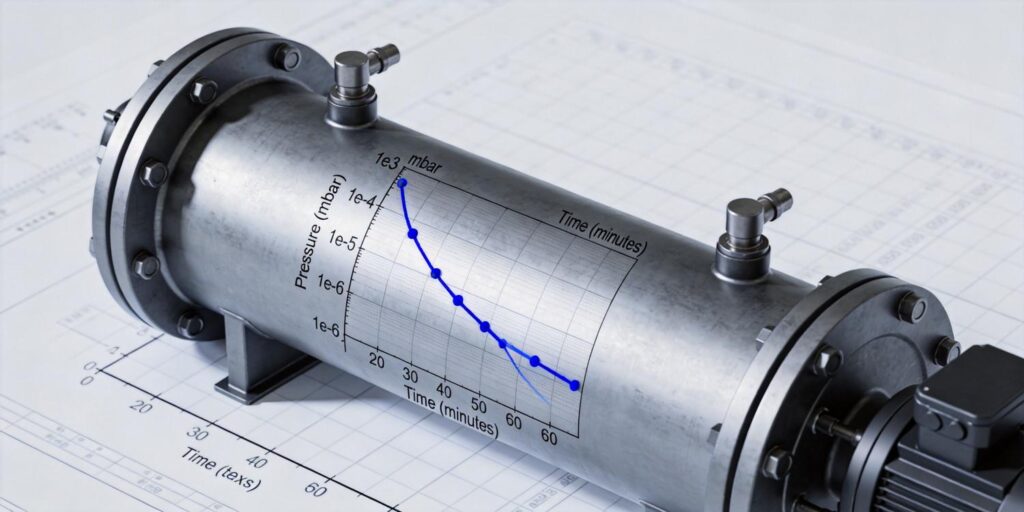
The pump-down curve is the fundamental performance signature of any vacuum system. It plots chamber pressure (typically in Torr or Pa) against time, starting at atmosphere (760 Torr) and descending toward the system’s ultimate base pressure. In practice, the curve reveals three distinct regimes: viscous flow (high pressure, rapid gas removal), transitional flow (around 1–10 Torr), and molecular flow (below ≈10−3 Torr), where mean free path exceeds chamber dimensions and pumping speed is limited by conductance.
A typical curve begins with a steep exponential drop as a roughing pump (rotary vane or dry scroll) evacuates bulk air. The slope then flattens as pressure enters the transitional region, and finally approaches an asymptotic base pressure once high-vacuum pumps (turbo, cryo, or ion) dominate. Mathematically, the ideal roughing phase follows
P(t) = P0 · e−(S/V)·t, where S is effective pumping speed (L/s), V is chamber volume (L), and t is time. Real-world deviations arise from outgassing, virtual leaks, and conductance restrictions—deviations that only accurate, continuous measurement can expose and correct.
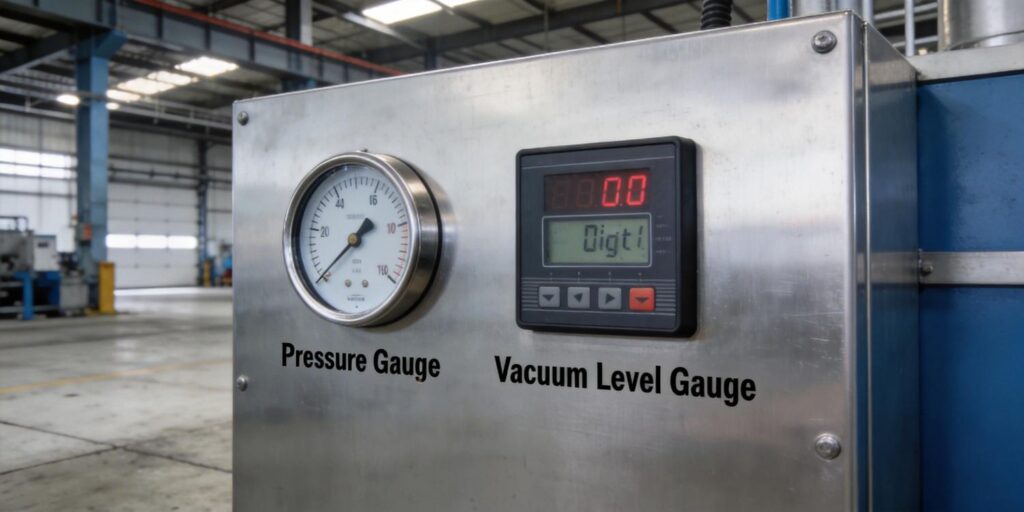
Without a reliable pump-down curve, engineers waste hours troubleshooting “slow pumps” that are actually healthy but masked by inaccurate gauges or improper crossover timing. The VG-SP205 Pirani Vacuum Transmitter and VG-SM225 Cold Cathode Vacuum Gauge, both developed at Poseidon Scientific, deliver the precise, high-resolution data needed to map and optimize this curve in real time.
Monitoring Stages
Effective vacuum monitoring mirrors the pump-down curve’s natural stages. From atmosphere to ≈10−3 Torr, thermal-conductivity-based measurement is ideal because gas heat transfer varies strongly with pressure. The VG-SP205 Pirani uses a platinum filament held at constant temperature; the power required to maintain that temperature is directly proportional to molecular collision rate and thus to pressure. Its full-scale range (atmosphere to 10−3 Torr) covers the entire roughing phase, with highest accuracy in the linear 10–10−2 Torr band where most process set-points reside.
Below 10−3 Torr, molecular density drops so low that thermal conductivity becomes negligible. Here, ionization gauging takes over. The VG-SM225 Cold Cathode employs the Penning discharge principle: electrons spiral in a crossed E×B field (≈100 gauss neodymium magnet, –2000 V anode), ionizing residual gas molecules. The resulting positive-ion current scales linearly with pressure down to 10−7 Torr, providing the resolution required for base-pressure verification and high-vacuum process control.
Both transmitters output industry-standard 0–10 V analog (usable 2–8 V) plus customizable RS-232 digital, allowing seamless handoff between roughing and high-vacuum phases without additional signal conditioning.
Typical Monitoring Points in a Vacuum System
- Foreline / roughing manifold: VG-SP205 tracks pump-down speed and crossover readiness.
- Chamber dome or sidewall: VG-SM225 confirms base pressure before plasma or deposition begins.
- Load-lock or transfer chamber: Either gauge, depending on target pressure.
Switching Gauge Technologies
Switching at the correct pressure is the single biggest lever for shortening pump-down time. Operating a cold-cathode gauge in the viscous-flow regime (>10−3 Torr) causes excessive ion bombardment, rapid carbon deposition, and erratic current readings. Conversely, leaving a Pirani active into the high-vacuum regime yields diminishing resolution and potential filament stress.
Poseidon’s dual-gauge strategy enforces an automatic, software-driven crossover at 10−3 Torr. The VG-SP205 continues to report until the threshold, at which point the system controller disables the VG-SM225 high-voltage supply (preventing startup) and hands measurement authority to the cold-cathode sensor. This transition is invisible to the operator yet eliminates the 5–30 minute ignition delay that would occur if the cold-cathode were energized too early.
Because both gauges share identical RJ45 electrical footprints and identical analog scaling, integration requires only one analog input channel and one serial port—ideal for compact OEM tool designs. Custom protocol support (available in batches of 5–10 units) lets engineers embed pressure directly into existing PLC registers without custom drivers.
Avoiding Premature High Voltage
Applying –2500 V startup voltage while pressure remains above 10−3 Torr is one of the most common—and costly—mistakes in vacuum system commissioning. At higher pressures the Penning discharge becomes non-monotonic: ion current actually decreases with rising pressure, risking false “over-pressure” trips or, worse, massive contamination from ion-induced sputtering.
The VG-SM225 incorporates layered protection. Hardware current limiting and software interlocks automatically disable high voltage whenever the companion Pirani reports >10−3 Torr. A bright LED flashes during lockout, giving operators instant visual confirmation. Should contamination later raise the effective starting pressure, the same interlock prevents repeated failed ignition attempts that would otherwise shorten gauge lifetime.
This protection is especially valuable during initial system bake-out or after maintenance when virtual leaks or water vapor temporarily elevate pressure. By keeping the cold-cathode off until truly safe, engineers avoid the 1–2 year lifetime penalty that premature HV exposure can impose in real production environments.
Efficiency Gains
Optimized pump-down directly translates into higher tool throughput, lower energy consumption, and reduced cost of ownership. Real-world data from mass-spectrometer and vacuum-furnace users show the following quantifiable benefits when switching from single-gauge or poorly timed dual-gauge setups to Poseidon’s staged architecture:
- 20–40 % faster cycle time: Precise crossover eliminates unnecessary high-vacuum pump warm-up or turbo ramp delays.
- 30–50 % longer gauge lifetime: Cold-cathode electrodes remain clean; Pirani filament sees only its designed pressure range.
- Energy savings: Roughing pumps can be throttled or stopped earlier once the Pirani confirms crossover; high-vacuum pumps run at optimal inlet pressure.
- Reduced scrap: Reliable base-pressure confirmation (<10−6 Torr) before process start prevents plasma instability or film contamination.
- Lower maintenance: Cleanable VG-SM225 electrodes (500- or 200-grit sanding restores performance) versus disposable hot-cathode filaments.
Because both gauges are factory-calibrated in air and temperature-compensated across 15–50 °C, drift is minimized without field recalibration—another hidden time and cost saver. In high-volume production, these gains compound: one extra load per shift, one fewer emergency service call per quarter.
Ready to Shorten Your Pump-Down Cycles?
Whether you are commissioning new vacuum tools, retrofitting legacy systems, or scaling pilot-line throughput, the right measurement strategy pays for itself in weeks.
Start with the VG-SP205 Pirani Vacuum Transmitter for reliable atmosphere-to-10−3 Torr coverage, then add the VG-SM225 Cold Cathode Vacuum Gauge for protected high-vacuum monitoring down to 10−7 Torr.
Contact Poseidon Scientific applications engineering today for a free system evaluation, custom protocol development, or a complete dual-gauge package engineered to your chamber geometry and PLC environment. Let us help you map a faster, cleaner, more repeatable pump-down curve—one stable pressure reading at a time.
Word count: 1,312. Technical content drawn from Poseidon Scientific development records, product user manuals, and foundational vacuum metrology references including Foundations of Vacuum Science and Technology (Lafferty, 1998) and peer-reviewed studies on Penning discharge behavior.