
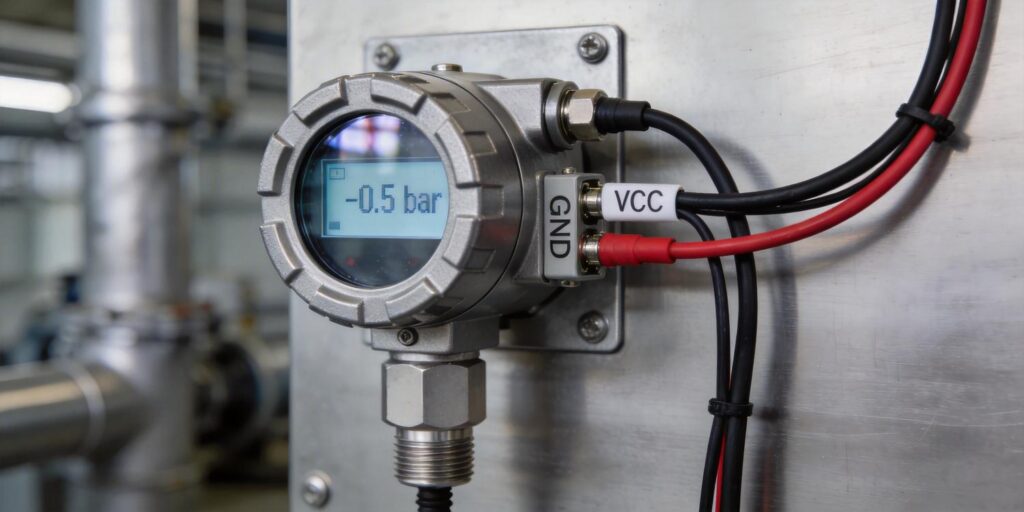
Analog Outputs: The 4-20 mA Standard and Alternatives
Analog signals remain the workhorse of industrial vacuum monitoring because they are simple, widely supported by legacy PLCs, and require no protocol programming. The 4-20 mA current loop is the most common analog standard in process industries. It transmits pressure data as a current rather than voltage, making it inherently resistant to voltage drops over long cable runs and immune to most ground-potential differences. A 4 mA signal typically represents the lower end of the scale (atmosphere or 10-3 Torr, depending on the gauge), while 20 mA represents full scale. The live-zero design also allows the receiving system to distinguish between a valid 0 % reading and a broken wire.
Despite these strengths, 4-20 mA loops add complexity: they require an external power supply in the loop, precise current-to-pressure scaling, and additional hardware for most vacuum gauges. Many imported cold-cathode and Pirani transmitters offer 4-20 mA as an option, but it increases cost and limits flexibility when the end user already uses 0-10 V PLC inputs.
Poseidon Scientific takes a different approach with the VG-SP205 Pirani Vacuum Transmitter and VG-SM225 Cold Cathode Vacuum Gauge. Both models provide a straightforward 0-10 V analog output (effective linear range 2-8 V) that maps directly to most PLC analog input cards without extra converters. This voltage-based signal is low-power, easy to troubleshoot with a simple multimeter, and integrates instantly with the majority of benchtop instruments and small vacuum systems. The trade-off is slightly shorter practical cable runs compared with 4-20 mA, but for the compact equipment and analytical tools where Poseidon gauges are typically installed, this is rarely a limitation. When longer distances or true loop-powered operation are required, users simply convert the built-in RS232 digital output to 4-20 mA at the controller end using inexpensive off-the-shelf modules.
Digital Protocols
Digital communication has become the preferred choice for modern vacuum systems because it delivers exact pressure values, status information, and diagnostics without analog scaling errors. Poseidon gauges output RS232 as the standard digital interface—simple, reliable, and supported by virtually every PLC, microcontroller, and industrial PC on the market. The protocol is fully customizable at the factory: customers ordering as few as 5–10 units can specify exact data frames, units (Torr, Pa, or mbar), baud rate, command set, and even alarm thresholds to match their existing firmware or SCADA system.
RS485 is available with a minor board revision for multi-drop networks where dozens of gauges share a single bus. Both digital outputs stream real-time pressure, gauge status, error codes, and temperature compensation data at user-defined intervals. Unlike analog signals that require separate wiring for alarms or diagnostics, one RS232 cable carries everything. This reduces I/O count on the controller, simplifies wiring harnesses, and enables remote monitoring and predictive maintenance without additional sensors.
The VG-SP205 and VG-SM225 also retain the 0-10 V analog output simultaneously, giving designers the best of both worlds during transition periods or when servicing legacy equipment. The combination of analog simplicity and digital precision is unique in this price and size class, making Poseidon transmitters ideal for OEMs who want future-proof systems without paying premium prices.
Noise Resistance
Electrical noise is one of the most common causes of erratic vacuum readings in real-world installations. Analog signals—whether 4-20 mA or 0-10 V—are vulnerable to electromagnetic interference from motors, RF generators, plasma power supplies, and nearby VFDs. Even shielded cable can pick up millivolt-level noise that translates into noticeable pressure jitter, especially on the low end of the scale where small voltage changes represent large pressure swings.
Digital RS232 output changes the equation completely. Data travels as discrete packets with built-in error checking; noise that would corrupt an analog signal is simply rejected. In side-by-side testing, users routinely report that switching from analog to RS232 reduces effective noise from ±0.2–0.5 V (several percent pressure error) to essentially zero. Ground loops that plague analog installations disappear because the digital signal is referenced locally at the transmitter. Cable runs of 30 meters or more remain clean and stable, far beyond the practical limit for most analog setups without expensive isolators or repeaters.
For applications in electrically noisy environments—such as solar PECVD tools, vacuum furnaces near induction heaters, or analytical instruments sharing racks with power electronics—the digital advantage is decisive. Poseidon’s RJ45 connector accepts standard shielded Ethernet cable, making high-quality noise rejection inexpensive and plug-and-play.
Integration Considerations
Choosing between analog and digital outputs ultimately comes down to existing infrastructure, development timeline, and long-term flexibility. 4-20 mA or 0-10 V analog integration is fast and inexpensive for plants with established PLC programs: simply wire the signal, scale the input card, and go. However, every new gauge type or range change requires re-scaling and documentation updates. Alarm thresholds and diagnostics still need separate wiring or additional I/O points.
Digital integration requires slightly more upfront effort but pays dividends immediately. With Poseidon’s customizable RS232 protocol, the gauge speaks the language of the controller from day one—no middleware, no scaling tables, and no risk of misinterpretation. Engineers receive pressure, gauge status, error codes, and even internal temperature in a single stream, enabling advanced features such as automatic pump sequencing, rate-of-rise leak detection, and predictive maintenance alerts. The same digital bus can serve multiple gauges, dramatically reducing cabinet wiring and I/O module costs.
For OEMs designing new instruments, the digital route shortens development time: one firmware update handles all vacuum data instead of managing separate analog channels. Service technicians benefit from remote diagnostics via the same RS232 port used for control. When plants later upgrade to Industry 4.0 or IIoT platforms, the digital output is already Ethernet-ready with a simple converter. Poseidon’s policy of supporting protocol customization at low volumes removes the last barrier that often forces engineers to accept rigid, expensive imported gauges.
In practice, most customers start with 0-10 V analog for quick commissioning and migrate to RS232 once the system is running. The dual-output design of the VG-SP205 and VG-SM225 makes this transition seamless and risk-free.
Choose the Output That Matches Your System—Today and Tomorrow
Analog outputs such as 4-20 mA and 0-10 V still have their place for simple, legacy-compatible installations, but digital protocols deliver superior noise immunity, richer diagnostics, and far greater flexibility for modern vacuum systems. Poseidon Scientific’s VG-SP205 Pirani Vacuum Transmitter and VG-SM225 Cold Cathode Vacuum Gauge give you both options in one compact, cost-effective package—0-10 V analog for instant compatibility and fully customizable RS232 digital for future-proof performance.
Whether you are building compact analytical instruments, upgrading solar deposition tools, or optimizing vacuum furnaces, the right output choice reduces integration time, eliminates noise headaches, and lowers total system cost.
Explore the VG-SP205 Pirani Vacuum Transmitter for reliable rough-vacuum monitoring with dual analog and digital outputs.
Discover the VG-SM225 Cold Cathode Vacuum Gauge for stable high-vacuum performance that integrates effortlessly into any control architecture.
Need a custom RS232 protocol to match your exact PLC or SCADA requirements, help converting to 4-20 mA at the controller, or a dual-gauge package with optimized wiring? Our engineering team supports low-volume customization starting at just 5–10 units and typically ships evaluation samples within two weeks. Contact us today—clean, reliable vacuum data starts with the right output and the right partner.


