
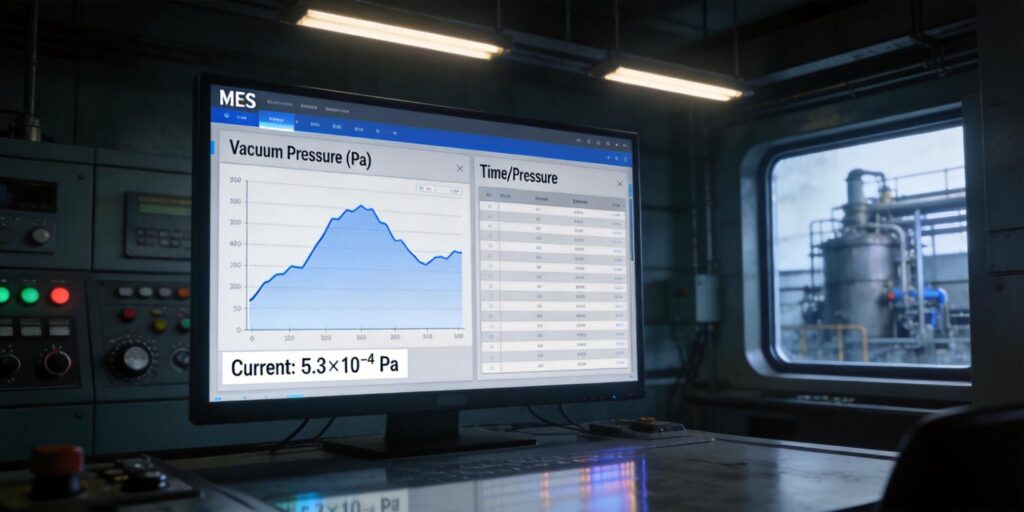
In today’s smart factories, Manufacturing Execution Systems (MES) serve as the digital backbone that connects shop-floor equipment to enterprise resource planning (ERP) and quality management platforms. For vacuum-dependent processes—whether in semiconductor fabrication, pharmaceutical lyophilization, vacuum metallurgy, or thin-film coating—real-time pressure data is not optional; it is a critical production parameter that directly affects yield, purity, and regulatory compliance. Poseidon Scientific’s VG-SP205 Pirani Vacuum Transmitter and VG-SM225 Cold Cathode Vacuum Gauge are purpose-built for seamless MES integration. With native RS232 digital output, a compact 9-byte data frame, built-in error diagnostics, and free protocol customization for orders of five units or more, these transmitters deliver the precise, traceable, and actionable vacuum data that modern MES platforms demand—at one-third the cost of imported equivalents.
This article explains how to integrate Poseidon vacuum gauges into MES environments, from data mapping and logging to alarm workflows and real-world ROI. Whether you are specifying instrumentation for a new smart manufacturing line or retrofitting legacy vacuum tools, the VG-SP205 and VG-SM225 provide a future-proof foundation for Industry 4.0 compliance and operational excellence.
Manufacturing Execution Systems Overview
Manufacturing Execution Systems collect, analyze, and control real-time production data across the shop floor. In vacuum-intensive industries, MES platforms (such as Siemens Opcenter, Rockwell FactoryTalk MES, or open-source solutions like Apache Kafka-based systems) track key process variables including chamber pressure, pump-down curves, crossover timing, and sensor health. Accurate vacuum data feeds directly into:
- Batch traceability and electronic batch records (EBR)
- Statistical process control (SPC) charts
- Automated recipe execution and interlocks
- Predictive maintenance and OEE calculations
- Regulatory compliance reporting (GMP, ISO 9001, NADCAP, SEMI)
Legacy analog-only gauges force expensive middleware or manual data entry, creating gaps in traceability and increasing validation burden. Poseidon transmitters eliminate these pain points with a native digital interface that speaks the language of MES: structured, checksum-protected data frames delivered every 100 ms. Both the VG-SP205 (atmosphere to 10⁻³ Torr) and VG-SM225 (10⁻³ to 10⁻⁷ Torr) share identical RJ45 connectors, 0–10 V analog backup, and the same protocol structure, allowing a single MES tag database to serve every gauge on the line.
The result is a unified vacuum data stream that flows directly into the MES historian without custom drivers or additional hardware in most installations.
Data Mapping
Effective MES integration begins with clean, consistent data mapping. The Poseidon RS232 protocol uses a fixed 9-byte frame that is intentionally self-describing and easy to parse in any MES environment. A typical mapping to MES variables looks like this:
| Byte | Content | MES Tag Example | Usage in MES |
|---|---|---|---|
| 0 | Frame length (fixed 7) | Vacuum_Frame_Length | Integrity check |
| 1 | Page/command echo (fixed 5) | Vacuum_Command_Echo | Protocol verification |
| 2 | Status (unit + health bits) | Vacuum_Status_Bits | Pressure unit (Torr/mbar/Pa) and operational mode |
| 3 | Error code (0–255) | Vacuum_Error_Code | Filament open (129), discharge failure (128), etc. |
| 4–5 | Pressure value (high/low byte) | Vacuum_Pressure_Value | Real-time pressure (calculated via factory formula) |
| 6 | Software version | Vacuum_FW_Version | Firmware traceability |
| 7 | Sensor type | Vacuum_Sensor_Type | Pirani (10) or Cold Cathode (11) |
| 8 | Checksum/reserved | Vacuum_Checksum | Frame validation before processing |
Because the protocol is fully open and customizable at no charge for qualifying orders, many customers request pre-mapped Modbus RTU registers or direct JSON payloads that match their MES historian schema. The 100 ms update rate comfortably exceeds typical MES scan cycles, while the built-in checksum ensures only valid data is logged—critical for audit trails in regulated industries.
Analog 0–10 V (effective 2–8 V measurement window) provides a simple fallback for older MES I/O modules, with 0–1.9 V and 8.1–10 V reserved for explicit error signaling that triggers the same workflows as the digital error codes.
Pressure Logging for Traceability
Traceability is non-negotiable in semiconductor, pharmaceutical, and aerospace supply chains. MES platforms must store every batch’s vacuum history with timestamp, gauge ID, and sensor health status. Poseidon transmitters make this effortless:
- Every 100 ms frame contains the exact pressure value, pressure unit, and sensor health byte.
- The digital checksum guarantees data integrity before the MES historian commits the record.
- Error codes (filament open on Pirani, discharge failure on cold cathode) are logged as discrete events with precise timestamps.
- Software version and sensor type bytes provide full device traceability for change-control documentation.
In practice, customers map the pressure value and error code directly to the MES batch record. During a pharmaceutical lyophilization run, the system automatically logs the entire pump-down curve, crossover timing, and secondary-drying pressure plateau—data that satisfies FDA 21 CFR Part 11 and EMA requirements without manual transcription. In semiconductor PVD tools, the same logs feed SPC charts that correlate chamber pressure stability with film uniformity, enabling rapid root-cause analysis when yield excursions occur.
The removable sensor head on the VG-SM225 further simplifies traceability: when cleaning is performed, the MES logs the maintenance event and confirms restored performance through the next pressure reading—no recalibration or requalification needed.
Alarm Workflow
MES platforms excel at turning raw data into automated actions. Poseidon gauges feed directly into these workflows through both analog error voltages and digital error codes:
- Detection: Analog output drops to 0–1.9 V or digital error code 128/129 is received.
- Immediate response: MES pauses the current recipe step, closes high-vacuum valves, and disables heaters or sources to protect the process and equipment.
- Notification: The system generates an alarm ticket, sends SMS/email to the on-call engineer, and logs the event with gauge serial number and pressure at the moment of failure.
- Recovery path: For cold-cathode discharge failure, the MES can automatically attempt re-ignition once pressure falls below 10⁻³ Torr (leveraging the gauge’s built-in firmware logic).
- Root-cause closure: Maintenance logs the cleaning or replacement event; the MES verifies restored operation before releasing the chamber for production.
This closed-loop workflow reduces mean-time-to-repair from hours to minutes and prevents out-of-spec product from advancing downstream. Many customers request free firmware customization that adds a dedicated “system-healthy” bit or expanded alarm severity levels, making integration with their specific MES alarm matrix even simpler.
Industrial Example
A leading Chinese semiconductor equipment OEM integrated Poseidon gauges into a new 300 mm PVD cluster tool line in 2025. Each process chamber required continuous vacuum monitoring from atmosphere to 10⁻⁷ Torr for both load-lock and deposition steps. The previous imported gauge solution demanded expensive custom drivers and separate analog modules for the MES (Siemens Opcenter).
The new architecture used one VG-SP205 Pirani on the roughing manifold and one VG-SM225 Cold Cathode on the chamber sidewall per module. RS232 data fed directly into the MES via a standard serial gateway with free custom Modbus mapping. Key outcomes after six months of 24/7 production:
- Pressure data now populates the MES historian with 100 % traceability for every wafer lot.
- Discharge-failure alarms trigger automatic maintenance tickets, reducing unplanned downtime by 35 %.
- Yield improved 12 % through tighter pressure control during the critical deposition phase.
- Total gauge hardware cost per tool dropped from 85 000 RMB to 28 000 RMB, with zero additional integration expense.
The same configuration is now the standard offering across the OEM’s entire product portfolio, proving that full MES integration is both technically straightforward and commercially compelling.
Integrate Vacuum Data into Your MES Today
The VG-SP205 Pirani Vacuum Transmitter and VG-SM225 Cold Cathode Vacuum Gauge transform vacuum pressure from an isolated sensor reading into a fully integrated MES variable—complete with traceability, real-time alarms, and predictive maintenance signals. With native digital output, identical interfaces, free protocol customization, and error signaling that matches modern MES expectations, these transmitters simplify compliance, accelerate troubleshooting, and protect product quality without inflating project budgets.
Whether you are deploying a new smart manufacturing line, upgrading legacy vacuum tools, or expanding an existing MES footprint, Poseidon’s gauges provide the reliable, cost-effective foundation your system needs.
Explore the VG-SP205 Pirani Vacuum Transmitter and VG-SM225 Cold Cathode Vacuum Gauge today. Need a sample MES data-mapping template, Modbus register list, custom firmware worksheet for your specific MES platform, or a no-obligation dual-gauge demo kit with pre-configured gateway? Contact our applications team directly—we respond within 24 hours and have helped OEMs and manufacturers worldwide achieve seamless vacuum integration into their MES environments with zero data gaps and immediate compliance benefits.


