Challenges of Soil Matrices in Solid Phase Extraction
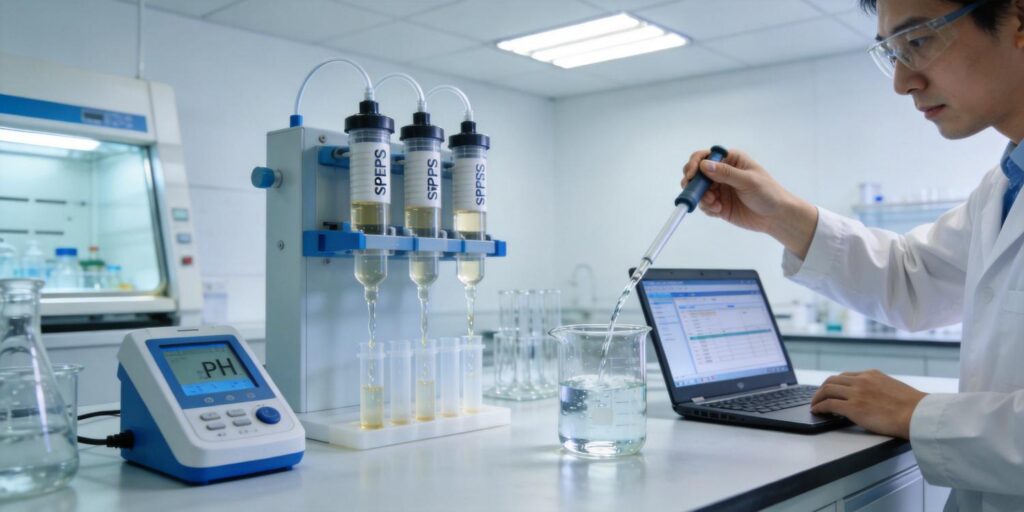
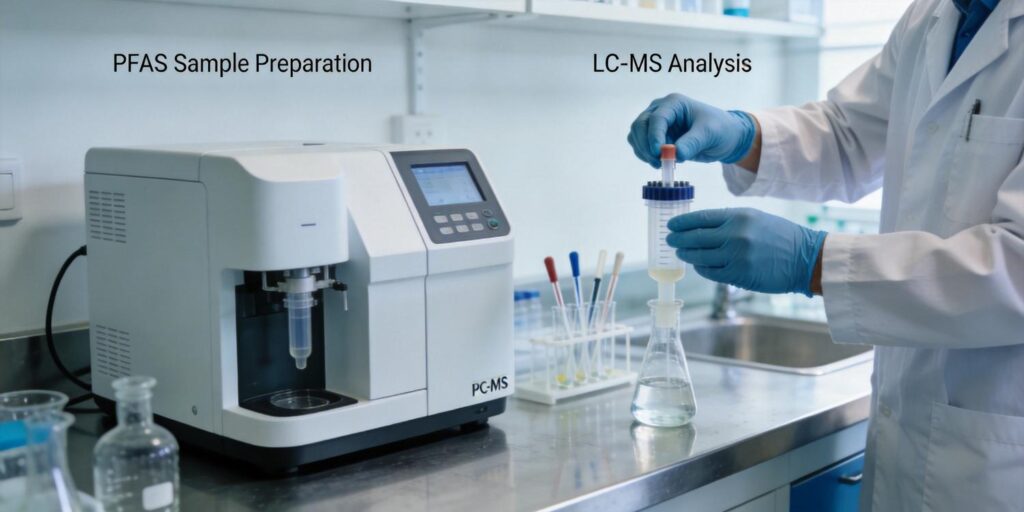
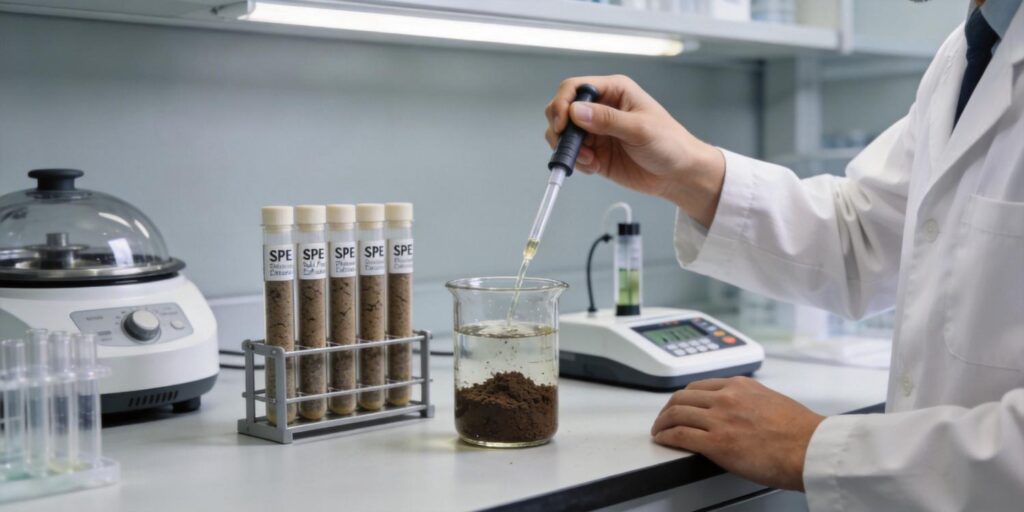
Soil samples present some of the most complex challenges for analytical chemists working with Solid Phase Extraction (SPE). Unlike clean aqueous samples, soil matrices contain a heterogeneous mixture of organic and inorganic components that can interfere with analyte recovery and complicate the extraction process.
Complex Matrix Composition
Soil matrices typically contain humic and fulvic acids, inorganic particulates, sulfurous compounds, and biological debris. As noted in environmental chemistry literature, “Even with careful selection of the primary extraction mechanism, considerable additional clean-up is often required prior to analysis” (Simpson, 2000). The presence of these components means that simple SPE methods often provide only partial cleanup, requiring additional purification steps.
Analyte Binding and Liberation Challenges
A prerequisite for successful SPE extraction of soil samples is the liberation of analytes from the solid matrix into a liquid form. This often requires physical manipulation such as Soxhlet extraction, homogenization in extraction buffers, or other mechanical treatments. The challenge lies in selecting conditions that minimize co-extraction of biological debris and inorganic matrix components while maximizing analyte recovery.
Particulate and Organic Matter Interference
Environmental samples may contain inorganic, organic, and/or biological particulates that can bind pollutants reversibly or irreversibly. Unlike dissolved organic matter, particulates can often be removed prior to SPE analysis through filtration or centrifugation. However, as research has shown, when dealing with sediment or soil extracts, “centrifugation and/or centrifugation followed by filtration reduced plugging SPE discs” (Wells et al., 1995).
Dissolved Organic Matter Interactions
Early in the development of SPE for environmental applications, analysts recognized both the pitfalls and benefits of interactions between dissolved organic matter (DOM) and SPE sorbents. Organic pollutants and metals are known to bind to DOM such as humic or fulvic acids, creating complexes that may bind differently to sorbents under various analytical conditions. This presents challenges in determining whether to measure total toxicants or only the portion that could leach into water supplies.
Extraction Methods for Soil Samples
Several extraction methods have been developed specifically for soil matrices, each with its own advantages and limitations.
Soxhlet Extraction
Traditional Soxhlet extraction remains a standard method for soil analysis, particularly for exhaustive extraction of samples. However, as noted in regulatory methods, “a Soxhlet extraction is used. The extract is rich in humic and fulvic acids, and may also contain a high level of sulfurous compounds and other inorganics” (U.S. EPA Contract Laboratory Program, 1990). The resulting extracts often require multiple cleanup steps including gel permeation chromatography, desulfurization, and additional contaminant removal procedures.
Toxicity Characteristic Leaching Procedure (TCLP)
For environmental chemists facing the philosophical dilemma of whether to measure total toxicants or only leachable fractions, the TCLP approach offers a practical solution. This method involves “tumbling of the sample in an aqueous medium, or alternatively the passage of water through the sample, and extraction of the resulting leachate using LLE or SPE” (Crepeau, 1991). This approach focuses on the portion of contaminants that could potentially enter water supplies.
Solid-Phase Extraction Integration
SPE can be integrated with other extraction techniques to enhance soil sample preparation. For example, supercritical fluid extraction (SFE) can be used to elute analytes from SPE cartridges, providing better elution than typical liquid eluents in some cases. As research demonstrates, “SFE elution of SPE devices can provide better elution of analytes than is given by typical liquid eluents” (Wolfe et al., 1995).
Matrix Solid-Phase Dispersion (MSPD)
MSPD represents an alternative approach to traditional grinding and liquid-solid separation methods. This technique, along with SFE, has been applied to solid or viscous liquid samples as alternatives to conventional sample preparation methods, bringing distinct advantages and challenges that are addressed in specialized literature.
SPE Cleanup Workflow for Soil Samples
Developing an effective SPE cleanup workflow for soil samples requires careful consideration of multiple factors, from initial sample preparation to final elution.
Initial Sample Preparation
Before SPE can be applied, soil samples must be converted to a liquid form. This typically involves:
- Sample Disruption: Physical disruption through mincing, maceration, or mechanical blending
- Chemical Treatment: Enzymatic digestion, acid/base hydrolysis, or detergent treatment to disrupt cellular structures
- Solvent Extraction: Incorporation of organic solvents to liberate analytes from the solid matrix
As noted in analytical literature, “Most of these processes disrupt the structure of the sample as well as its cellular components, but they are often not very efficient” (Simpson, 2000).
Particulate Removal Strategies
For samples containing high particulate loads, several strategies have proven effective:
- Prefiltration: Step-wise filtration through glass-fiber filters (e.g., 0.7 μm followed by 0.45 μm)
- Filter Aids: Use of glass wool, glass beads, or diatomaceous earth (Hydromatrix®) to reduce SPE disc plugging
- Centrifugation: Particularly effective for sediment or soil extracts to reduce plugging of SPE devices
SPE Method Development Strategy
Successful SPE method development for soil samples follows a systematic approach:
- Research the Problem: Review previous SPE and analysis conditions for the analyte and matrix
- Characterize the Analyte: Determine structure, pKa, polarity, functional groups, solubility, and stability
- Characterize the Sample Matrix: Identify possible interferences, pH, ionic strength, and variability
- Select SPE Mode: Choose between analyte adsorption (for preconcentration) or matrix adsorption (for cleanup)
Fundamental SPE Steps
The core SPE process involves five essential steps:
- Conditioning: Prepare the cartridge with methanol or similar solvent followed by water or buffer
- Loading: Transfer the sample in a form compatible with SPE
- Washing: Remove unwanted materials with solvents that won’t elute the analyte
- Elution: Recover analytes in the smallest possible volume of appropriate solvent
- Concentration: Further concentrate the eluate if necessary using techniques like Kuderna-Danish concentration
Environmental Applications of SPE for Soil Analysis
SPE has found widespread application in environmental soil analysis, particularly for regulatory monitoring and research purposes.
Regulatory Monitoring Applications
Environmental agencies worldwide have adopted SPE-based methods for soil analysis. The U.S. Environmental Protection Agency’s Statement of Work for determination of chlorinated pesticides and other chlorinated organic species in sludge and soil samples incorporates SPE as part of a comprehensive cleanup strategy. While historically SPE using Florisil cartridges has been used for only part of the potential cleanup role, modern applications demonstrate more comprehensive utilization.
Pollutant Monitoring
SPE enables the monitoring of various environmental pollutants in soil matrices:
- Pesticides and Herbicides: Monitoring of atrazine, simazine, and other agricultural chemicals
- Chlorinated Compounds: Analysis of chlorinated pesticides and organic species
- Polycyclic Aromatic Hydrocarbons (PAHs): Identification of oxygenated PAHs in contaminated soils
- Heavy Metals: Determination of lead and other metals through SPE-FAAS combinations
Research Applications
Beyond regulatory monitoring, SPE supports various research applications:
- Binding Constant Determination: Using SPE to determine binding constants for DOM-pollutant interactions
- Fate and Transport Studies: Investigating how pollutants move through soil systems
- Remediation Assessment: Evaluating the effectiveness of soil remediation techniques
- Ecological Risk Assessment: Determining bioavailability of contaminants in soil ecosystems
Advantages Over Traditional Methods
SPE offers several advantages over traditional liquid-liquid extraction (LLE) for soil analysis:
- Improved Throughput: Parallel processing capabilities versus serial LLE
- Reduced Solvent Usage: Decreased organic solvent consumption and waste generation
- Higher Recoveries: More reproducible and higher analyte recoveries
- Cleaner Extracts: Reduced contamination from solvent impurities
- Tunable Selectivity: Ability to select specific SPE phases and solvent mixtures
- Automation Compatibility: Readily automated for high-throughput applications
Future Directions
The application of SPE to soil analysis continues to evolve with several promising developments:
- Advanced Sorbent Materials: Development of specialized sorbents for specific soil contaminants
- Integrated Techniques: Combining SPE with SFE, MSPD, and other extraction methods
- Automation and High-Throughput: Implementation of 96-well plate systems and automated workstations
- Miniaturization: Development of smaller bed masses for smaller sample volumes
- Green Chemistry Approaches: Minimization of organic solvents and waste generation
As environmental regulations become more stringent and analytical requirements more demanding, SPE will continue to play a crucial role in soil analysis. The technique’s versatility, combined with ongoing advancements in sorbent technology and method development, ensures its position as an essential tool for environmental chemists working with complex soil matrices.
For laboratories seeking reliable SPE solutions for soil analysis, HLB SPE cartridges, MAX SPE cartridges, and MCX SPE cartridges offer specialized capabilities for different analyte classes. For high-throughput applications, 96-well SPE plates provide efficient processing of multiple samples simultaneously.