
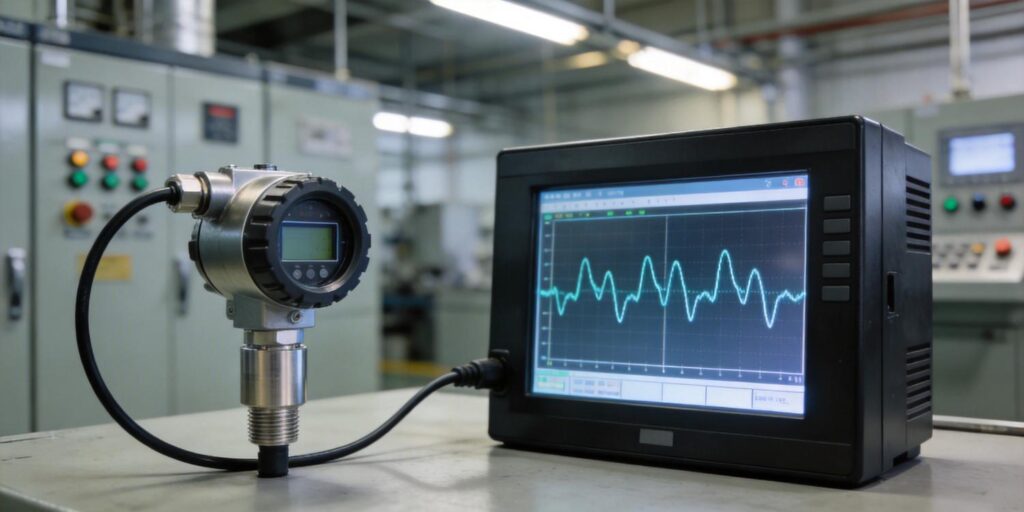
In vacuum process control, raw gauge signals often contain noise from thermal fluctuations, electromagnetic interference, plasma transients, or minor mechanical vibrations. Filtering smooths these variations to produce stable pressure readings suitable for alarms, interlocks, and closed-loop control. The choice between hardware (analog) filtering and software (digital) filtering significantly affects system responsiveness, noise rejection, and overall reliability. Both approaches are valid, but their trade-offs become critical in high-throughput or precision applications such as sputtering, reactive-ion etching, and vacuum heat treatment.
The Poseidon Scientific VG-SP205 Pirani Vacuum Transmitter (0–10 V analog + RS232) and VG-SM225 Cold Cathode Vacuum Gauge deliver inherently low-noise outputs thanks to careful circuit design and temperature compensation. Yet even these robust transmitters benefit from thoughtful filtering when integrated into noisy production environments. This article compares hardware and software filtering techniques, quantifies their impact on response time and stability, and provides practical guidance for engineers and procurement teams implementing vacuum monitoring and control systems.
Analog Hardware Filtering
Hardware filtering is implemented directly in the signal path before digitization or transmission. Common implementations include:
- Passive RC low-pass filters: A simple resistor-capacitor network on the 0–10 V analog output (e.g., R = 10 kΩ, C = 10 µF yields τ ≈ 0.1 s, f_c ≈ 1.6 Hz).
- Active filters: Op-amp-based Sallen-Key or multiple-feedback designs for sharper roll-off (e.g., 2nd-order Butterworth, –40 dB/decade beyond cutoff).
- Ferrite beads and common-mode chokes: Primarily for EMI suppression but also attenuate high-frequency noise on power and signal lines.
Advantages include zero latency from software execution, immunity to digital sampling artifacts, and protection of downstream electronics from transients. The VG-SP205’s analog output is particularly clean after a modest RC filter (τ = 50–200 ms), reducing broadband noise by 10–20 dB while preserving millisecond-scale pressure changes during pump-down or valve actuation. Hardware filters are set-and-forget: once tuned, they require no PLC reprogramming or firmware updates.
Disadvantages emerge when aggressive filtering is needed: long time constants (τ > 1 s) introduce noticeable lag, delaying detection of rapid events such as leaks or sudden venting. Over-filtering can also mask legitimate process transients that require fast response (e.g., plasma ignition pressure spikes).
PLC Software Smoothing
Software filtering is applied after the gauge signal reaches the controller—typically a PLC, embedded system, or SCADA platform. Common algorithms include:
- Moving average: Simple, effective for white noise; N-point average (e.g., 10–60 samples at 1 Hz) reduces standard deviation by √N.
- Exponential moving average (EMA): Gives more weight to recent samples; single-parameter smoothing factor α (0 < α ≤ 1) approximates a first-order low-pass filter with τ = –Δt / ln(1–α).
- Median filter: Excellent for impulse noise (spikes from arcing or EMI); preserves sharp edges better than averaging.
- Kalman filter: Advanced state estimation that combines process model and measurement noise statistics; used in high-end systems for optimal noise reduction with minimal lag.
Software offers flexibility: parameters can be adjusted on the fly, different filters applied to different pressure regimes, and filtering disabled during critical transients (e.g., pump crossover). The VG-SM225’s RS232 stream (customizable protocol available even for small quantities) delivers high-resolution digital data, enabling sophisticated smoothing without analog-to-digital conversion losses. For the VG-SP205, many PLCs read the 0–10 V input at 10–100 ms intervals and apply EMA with α = 0.1–0.3 for effective τ of 0.3–3 s.
The main drawback is added latency from sampling and computation—typically negligible in modern PLCs but non-zero. Poorly tuned software filters can introduce overshoot, ringing, or phase distortion, especially during rapid pressure changes.
Trade-off between Response Time and Stability
Filtering always involves a fundamental compromise: stronger noise suppression increases time constant and delays response. A first-order low-pass filter (hardware RC or software EMA) has step-response time constant τ and settles to 95 % in ≈3τ. Noise reduction scales roughly with √(bandwidth reduction).
Practical examples:
- τ = 0.1 s → fast response, moderate noise reduction (~6–10 dB); suitable for leak detection or valve sequencing.
- τ = 1 s → good stability for steady-state control, noise reduction ~16–20 dB; common in long-term pressure monitoring.
- τ = 5 s → very stable base-pressure readings, but sluggish during pump-down or venting; risks missing short excursions.
In high-vacuum applications (VG-SM225 range), discharge noise is inherently higher than Pirani filament noise, so longer time constants (1–3 s) are often acceptable. In rough-vacuum control (VG-SP205), faster response (τ ≤ 0.5 s) is preferred to catch crossover events accurately.
Practical Control Example
Consider a 100 L sputtering chamber with turbomolecular pump and rotary-vane roughing pump. The VG-SP205 monitors foreline pressure for crossover interlock (setpoint 8 Torr), while the VG-SM225 tracks chamber base pressure (target <5×10⁻⁵ Torr).
Hardware approach: 100 ms RC filter on VG-SP205 analog output → τ ≈ 0.1 s. Crossover decision is fast and reliable; minor noise during roughing is tolerable since setpoint is in the linear Pirani range.
Software approach: VG-SM225 RS232 data at 1 Hz, EMA with α = 0.2 (τ ≈ 4 s). Base-pressure reading is extremely stable for endpoint detection and leak trending, but a sudden 20 % pressure rise (e.g., small leak) takes ≈12 s to reach 95 % of final value—acceptable for trend monitoring but too slow for fast safety interlocks.
Hybrid solution: Apply light hardware filtering (τ = 50 ms) to both gauges for EMI rejection, then software EMA (τ = 0.5–2 s) in the PLC only for display and logging. Fast interlocks use unfiltered or minimally filtered raw signals to preserve speed.
Avoiding Hidden Instability
Excessive filtering can mask control-loop instability. A sluggish filtered signal may hide oscillations that would otherwise trigger tuning adjustments. Symptoms include:
- Slow recovery from setpoint changes
- Apparent “hunting” around target pressure
- Delayed alarm response leading to undetected excursions
Mitigation steps:
- Always compare filtered vs. raw signals during commissioning.
- Implement derivative action or rate-of-change alarming on raw data for critical events.
- Use redundant gauges (primary + backup) and cross-check filtered outputs against each other.
- Log both raw and filtered values; review trends after any process deviation to confirm filtering did not conceal root causes.
The VG-SP205 and VG-SM225 support this by providing both analog (fast) and digital (high-resolution) outputs simultaneously.
Best Practice Recommendation
For most production vacuum systems:
- Use light analog hardware filtering (τ = 50–200 ms) on all gauge outputs to suppress EMI and high-frequency noise.
- Apply moderate software smoothing (τ = 0.3–1.5 s) in the controller for display, logging, and non-critical alarms.
- Reserve raw or minimally filtered signals for fast interlocks and safety-critical decisions (e.g., turbopump overload protection).
- Take advantage of Poseidon’s custom RS232 protocol to stream high-resolution data and embed basic smoothing flags or pre-filtered values when needed.
- Document time constants and filter settings in the system P&ID and SOPs for future troubleshooting and audits.
This hybrid strategy delivers clean, stable readings without sacrificing the responsiveness required in dynamic vacuum processes.
CTA
Effective signal filtering turns noisy gauge outputs into reliable process variables. The Poseidon Scientific VG-SP205 Pirani Vacuum Transmitter and VG-SM225 Cold Cathode Vacuum Gauge provide clean, flexible outputs that integrate easily into both hardware- and software-filtered control architectures—helping engineers achieve the optimal balance of stability and speed.
Review detailed specifications and user manuals:
VG-SP205 Pirani Vacuum Transmitter
VG-SM225 Cold Cathode Vacuum Gauge
Need help selecting filter time constants for your specific process, tuning software algorithms, customizing digital protocols for advanced smoothing, or validating hybrid filtering on your vacuum tool? Contact our applications engineering team today—we support detailed signal-integrity analysis and control-system integration for both prototype and production environments.


