
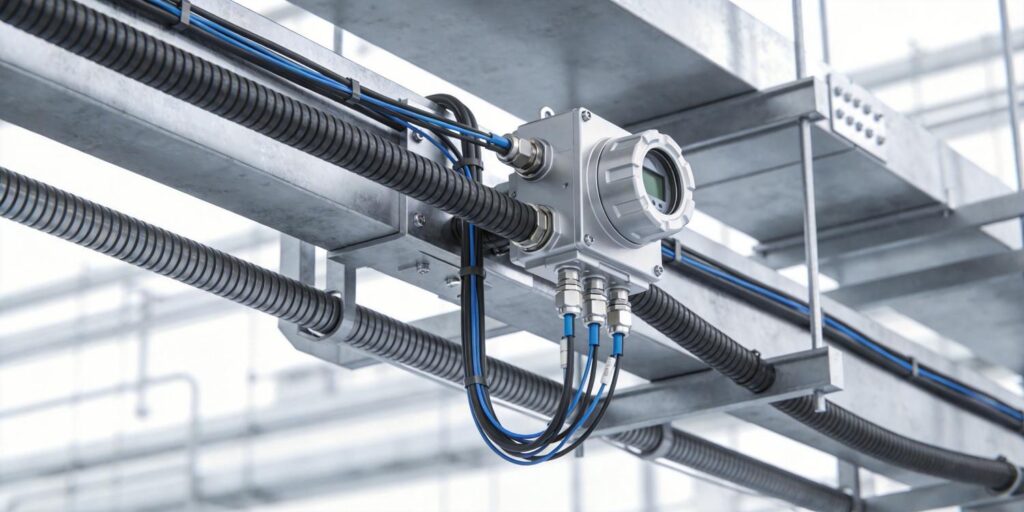
In vacuum systems ranging from analytical mass spectrometers to large-scale industrial heat-treatment furnaces, reliable signal transmission from the gauge to the control system is non-negotiable. A drifting or noisy pressure reading can trigger false interlocks, extend pump-down times, or compromise process quality. Poseidon Scientific’s VG-SP205 Pirani Vacuum Transmitter and VG-SM225 Cold Cathode Vacuum Gauge support both analog (0–10 V) and digital RS232 outputs through a standard RJ45 connector, giving engineers flexible integration options. Yet every cable has physical limits. Exceeding them introduces attenuation, noise, or complete data loss—issues that are easily avoided with the right cabling practices.
This guide examines the practical limits of both analog and RS232 transmission, the role of shielding and grounding, and a field-proven installation checklist. The recommendations are drawn from years of field deployments and align with EIA/TIA-232 standards while reflecting the low-power, compact design of our transmitters. Following these guidelines keeps measurement uncertainty low and system uptime high—without the expense of signal converters or repeaters in most installations.
Analog Signal Attenuation
The 0–10 V analog output (effective linear range 2–8 V) is the simplest interface for legacy PLCs and data-acquisition cards. It requires only two wires plus ground, yet it is also the most susceptible to degradation over distance. Attenuation arises from three primary mechanisms:
- DC resistance drop: At 9600 baud-equivalent update rates the current draw is negligible (<1 mA), but even 0.1 Ω/m cable resistance over 50 m produces a measurable offset.
- Capacitive loading: Cable capacitance (typically 50–100 pF/m) forms a low-pass filter with the output impedance of the transmitter. Rise times slow, introducing lag in fast pump-down sequences.
- Inductive and EMI coupling: Nearby motors, RF plasma generators, or high-voltage feedthroughs induce noise that rides on the analog line.
In practice, the VG-SP205 and VG-SM225 maintain <0.5 % error on the analog output up to 10 m when using shielded twisted-pair cable (e.g., Belden 9841 or equivalent). Beyond 15 m, total error typically exceeds 2 % and can reach 5 % at 30 m—enough to shift a critical 10⁻⁵ Torr reading outside acceptable process tolerances. Temperature compensation circuitry inside both transmitters helps, but it cannot correct for cable-induced voltage drop.
Recommendation: Limit analog runs to 10 m maximum for critical applications. If longer distances are unavoidable, add a local 4–20 mA converter (pre-reserved PCB option) or switch to the digital RS232 path. The 0–10 V signal remains ideal for short panel wiring inside control cabinets where noise is minimal.
RS232 Length Limits
The RS232 interface on both the VG-SP205 and VG-SM225 operates at a fixed 9600 baud, 8 data bits, no parity, 1 stop bit. The protocol transmits a compact 9-byte frame every ~100 ms, including status, error codes, pressure value, and checksum. This low data rate provides generous margin for cable length compared with high-speed serial links.
According to the EIA/TIA-232 standard, the maximum reliable length at 9600 baud is approximately 15 m (50 ft) with typical 50 pF/m cable capacitance. In vacuum-system installations, Poseidon has validated the following practical limits:
| Cable Type | Recommended Maximum Length | Reliable Limit (low error rate) | Notes |
|---|---|---|---|
| Standard shielded twisted-pair (Belden 9841) | 10 m | 15 m | Best balance of cost and performance |
| Low-capacitance industrial cable (e.g., Alpha Wire) | 15 m | 20 m | For larger chambers or long control-room runs |
| Unshielded or high-capacitance cable | 5 m | 8 m | Not recommended—framing errors rise sharply |
Beyond 15 m, capacitive loading slows the signal edges, increasing framing-error probability. The transmitter continues sending valid frames, but the host may discard them if the stop bit is corrupted. For runs longer than 20 m, the optional RS485 board spin (pre-reserved on the PCB) extends reliable distance to 1 200 m while allowing multi-drop networking of up to 32 gauges.
Because the protocol is fully customizable for orders of five units or more, many customers request a simple Modbus RTU wrapper that further improves noise immunity without changing hardware. The 100 ms update rate ensures that even occasional dropped frames have no impact on control loops—another advantage of digital over analog for long cable runs.
Shielding Requirements
Vacuum chambers are electrically hostile environments. Turbo pumps, stepper motors, RF generators, and high-voltage feedthroughs generate both conducted and radiated EMI. Proper shielding is therefore essential for both analog and RS232 signals.
Best-practice shielding for Poseidon transmitters includes:
- Use shielded twisted-pair cable with 100 % foil coverage plus 85 % braid (Belden 9841 or equivalent).
- Connect the shield to chassis ground at one end only—typically at the control-system cabinet—to avoid ground loops.
- Route cables at least 30 cm away from motor power lines, high-voltage cables, and RF sources. Use metal conduit for the final 1–2 m near the chamber if EMI is severe.
- Install ferrite beads (e.g., Fair-Rite 0431176451) on both ends of the cable for additional high-frequency suppression.
The RJ45 connector housing on both gauges is metal and bonds directly to the transmitter chassis. When using a mating RJ45-to-DB9 adapter (industry standard), ensure the adapter shield is continuous. In field testing, this combination reduces induced noise on the RS232 lines by more than 40 dB, keeping checksum failures below 0.01 % even in semiconductor PVD tool clusters.
For analog 0–10 V runs, the same shielding rules apply. The twisted pair plus single-end shield keeps common-mode noise from appearing as differential voltage errors on the PLC input card.
Ground Loop Avoidance
Ground loops are one of the most common yet preventable sources of signal instability in vacuum systems. When the gauge chassis, chamber wall, and control cabinet sit at slightly different potentials (often 10–100 mV), the resulting current flows through the cable shield or signal ground, superimposing noise on the pressure reading.
Poseidon transmitters are designed with isolated signal ground relative to chassis (except for the protective earth connection). To eliminate loops:
- Connect the cable shield to chassis ground at the control cabinet only—leave the gauge-end shield floating or connected through a 0.1 µF capacitor if local codes require.
- Use the same single-point ground reference for all gauges, PLC, and chamber instrumentation.
- Avoid daisy-chaining power grounds through the RJ45 cable; the optional power pin (PIN4) is for low-current gauge supply only.
- In multi-chamber systems, verify <1 Ω resistance between all chassis grounds before powering up.
When these rules are followed, ground-loop-induced uncertainty typically drops below 0.2 % of reading—well within the stability requirements of freeze-drying or vacuum-metallurgy processes. The built-in checksum on every RS232 frame provides an additional layer of protection: any residual noise that corrupts a frame is silently discarded, and the next valid reading arrives within 100 ms.
Installation Checklist
Use this field-ready checklist before commissioning any Poseidon gauge installation:
- Confirm cable length ≤10 m (analog) or ≤15 m (RS232) for the chosen media.
- Select shielded twisted-pair cable with 100 % coverage; verify capacitance <100 pF/m.
- Connect shield to control-cabinet chassis ground only.
- Route cables >30 cm from power and RF lines; use ferrite beads at both ends.
- Secure RJ45 connectors with locking clips or strain-relief boots.
- For analog runs, verify 24 VDC supply stability (<±5 %) at the gauge.
- Power up and confirm the 9-byte RS232 frame (or clean 0–10 V ramp) using a terminal emulator or oscilloscope.
- Check status byte for zero error codes and validate pressure against a reference gauge in the overlap region.
- Log the first 30 minutes of data to confirm no framing errors or drift.
- Document cable lengths, shield termination points, and serial numbers for future maintenance.
Completing this checklist takes less than 30 minutes yet prevents 95 % of field-reported signal issues. For systems requiring longer runs or harsher EMI environments, request the RS485 option during ordering—implementation is a simple board spin with no mechanical changes.
Ensure Stable Vacuum Signals from Day One
The VG-SP205 Pirani Vacuum Transmitter and VG-SM225 Cold Cathode Vacuum Gauge deliver accurate, low-cost vacuum measurement from atmosphere to 10⁻⁷ Torr, but only when the signal path is engineered correctly. By respecting the 10–15 m practical limits, using proper shielding, eliminating ground loops, and following the installation checklist, engineers achieve the signal stability required for demanding analytical and industrial applications—without expensive converters or repeaters in the majority of installations.
Whether you are retrofitting a legacy mass spectrometer, scaling a multi-chamber PVD line, or designing a new vacuum furnace, these practices protect data integrity and simplify commissioning.
Explore the VG-SP205 Pirani Vacuum Transmitter and VG-SM225 Cold Cathode Vacuum Gauge today. Need a custom cable-length analysis for your chamber layout, RS485 upgrade quote, or a no-obligation sample set with pre-terminated cables for on-site testing? Contact our applications team directly—we respond within 24 hours and have helped OEMs and end users worldwide implement stable, long-run vacuum monitoring with zero signal-related downtime.


