
Understanding Cation Exchange SPE: MCX vs WCX Fundamentals
In the world of solid-phase extraction (SPE), cation exchange cartridges play a crucial role in isolating and purifying basic compounds from complex matrices. Two primary cation exchange options dominate the market: Mixed-mode Cation eXchange (MCX) and Weak Cation eXchange (WCX). As Dr. Xu, product manager at Poseidon Scientific, I’ll guide you through the essential differences between these two technologies, helping engineers, researchers, and procurement specialists make informed decisions for their analytical workflows.
Strong vs Weak Cation Exchange Mechanisms
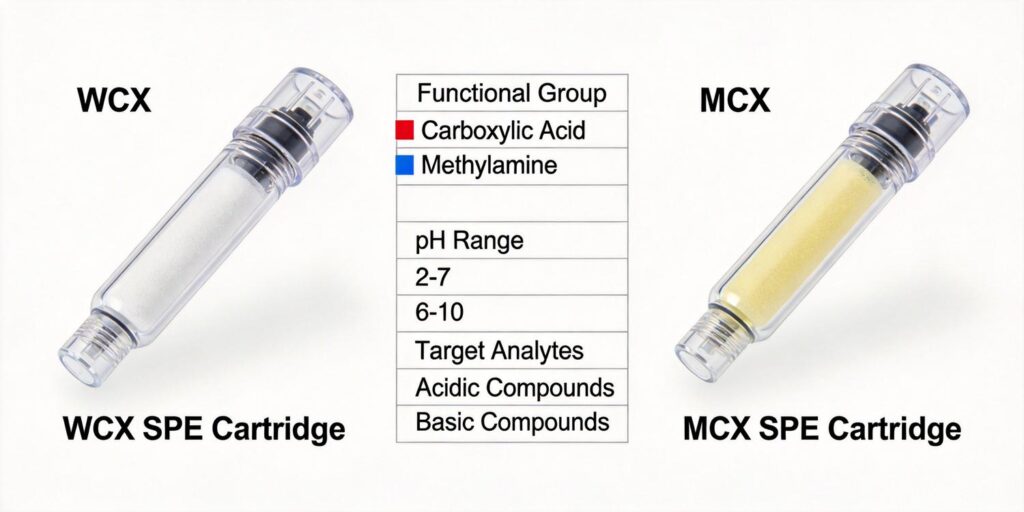
The fundamental distinction between MCX and WCX lies in their ion-exchange mechanisms. MCX utilizes sulfonic acid groups (SO3–) as strong cation exchange sites with an ion-exchange capacity of 1 meq/g. These sulfonic acid groups remain ionized across the entire pH range (0-14), providing consistent cation exchange capability regardless of pH conditions. This makes MCX particularly effective for retaining basic compounds with pKa values typically between 2-10.
In contrast, WCX employs carboxylic acid groups (COO–) as weak cation exchange sites with a controlled ion-exchange capacity of 0.7 meq/g. The weak cation exchange mechanism means these functional groups are only ionized within specific pH ranges, typically above pH 4-5. This pH-dependent behavior provides unique advantages for specific applications, particularly for strong bases and quaternary amines.
Both technologies utilize mixed-mode retention mechanisms, combining ion-exchange interactions with reversed-phase hydrophobic interactions. This dual retention approach significantly improves selectivity and retention for various basic analytes. The polymeric sorbent base in both MCX and WCX cartridges is water-wettable and stable across the entire pH range (0-14), eliminating complications from silanol groups that can complicate retention modes in traditional silica-based sorbents.
pH Effects on Retention and Selectivity
The pH sensitivity of these two cation exchange technologies represents their most significant operational difference. For MCX cartridges, the strong sulfonic acid groups maintain their negative charge across all pH conditions. This means retention of basic compounds occurs primarily through ionic interactions that are relatively independent of pH. The retention mechanism can be summarized as:
- MCX Retention: Ionic interaction between positively charged basic analytes and negatively charged sulfonic acid groups, plus hydrophobic interactions with the polymeric backbone
- pH Independence: Sulfonic acid groups remain ionized from pH 0-14
- Elution Strategy: Requires disruption of ionic bonds through pH adjustment or competitive ion displacement
WCX cartridges, with their carboxylic acid functional groups, exhibit significant pH-dependent behavior. The ionization state of these weak acid groups follows typical acid-base equilibrium principles:
- pH < 4: Carboxylic acid groups are protonated (COOH), reducing ion-exchange capacity
- pH 4-6: Partial ionization occurs, providing moderate cation exchange capability
- pH > 6: Carboxylic acid groups are fully ionized (COO–), maximizing cation exchange capacity
This pH sensitivity allows for more selective retention and elution strategies. For strong bases with pKa > 10, WCX provides superior retention because the weak cation exchange sites can be neutralized to release these strongly bound compounds, whereas strong cation exchangers like MCX would retain them too strongly for efficient elution.
Application Scenarios: When to Choose MCX vs WCX
MCX Applications
Mixed-mode Cation eXchange cartridges excel in applications requiring robust, pH-independent retention of basic compounds. Key application areas include:
- General Basic Drug Analysis: Pharmaceutical compounds with pKa values between 2-10, including β-blockers, antidepressants, and antihistamines
- Multi-analyte Screening: Forensic and clinical applications where consistent retention across varied pH conditions is essential
- High-Throughput Environments: Laboratories requiring method robustness and minimal pH optimization
- Complex Matrices: Biological fluids where consistent performance despite variable sample pH is critical
The 1 meq/g ion-exchange capacity of MCX provides substantial loading capacity for basic compounds, making it suitable for applications requiring high sensitivity or dealing with concentrated samples.
WCX Applications
Weak Cation eXchange cartridges are specifically designed for challenging applications involving strong bases and quaternary amines. Primary application scenarios include:
- Strong Basic Compounds: Analytes with pKa > 10, including quaternary ammonium compounds and permanently charged bases
- Selective Isolation: Applications requiring pH-controlled selectivity, such as separating compounds with similar structures but different basicity
- Metabolite Studies: Analysis of basic metabolites where pH manipulation can enhance selectivity
- Method Development Flexibility: Research applications where pH optimization is part of method development strategy
The 0.7 meq/g ion-exchange capacity of WCX, while slightly lower than MCX, is optimized for the specific retention characteristics of strong bases. The pH-dependent nature allows for more controlled elution profiles, particularly important for compounds that might be too strongly retained on strong cation exchangers.
Practical Considerations for Method Development
Conditioning and Loading Strategies
For both MCX and WCX cartridges, proper conditioning is essential for optimal performance. The water-wettable polymeric sorbent requires methanol conditioning followed by aqueous buffer or water. For MCX, the conditioning pH is less critical due to pH-independent functionality. For WCX, conditioning at pH > 6 ensures maximum ionization of carboxylic acid groups.
Sample loading should be performed at pH conditions where analytes are ionized. For basic compounds, this typically means pH at least 2 units below their pKa values. The mixed-mode retention mechanism provides additional security through hydrophobic interactions, reducing the risk of breakthrough during loading.
Wash and Elution Optimization
Wash steps for both cartridge types typically involve aqueous solutions to remove matrix interferences while retaining analytes through ionic interactions. For WCX, careful pH control during washing can enhance selectivity by differentially eluting weakly bound interferences.
Elution strategies differ significantly between the two technologies:
- MCX Elution: Requires disruption of strong ionic bonds through either:
1. pH adjustment to neutralize analyte charge (typically using basic organic solvents)
2. Competitive displacement with high concentrations of counter-ions - WCX Elution: Can utilize two approaches:
1. pH adjustment to neutralize the weak cation exchange sites (typically acidic conditions)
2. pH adjustment to neutralize analyte charge
The ability to neutralize the sorbent itself provides additional elution flexibility
Technical Specifications and Product Formats
Both MCX and WCX cartridges are available in various formats to accommodate different laboratory needs:
- Cartridge Formats: 1 cc (10-30 mg), 3 cc (60 mg), 6 cc (150-500 mg), 20 cc, and 35 cc sizes
- Particle Sizes: 30 μm for standard applications and 60 μm for viscous samples
- Plate Formats: 96-well plates with 2 mg, 10 mg, 30 mg, and 60 mg sorbent masses
- Specialized Formats: μElution plates for low-volume elution, flangeless cartridges, and vacuum manifolds
The availability of both 30 μm and 60 μm particle sizes allows selection based on sample viscosity and turbidity. For most plasma, serum, and human urine applications, 30 μm sorbents provide optimal flow characteristics. For more viscous samples like animal urine, 60 μm sorbents offer better flow rates in both cartridges and plates.
Conclusion: Making the Right Choice
Selecting between MCX and WCX cation exchange SPE cartridges depends on your specific analytical requirements:
Choose MCX when:
– You need pH-independent performance
– Analyzing general basic compounds (pKa 2-10)
– Method robustness and consistency are priorities
– Working with variable sample matrices
Choose WCX when:
– Analyzing strong bases or quaternary amines (pKa > 10)
– pH-controlled selectivity is advantageous
– Dealing with compounds that might be too strongly retained on strong cation exchangers
– Method development includes pH optimization
Both technologies offer the advantages of mixed-mode retention, eliminating silanol complications, and providing excellent stability across the pH range. For laboratories analyzing diverse basic compounds, maintaining both MCX and WCX cartridges in inventory provides maximum flexibility for method development and optimization.
At Poseidon Scientific, we offer comprehensive technical support for both MCX and WCX applications, helping you achieve optimal recovery, selectivity, and sensitivity in your analytical workflows. Whether you’re developing new methods or optimizing existing protocols, understanding these fundamental differences will guide you toward the most effective SPE solution for your specific needs.


