
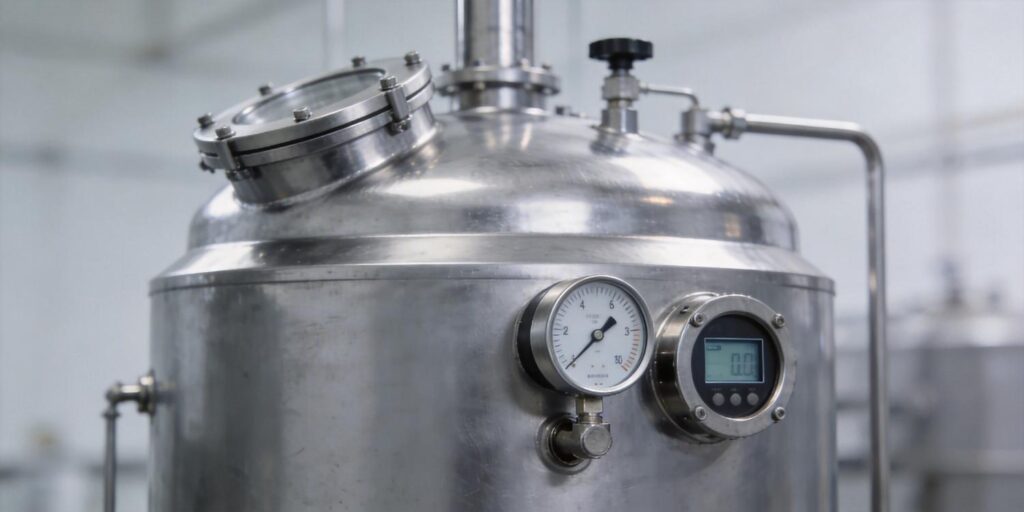
Defining the High Vacuum Region
High vacuum is the pressure regime where gas behavior transitions fully into molecular flow and surface effects dominate. In practical industrial and laboratory terms, high vacuum spans from 10−3 Torr (≈0.133 Pa) down to 10−7 Torr (and below). At these pressures the mean free path of molecules exceeds the dimensions of typical process chambers, so gas-phase collisions are rare and molecules travel in straight lines until they strike a surface.
This region sits between medium vacuum (where viscous flow still occurs) and ultra-high vacuum (10−9 Torr and lower). Most PVD coaters, semiconductor load locks, vacuum furnaces, and analytical instruments operate squarely inside the 10−3 to 10−7 Torr window. Accurate measurement here is essential because even small pressure changes alter deposition rates, etch uniformity, and contamination levels. The Poseidon Scientific VG-SM225 Cold Cathode Vacuum Gauge was developed specifically for this exact range, delivering stable, repeatable readings without the filament-related limitations of hot-cathode designs.
Why Precise Measurement Matters
In high vacuum, pressure directly controls gas density, mean free path, and collision frequency. A 10 % deviation at 5 × 10⁻⁷ Torr can increase residual oxygen partial pressure enough to oxidize a growing metal film or shift refractive index in optical coatings. In semiconductor processing, base-pressure drift of only 2 × 10⁻⁷ Torr can introduce particles or cause arcing during plasma ignition.
Precise, continuous measurement enables closed-loop control of throttle valves, mass-flow controllers, and pump interlocks. It also provides the data required for traceability under ISO 9001 or SEMI standards. Without a gauge that remains accurate and stable across the entire high-vacuum decade, engineers must rely on indirect indicators or frequent manual checks—both of which reduce throughput and increase scrap risk. The VG-SM225 solves this problem by providing a logarithmic 0–10 V analog output (1.33 V per decade) that gives uniform resolution from 10−3 to 10−7 Torr, making PID tuning and trending simple and reliable.
Cold Cathode Ionization Mechanism
The VG-SM225 uses an inverted-magnetron cold cathode design to generate measurable ion current without a hot filament. A cylindrical cathode is biased at up to −2500 V while a central anode wire is at ground. A pair of ring magnets produces an axial field of ≈1200 gauss, creating crossed electric and magnetic fields inside the sensor volume.
Free electrons (seeded by cosmic rays or field emission) are trapped in long helical paths by the Lorentz force. Each electron travels several kilometers before colliding with a gas molecule, ionizing it and releasing secondary electrons that continue the avalanche. Positive ions are collected at the cathode, producing a current proportional to gas density. Because the discharge is self-sustaining, the gauge requires no heated filament—eliminating outgassing, filament burnout, and decomposition of reactive gases such as oxygen or halogens.
The guarded-cathode geometry and optimized magnetic field keep the ion-current-versus-pressure relationship reproducible, with a near-linear slope above ≈10−9 Torr. This mechanism gives the VG-SM225 its robustness in aggressive environments and its ability to measure down to 10−7 Torr without the x-ray limit that constrains hot-cathode gauges.
Startup Delay Explanation
At high pressure abundant molecules supply initiating electrons, so the discharge ignites almost instantly. As pressure drops, the probability of an initial ionizing collision decreases, extending ignition time. Typical delays for the VG-SM225 are:
- ≈2 s at 10−4 Torr
- ≈1 min at 10−5 Torr
- ≈5 min at 10−6 Torr
This is a fundamental physical limit of any cold-cathode gauge, not a fault. In practice, the companion VG-SP205 Pirani Vacuum Transmitter handles the initial roughing phase and confirms pressure <1 Torr before high voltage is applied to the VG-SM225. The red status LED flashes until the plasma stabilizes, giving operators and automation systems a clear visual cue. Forced-start circuitry and optional UV triggering are available for applications that demand faster high-vacuum confirmation.
Accuracy Considerations
The VG-SM225 delivers the following performance in air (factory calibration at 20 °C):
- ±20 % accuracy from 10−6 to 10−3 Torr
- ±30 % accuracy from 10−7 to 10−6 Torr
- Repeatability ±20 % across the full range
Accuracy is gas-dependent; correction factors are published for argon (≈0.7× air), helium (≈1.4× air), and other common process gases. Long-term stability is excellent because there is no filament evaporation or thermal drift. Periodic cleaning of the cathode every 6–12 months (depending on process contamination) restores original performance. The logarithmic analog output ensures that small voltage changes at the low-pressure end still produce usable resolution in the PLC or data logger.
When paired with the VG-SP205 Pirani (which covers 10−3 to 760 Torr with ±5 % repeatability), the two transmitters provide continuous coverage and automatic crossover at the natural transition point, eliminating the accuracy gaps common with mixed-vendor gauge sets.
Industrial Application Examples
Reactive sputtering for optical coatings: The VG-SM225 monitors base pressure below 5 × 10⁻⁷ Torr before introducing argon to 5 mTorr. Its filament-free design tolerates oxygen and maintains stability throughout long coating runs, reducing thickness variation from ±8 % to ±2 %.
Semiconductor load-lock and etch chambers: The gauge confirms high vacuum before wafer transfer and provides continuous feedback during plasma processing. The logarithmic output feeds directly into the PLC for precise pressure interlocks and trending.
Vacuum furnaces for brazing and annealing: Operators track pump-down curves from 10−3 Torr (Pirani) to 10−6 Torr (cold cathode), ensuring metallurgical quality and detecting leaks early. The compact KF25 sensor fits easily inside furnace ports without magnetic interference to nearby instrumentation.
In every case the VG-SM225’s robustness, low maintenance, and clean analog signal have proven superior to hot-cathode alternatives that require frequent filament replacement and suffer from outgassing in reactive environments.
Why the VG-SM225 Is Ideal for High Vacuum
The VG-SM225 combines proven inverted-magnetron physics with modern engineering advantages:
- No hot filament—tolerates reactive gases and eliminates outgassing
- Compact sensor volume (<50 cm³) with KF25 flange for easy integration
- Logarithmic 0–10 V output (1.33 V/decade) for direct PLC compatibility
- Built-in status LEDs and error signaling for instant diagnostics
- Bake-out rating to 150 °C and 12-month typical calibration interval
When paired with the VG-SP205 Pirani, the two gauges deliver full-range coverage with unified spare parts, identical mounting, and simple crossover logic. The result is lower total cost of ownership, reduced inventory, and the confidence that your high-vacuum data is always accurate and ready for automation.
Conclusion
High vacuum from 10−3 to 10−7 Torr is the regime where process quality is won or lost. Precise, stable measurement is non-negotiable. The Poseidon VG-SM225 Cold Cathode Vacuum Gauge, based on proven cold-cathode ionization physics and engineered for real-world production and laboratory use, delivers exactly the performance engineers need—robust, filament-free, and easy to integrate.
Ready to implement reliable high-vacuum measurement in your system? Our applications team specializes in PVD, semiconductor, furnace, and research installations. We offer free technical reviews, sample PLC code, custom calibration curves, and rapid quotations. Contact us today for a no-obligation consultation—simply visit the product page or reply to this article.
VG-SM225 Cold Cathode Vacuum Gauge – Specifications & Downloads
VG-SP205 Pirani Vacuum Transmitter – Roughing Companion for Full-Range Coverage
At Poseidon Scientific we design vacuum instrumentation that engineers trust—delivering the accuracy, stability, and integration simplicity your high-vacuum processes demand.


