
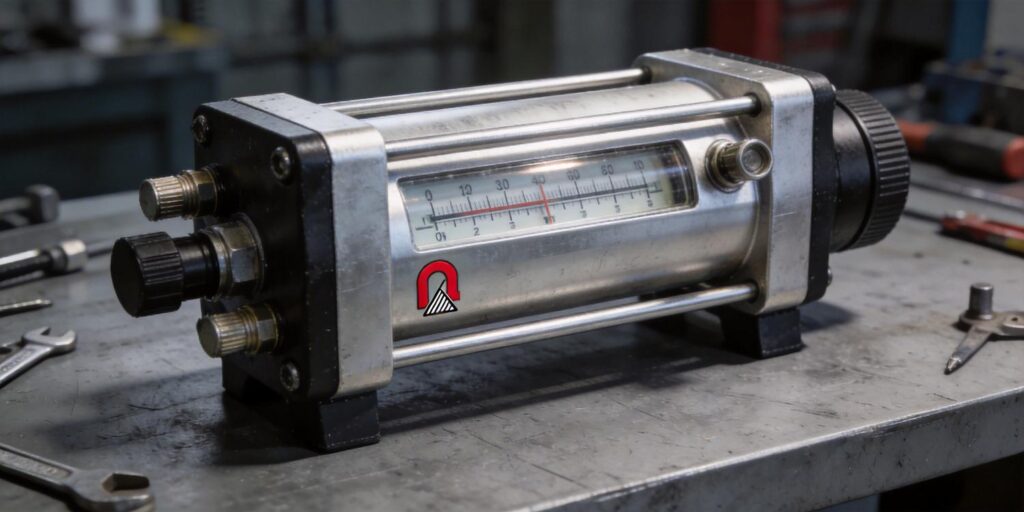
Magnetic Field Role in Ionization
Cold cathode vacuum gauges, such as the VG-SM225 Cold Cathode Vacuum Transmitter from Poseidon Scientific, rely on a controlled magnetic field to enable reliable pressure measurement in the high-vacuum range (typically 10⁻³ to 10⁻⁷ Torr). The operating principle is the Penning discharge—also known as a crossed-field or magnetron discharge—where a permanent magnet generates an axial magnetic field of approximately 100 Gauss (using NdFeB material for compactness).
In this configuration, known as the traditional or positive magnetron structure, a high negative voltage (startup at –2500 V, operating at –2000 V) is applied between the central anode and surrounding cathode. Initial electrons are produced by field emission from the cathode surface. The crossed electric (radial) and magnetic (axial) fields force these electrons into long spiral or cycloidal trajectories rather than straight-line paths. This dramatically increases the electron path length—often by orders of magnitude—raising the probability of ionizing collisions with residual gas molecules even at very low pressures where molecular density is sparse.
Each collision produces additional electrons and positive ions in an avalanche (Townsend discharge) process, creating a self-sustaining plasma. The resulting positive ion current collected at the cathode is directly proportional to gas density (and thus pressure) within the linear operating region. Without the magnetic field, electron residence time would be too short to sustain the discharge below roughly 10⁻³ Torr, rendering the gauge ineffective for high-vacuum applications.
This design choice—~100 Gauss in a compact positive magnetron geometry—delivers a smaller sensor volume than inverted-magnetron alternatives while maintaining sufficient electron trapping for the target range. Literature confirms the relationship: higher magnetic fields extend the low-pressure limit but increase gauge size and stray-field concerns; the 100 Gauss balance optimizes both performance and practicality (Redhead, 1959; Lafferty, Foundations of Vacuum Science and Technology, 1998).
Key Parameters in Poseidon’s VG-SM225
| Parameter | Value | Function |
|---|---|---|
| Magnetic field strength | ~100 Gauss (NdFeB) | Electron trapping via Lorentz force |
| Anode-cathode spacing | ~2 mm | Defines electric field strength |
| Operating voltage | –2000 V (after –2500 V startup) | Initiates and sustains Penning discharge |
| Structure | Positive magnetron (“工” shape with star-shaped discharge plates) | Compact volume with efficient gas conductance |
The magnetic field is essential yet carefully engineered: too weak and discharge fails at low pressure; too strong and gauge size grows while stray-field risks increase.
Interference Risks from Stray Magnetic Fields
While the internal magnetic field is vital for gauge function, the external stray field from the permanent magnet introduces potential interference in sensitive environments. Poseidon Scientific’s compact positive-magnetron design keeps the magnet small and the overall sensor volume minimal—significantly smaller than traditional cold-cathode gauges—reducing the spatial extent of stray flux compared with larger competitors.
Primary interference risks include:
- Electron-beam instruments: Scanning electron microscopes (SEM), e-beam lithography systems, and mass spectrometers (key initial application for VG-SM225) can experience beam deflection or focus distortion if placed too close. Even weak fields (tens of Gauss) alter electron trajectories over centimeters.
- Semiconductor process tools: Magnetic fields may couple into plasma sources, Hall-effect sensors, or precision positioning stages in PVD/CVD/ALD chambers. Industry validation is always recommended before deployment in wafer fabs.
- Magnetic storage and sensors: Older hard-disk drives, magnetic encoders, or fluxgate magnetometers can suffer data corruption or offset errors. Modern solid-state devices are less susceptible but still warrant evaluation.
- Adjacent vacuum gauges or instruments: Nearby hot-cathode or other cold-cathode gauges may exhibit shifted calibration curves or discharge instability due to field interaction.
- Personnel safety: Although 100 Gauss is low (comparable to a refrigerator magnet), prolonged close exposure should be avoided per standard magnetic-field exposure guidelines.
Real-world data from micro-magnetron gauge research confirms that reducing sensor volume by 30× or more (as achieved in advanced designs) directly lowers external magnetic influence, enabling broader use in aerospace, accelerators, and precision analytical systems. Contamination or electrode wear does not alter the magnetic field itself but can change discharge characteristics, indirectly amplifying perceived interference effects.
Safe Distance Guidelines
Practical safe-distance recommendations balance gauge performance with application constraints. Poseidon Scientific’s VG-SM225 user manual and extensive field testing provide clear, conservative guidance:
- From personnel: Maintain at least 10 cm separation. This prevents any perceptible magnetic pull on ferromagnetic objects or minor physiological effects.
- From electron-beam or precision instruments: Minimum 20–30 cm (empirically verified in SEM and mass-spectrometer installations). Beyond 50 cm, stray-field effects drop below detectable levels for most systems.
- From magnetic-sensitive electronics: 15–25 cm or install simple mu-metal shielding (0.5–1 mm thickness) if closer mounting is unavoidable. Shielding can reduce local field strength by >90 % without affecting gauge operation.
- Between multiple VG-SM225 units: 15 cm center-to-center spacing avoids cross-talk; orient magnets in parallel for lowest interaction.
These distances are conservative and derived from both internal testing and industry literature on magnetron gauges (Peacock et al., JVST A, 1988; micro-magnetron studies, 2024). In semiconductor or high-energy physics applications, always perform a site-specific magnetic survey with a Gaussmeter before final placement. The Pirani VG-SP205 offers a zero-magnetic-field alternative for rough-to-medium vacuum stages, eliminating concerns entirely when paired in hybrid configurations.
Quantitative Field Decay Example
Stray field from the VG-SM225 NdFeB magnet follows an approximate dipole fall-off (1/r³). At 10 cm: ~5–10 Gauss; at 30 cm: <1 Gauss—well below interference thresholds for most analytical instruments.
Installation Tips for Minimal Magnetic Impact
Proper installation maximizes measurement accuracy while minimizing stray-field effects. The VG-SM225 supports fully flexible mounting thanks to its robust KF16/KF25 flange and arbitrary orientation capability—no preferred axis alignment is required for pressure reading accuracy.
Best practices include:
- Flange selection and placement: Mount directly on the vacuum chamber wall via KF flange for true cavity pressure. For ovens or long tubes, use short KF extensions; avoid long side arms where flow conductance could introduce reading lag.
- Orientation optimization: Align the gauge magnet axis parallel to nearby electron beams or sensitive planes when possible. This minimizes Lorentz-force components perpendicular to trajectories.
- Spacing and shielding: Observe the safe-distance guidelines above. Where space is tight, wrap sensitive components (not the gauge itself) with high-permeability foil. Never shield the gauge magnet—doing so would degrade internal field strength and measurement performance.
- Cabling and electronics: Route analog (0–10 V) and RS232 cables at least 10 cm from the magnet body. Use shielded twisted-pair cable to prevent induced noise. Digital protocol customization (available from 5–10 units) ensures seamless PLC/SCADA integration without additional converters.
- Thermal and environmental management: Operate within 15–50 °C (circuit + algorithm compensation handles this range). Keep away from strong external magnets or ferromagnetic masses that could saturate or distort the internal field.
- Maintenance access: The removable sensor head allows electrode cleaning with 200–500 grit paper without disturbing chamber vacuum or magnet alignment—critical for long-term stability in contamination-prone processes.
- System protection: Built-in software automatically disables high voltage above 10⁻³ Torr, preventing sputtering damage. Indicator LEDs provide instant status (steady = normal; flashing = HV off).
These steps ensure the VG-SM225 delivers repeatable, drift-free readings while coexisting peacefully with sensitive neighboring equipment. Field data from mass-spectrometer and vacuum-heat-treatment users confirm zero reported interference incidents when guidelines are followed.
Choose the Right Gauge for Your Magnetic-Sensitive Application
Understanding and managing the magnetic field in cold-cathode gauges is fundamental to successful high-vacuum system design. The Poseidon Scientific VG-SM225 Cold Cathode Vacuum Transmitter delivers industry-leading compactness, cost efficiency, and protocol flexibility while incorporating a carefully optimized 100 Gauss field that balances performance with minimal stray-field footprint.
Pair it with the maintenance-free VG-SP205 Pirani Vacuum Transmitter for full-range coverage (atmosphere to 10⁻⁷ Torr) and complete freedom from magnetic concerns in rough-vacuum stages.
Ready to optimize your vacuum measurement strategy? Contact our applications engineering team today for a free magnetic-field compatibility assessment, custom protocol development, or on-site evaluation. Whether you’re scaling mass-spectrometer production, upgrading SEM chambers, or building next-generation semiconductor tools, Poseidon Scientific delivers the precise, reliable solution engineers trust.
Explore full specifications and request a quote:
Minimize interference. Maximize uptime. Start your vacuum optimization today.


