
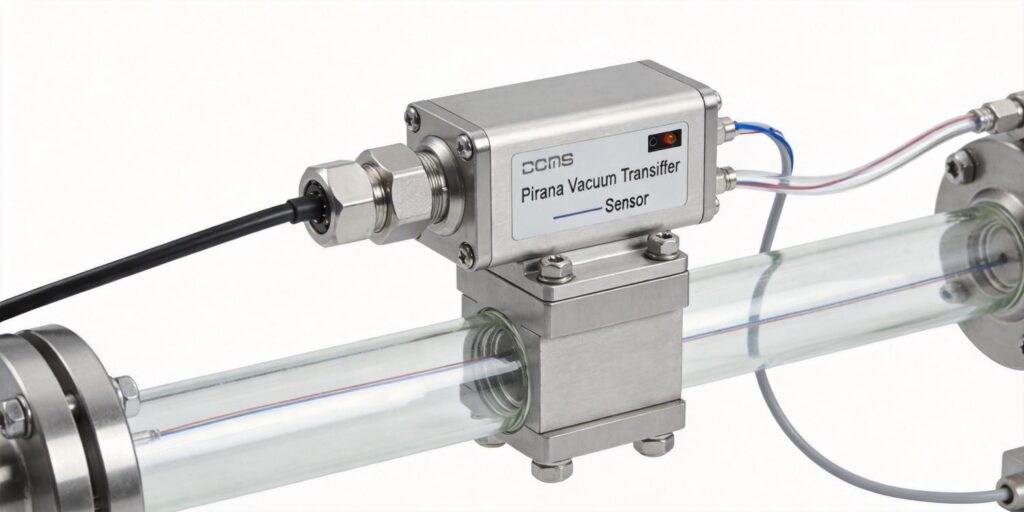
Pirani Thermal Conductivity Principle
Pirani vacuum gauges measure pressure by exploiting the thermal conductivity of residual gas molecules. In the VG-SP205 Pirani Vacuum Transmitter from Poseidon Scientific, a thin platinum filament is resistively heated and maintained at constant temperature by a precision feedback circuit. As gas pressure changes, the rate at which heat is conducted away from the filament to the cooler gauge envelope also changes.
At higher pressures (more molecules per unit volume), collision frequency increases and heat transfer rises, requiring greater electrical power to hold filament temperature steady. At lower pressures, fewer collisions occur and heat loss decreases, so less power is needed. The controller continuously monitors the voltage or current required to maintain constant temperature and converts this value into a pressure reading via a calibrated lookup table or polynomial fit.
This principle works effectively from atmospheric pressure down to approximately 10⁻³ Torr (0.1 Pa). The relationship is most linear—and therefore most accurate—between roughly 10 Torr and 10⁻² Torr. Outside this band the response becomes strongly nonlinear, which is why engineers avoid operating Pirani gauges near the extremes without careful compensation.
Platinum was selected as the filament material because of its large temperature coefficient of resistance, excellent drawability into fine wires, and superior chemical stability compared with tungsten or rhenium-tungsten alternatives. These properties deliver repeatable heat-loss behavior and resist corrosion from typical industrial process gases.
Causes of Pressure Drift in Pirani Gauges
Pressure drift—gradual or sudden deviation from the true vacuum level—is the most common field complaint with Pirani gauges. Understanding the root causes helps engineers implement preventive measures and avoid process interruptions.
| Cause | Mechanism | Typical Magnitude | Detection |
|---|---|---|---|
| Temperature drift | Ambient or process temperature changes alter baseline filament resistance and heat-loss curves | ±10–20 % outside 15–50 °C | Slow upward drift at constant pressure |
| Non-linear operating zones | At atmospheric and <10⁻² Torr the power-pressure relationship flattens | Up to ±50 % error | Readings stick or jump near range limits |
| Filament contamination | Deposits change surface emissivity and thermal mass | Progressive upward shift | Calibration curve no longer matches reference |
| Filament aging | Minor recrystallization or thinning over thousands of hours | Slow drift until burnout | Increasing power required at same pressure |
The VG-SP205 incorporates both analog circuit compensation and digital algorithmic correction to minimize temperature-induced drift within its rated 15–50 °C operating window. However, operation outside this range or exposure to rapid thermal cycling can still produce measurable offsets.
Contamination and aging are irreversible in the field. Unlike cold-cathode gauges, the sealed Pirani sensor cannot be cleaned; once drift exceeds acceptable limits the entire transmitter must be replaced.
Gas Composition Effects on Reading Stability
Pirani gauges are inherently gas-dependent because different molecules carry heat at different rates. Helium, with its high thermal conductivity, produces a lower apparent pressure reading than nitrogen at the same true pressure. Conversely, heavier vapors (NMP solvent in battery drying, for example) reduce heat loss and inflate the reading.
Typical sensitivity ratios relative to nitrogen (N₂ = 1.0):
- Helium: ~1.5–1.8 (reads lower)
- Air: 1.0 (factory calibration gas)
- Argon: ~0.7–0.8 (reads higher)
- Hydrogen: ~1.4–1.6
In processes with varying gas mixtures—common in coating, heat treatment, or leak testing—uncorrected gas dependency is a major source of apparent drift. Even small changes in residual gas composition can shift readings by 20–50 % without any actual pressure change.
Poseidon Scientific performs all VG-SP205 calibration in air. For applications with dominant process gases other than air, we offer custom gas-mapping at the time of order (minimum 5–10 units). The resulting lookup table is loaded into the firmware, restoring accuracy across the specific gas environment.
Calibration Methods and Limitations
Pirani gauges cannot be field-calibrated by end users. The sensor is a sealed unit whose internal geometry and filament resistance are fixed at manufacture; attempting adjustment risks permanent damage.
Factory calibration uses a reference capacitance diaphragm gauge or spinning-rotor gauge in a controlled vacuum system. Pressure is stepped across the full range while filament power (or voltage) is recorded, producing a multi-point calibration curve stored in the transmitter’s non-volatile memory. Temperature compensation coefficients are also determined during thermal cycling.
Because the curve is gas-specific and geometry-dependent, field checks are limited to verification against a trusted reference gauge at one or two known pressures (typically 1 Torr and 100 Torr in air). Significant deviation indicates either contamination, filament aging, or operation outside the compensated temperature band—none of which can be corrected on site.
Annual verification against a certified reference is recommended for critical processes. If readings deviate beyond ±10 % in the linear zone, replacement is the only reliable solution.
Replacement Guidelines for Pirani Vacuum Transmitters
The VG-SP205 is designed for long service life, but eventual replacement is inevitable. Typical lifetime is 3–5 years in clean vacuum environments and 1–3 years when exposed to aggressive solvents or frequent venting.
Replace the transmitter immediately when any of the following occur:
- Sudden complete loss of signal (filament open circuit—catastrophic burnout)
- Persistent upward drift >15 % at a stable known pressure after temperature stabilization
- Readings stuck at atmospheric or zero regardless of actual chamber pressure
- Power consumption at a fixed pressure increases >20 % over baseline (early sign of filament thinning or contamination)
- Process alarms trigger repeatedly with no corresponding change in system performance
Because the entire transmitter is a single replaceable unit (electronics and sensor integrated), swap-out takes minutes using the industry-standard RJ45 connector and KF flange. No recalibration of downstream PLC logic is required if the replacement unit carries the same custom protocol.
For systems requiring continuous operation, maintain one spare VG-SP205 per ten installed units. The compact size and low cost make on-site spares economical insurance against unplanned downtime.
Upgrade to Stable, Full-Range Vacuum Monitoring
Understanding and managing pressure drift in Pirani gauges is essential for any engineer responsible for vacuum system reliability. By selecting the right filament material, applying proper temperature compensation, accounting for gas composition, and following a disciplined replacement schedule, you can keep readings trustworthy across the rough-to-medium vacuum range.
When your process also requires high-vacuum measurement below 10⁻³ Torr, pair the VG-SP205 Pirani Vacuum Transmitter with the VG-SM225 Cold Cathode Vacuum Gauge. The two units share identical interfaces, compact footprints, and customizable RS232 protocols, giving you seamless coverage from atmosphere to 10⁻⁷ Torr with automatic range switching and minimal panel space.
Both instruments were developed at Poseidon Scientific to solve the exact pain points industrial users face—high imported costs, oversized legacy designs, and inflexible communication—while delivering platinum-level stability and field-proven durability.
Ready to eliminate drift and simplify your vacuum measurement strategy? Contact the Poseidon Scientific applications engineering team today. Submit your process parameters (pressure range, dominant gases, quantity, and integration needs) and receive a firm quotation plus custom protocol sample within 24 hours.
Explore full specifications and request an evaluation unit:
Stop fighting drift. Start measuring with confidence. Your optimized vacuum system is one conversation away.


