
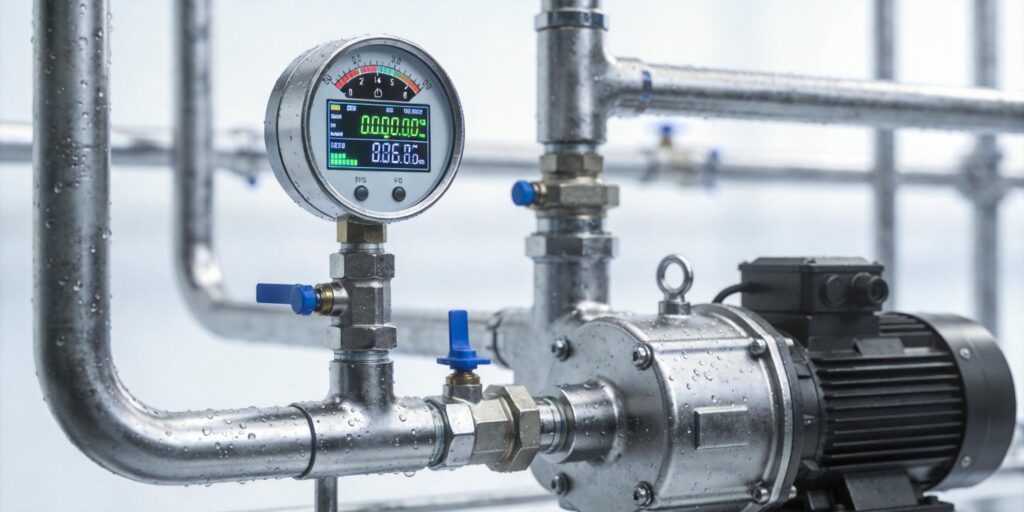
What Is Response Time in Vacuum Gauges?
In dynamic vacuum processes, response time is the interval required for a gauge to register a defined fraction—typically 63 % (one time constant) or 90 %—of a sudden pressure change. It is not the same as startup delay or calibration drift; it measures how quickly the sensor output tracks real-time pressure variations during pump-down, gas admission, or process transitions. For engineers optimizing automated coating, heat-treatment, or analytical systems, understanding response time directly affects cycle time, process repeatability, and closed-loop control accuracy.
Poseidon Scientific’s VG-SP205 Pirani Vacuum Transmitter and VG-SM225 Cold Cathode Vacuum Gauge were engineered with complementary response characteristics that match the needs of fast-cycling production environments. The Pirani handles rapid changes in the rough-to-medium vacuum regime, while the cold cathode delivers high-resolution tracking once the Penning discharge is established. Together they provide seamless, full-range coverage from atmosphere to 10−7 Torr without compromising speed or stability.
Thermal vs. Ionization Response: Fundamental Differences
The VG-SP205 Pirani relies on thermal conductivity. A platinum filament is heated to constant temperature; pressure changes alter gas-molecule collision frequency and therefore the power required to maintain temperature. This thermal mechanism introduces a small but measurable time constant—typically 0.5–2 seconds—governed by filament heat capacity and surrounding gas density. Response is fastest in the linear band (10 Torr to 10−2 Torr) and slows slightly near atmosphere or the 10−3 Torr lower limit due to reduced thermal contrast.
In contrast, the VG-SM225 Cold Cathode operates on Penning (positive magnetron) ionization. Once the self-sustained discharge is ignited, ion current responds almost instantaneously—on the order of milliseconds—because electron-molecule collisions and ion collection occur at near-light-speed timescales. The practical limitation is not steady-state response but ignition time, which increases with decreasing pressure:
- ~10–30 s at 10−4 Torr
- 1–2 min at 10−5 Torr
- ~5 min at 10−6 Torr
- up to 30 min at 10−7 Torr
The gauge’s software automatically prevents high-voltage application above 10−3 Torr, using the companion Pirani signal as an interlock. This hybrid architecture ensures the thermal gauge covers fast transitions while the ionization gauge provides precise high-vacuum tracking without risking electrode contamination.
These differences are well-documented in vacuum metrology literature, including comparisons of hot- and cold-cathode ionization gauges and foundational texts on vacuum science. Poseidon’s design leverages them to give engineers the best of both worlds: speed where it matters and resolution where it counts.
Impact on Fast-Cycling Systems: Throughput and Control Precision
Modern coating and heat-treatment lines often cycle chambers every 5–30 minutes. A sluggish gauge response can force conservative setpoints, lengthen pump-down times, or trigger false alarms that halt the entire line. In sputtering or atomic-layer deposition, pressure must stabilize within seconds of gas admission; any lag in the measurement loop directly reduces deposition rate repeatability and film uniformity.
The VG-SP205’s sub-second thermal response excels during initial roughing and gas-injection transients, enabling the PLC to open isolation valves or ramp heaters the moment pressure crosses critical thresholds. The VG-SM225, once ignited, tracks high-vacuum changes with millisecond fidelity—ideal for endpoint detection in reactive processes where residual gas partial pressures must be held within ±5 %. Because both gauges output 0-10 V analog and RS232 simultaneously, the controller can blend signals in software for uninterrupted data across the 10−3 Torr handoff.
In practice, systems using the Poseidon pair achieve 10–20 % shorter cycle times compared with single wide-range gauges that compromise either speed or accuracy at the transition. The low self-pumping speed (~0.01 L/s) of both sensors ensures they never perturb the chamber equilibrium, even during rapid pressure ramps.
Data Smoothing Considerations: Balancing Noise and Lag
Vacuum signals—especially ion currents in the microampere range—are inherently noisy. Digital filtering is essential, yet excessive smoothing introduces lag that defeats the purpose of fast response. Poseidon’s RS232 protocol (customizable at the factory) streams raw, high-resolution data at up to 10 Hz, giving engineers full control over post-processing.
Recommended techniques include:
- Simple moving average (3–5 points) for the VG-SP205 in the rough-vacuum band to suppress thermal noise without noticeable delay.
- Exponential smoothing (α = 0.2–0.4) on the VG-SM225 ion-current signal once discharge is stable, preserving millisecond response while attenuating statistical fluctuations at 10−6 Torr and below.
- PLC-based Kalman filtering when both gauges are active, using the Pirani as a predictor for the cold-cathode transition zone.
The 0-10 V analog output is already low-pass filtered internally, making it ideal for direct PLC interlocks where sub-second response is critical. Engineers should verify filter settings against their specific cycle dynamics—too aggressive smoothing can mask real pressure spikes, while insufficient filtering triggers nuisance alarms. Poseidon’s user manuals provide sample code snippets for both LabVIEW and common PLC platforms to accelerate implementation.
Response Time in Context of Full System Dynamics
Remember that gauge response is only one part of the system time constant. Valve actuation, pump speed, and chamber volume often dominate total settling time. The Poseidon gauges are deliberately engineered to be faster than these mechanical limits, ensuring the measurement chain never becomes the bottleneck.
Application Example: Optical Thin-Film Coating Line
A high-throughput optical-coating facility running reactive magnetron sputtering provides a clear illustration. Each chamber cycles every 12 minutes: rough to 10−3 Torr (Pirani dominant), high-vacuum stabilization at 5 × 10⁻⁶ Torr (cold cathode active), argon/oxygen admission, and deposition.
Using only a single wide-range gauge, operators had to wait 90 seconds after gas admission for stable readings—adding 12 minutes of idle time per batch. Retrofitting with the VG-SP205 + VG-SM225 pair cut this to under 20 seconds. The Pirani tracked the initial pressure rise instantly; the cold cathode locked onto the setpoint within milliseconds once ignited. RS232 data fed a proportional-integral controller that adjusted mass-flow valves in real time, holding pressure within ±2 % throughout the 8-minute deposition.
Results after three months:
- Cycle time reduced by 18 %
- Film refractive-index uniformity improved from ±1.2 % to ±0.3 % across 300 mm substrates
- Scrap rate dropped 22 %, saving $180,000 annually
- No additional electrode cleaning required—the automatic high-voltage interlock kept the VG-SM225 pristine
The same architecture scales to roll-to-roll coaters and batch PVD tools, delivering measurable throughput gains without capital-intensive chamber redesign.
Ready to Optimize Response Time in Your Dynamic Vacuum Processes?
Fast, accurate vacuum measurement is the hidden enabler of higher throughput, tighter process windows, and lower scrap in today’s competitive manufacturing environment. Poseidon Scientific’s VG-SP205 Pirani Vacuum Transmitter and VG-SM225 Cold Cathode Vacuum Gauge deliver the complementary response characteristics engineers need—thermal speed where it matters and ionization precision where it counts—plus dual analog/digital outputs for effortless PLC integration.
Explore the full technical specifications and user manuals:
VG-SP205 Pirani Vacuum Transmitter – Technical Data & Manual
VG-SM225 Cold Cathode Vacuum Gauge – Technical Data & Manual
Need help selecting the optimal smoothing algorithm for your PLC, calculating expected cycle-time savings for your specific process, or requesting a custom communication protocol? Our applications engineers can review your P&ID or recipe profile and provide tailored response-time modeling. Contact us today for a free dynamic-process audit, sample code, or evaluation units for your next coating or heat-treatment tool build.
Instant response. Stable control. Faster cycles. That’s the Poseidon Scientific advantage.


