
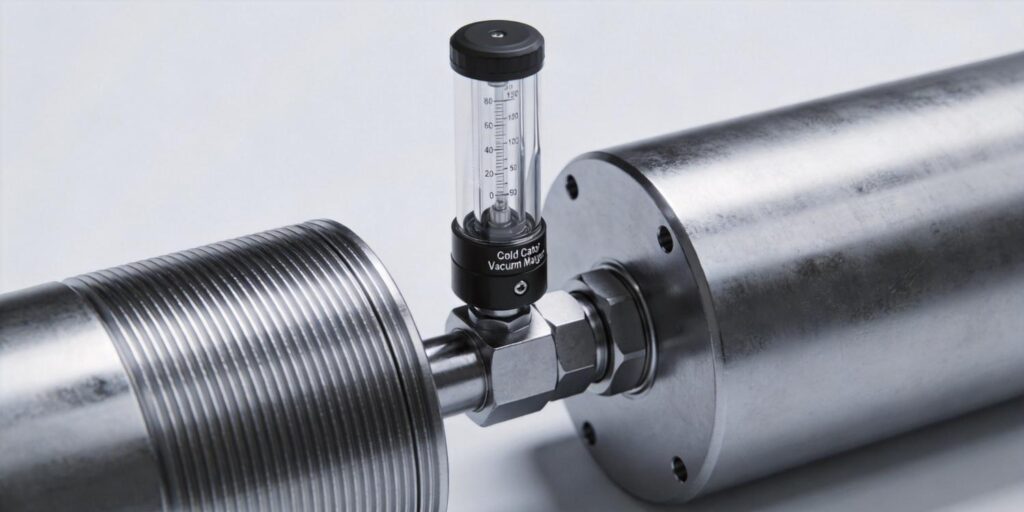
Ionization Mechanism
Cold cathode vacuum gauges measure high vacuum through a self-sustaining gas discharge known as the Penning discharge. Unlike hot-cathode ionization gauges that rely on a thermionic filament to emit electrons, cold cathode designs use field emission and crossed electric and magnetic fields to generate and trap electrons. This fundamental difference eliminates filament-related issues and makes the technology particularly suited to the high-vacuum regime.
The process begins when a high voltage (typically –2500 V at startup, dropping to –2000 V once running) is applied between a cylindrical anode and cathode. A permanent magnet produces an axial field of approximately 100 gauss. Free electrons—originating from cosmic rays, field emission at sharp edges, or residual gas—are accelerated in the radial electric field while being forced into long spiral or cycloidal paths by the magnetic field. These extended trajectories dramatically increase the probability of ionizing collisions with gas molecules, creating an avalanche of additional electrons and positive ions.
The resulting ion current collected at the cathode is directly proportional to gas density (and thus pressure) over a wide range. Because the discharge is self-sustaining down to extremely low pressures, no external electron source is required. This mechanism is inherently robust: there is no hot filament to outgas, burn out, or react with process gases, and the X-ray photocurrent limit that constrains hot-cathode gauges is absent.
Poseidon Scientific’s VG-SM225 Cold Cathode Vacuum Gauge implements a traditional positive-magnetron (Penning) geometry—“工”字形 structure with “之”字形 discharge plates—optimized for compactness and consistent performance. The design ensures uniform fields and repeatable electron trajectories, delivering stable ion-current readings without the discontinuities sometimes seen in older inverted-magnetron configurations.
Measurement Range
The VG-SM225 is engineered for the high-vacuum range of 10-3 Torr down to 10-7 Torr, precisely where most analytical instruments, vacuum heat-treatment furnaces, and coating systems operate during process hold. Within this span the ion-current versus pressure relationship is monotonic and repeatable, allowing reliable process control and interlock triggering.
Operation below 10-3 Torr is deliberately restricted by both hardware and software protection. At higher pressures the discharge current becomes non-monotonic and electrode contamination accelerates rapidly due to excessive ion bombardment. The gauge automatically disables high voltage when pressure exceeds the safe threshold, preventing damage and extending sensor life. Startup time is typically 5 minutes at 10-6 Torr and up to 30 minutes at 10-7 Torr; once ignited, readings stabilize within seconds.
This range complements thermal-conductivity (Pirani) gauges perfectly. While a Pirani such as Poseidon’s VG-SP205 covers atmosphere to 10-3 Torr with excellent speed, it loses sensitivity and accuracy below that point. Pairing the two instruments provides seamless full-range monitoring from atmosphere to high vacuum without gaps or overlap errors. The cold cathode’s absence of X-ray limitation and negligible pumping speed (≈10-2 L/s) make it the preferred choice for true high-vacuum verification in systems where absolute base pressure determines product quality.
Comparison with Hot-Cathode Gauges
| Characteristic | Cold Cathode (VG-SM225) | Hot Cathode (Typical Bayard-Alpert) |
|---|---|---|
| Measurement limit | 10-7 Torr (no X-ray limit) | ≈5 × 10-11 Torr (X-ray limited) |
| Outgassing during operation | Negligible | Significant (filament heating) |
| Reactive gas tolerance | Excellent | Poor (filament burnout) |
| Startup at high vacuum | 5–30 min | Instantaneous |
The cold cathode’s advantages become decisive whenever process gases, solvents, or long operating cycles are involved.
Durability
Durability is where cold cathode technology truly shines in industrial and analytical service. With no hot filament, the VG-SM225 eliminates the primary failure mode of conventional high-vacuum gauges. Electrode contamination—manifested as carbon deposits or oxide layers from residual hydrocarbons or process vapors—is the only significant aging mechanism, and Poseidon’s design makes recovery straightforward.
The sensor head is fully removable without disturbing the vacuum seal. Operators lightly abrade the stainless-steel electrodes with 500-mesh or 200-mesh sandpaper until the metallic luster returns, removing black carbon and colored oxide films. This field maintenance restores original sensitivity in under 10 minutes and can be performed repeatedly. In clean environments such as mass spectrometers or vacuum furnaces, service life reaches 3–5 years; in moderately contaminated applications it remains 1–2 years with periodic cleaning.
Additional durability features include:
- Hardware and software high-voltage protection that automatically shuts off above 10-3 Torr
- Stainless-steel electrodes and PEEK insulators rated for repeated thermal cycling
- NdFeB permanent magnet providing stable 100-gauss field without degradation
- Built-in status LED and digital error codes for instant fault identification
These attributes translate into dramatically lower total cost of ownership compared with hot-cathode gauges that require frequent filament replacement and vacuum breaks for recalibration.
Industrial Examples
Cold cathode gauges have become the standard for high-vacuum monitoring across multiple sectors where reliability and low maintenance are non-negotiable.
In mass spectrometry and GC-MS systems, the VG-SM225 monitors analyzer chambers at 10-5 to 10-7 Torr. Its lack of outgassing preserves spectral purity, while fast digital output integrates directly with instrument control software for interlocks and data logging. Benchtop and portable mass spectrometers benefit from the compact footprint that fits tight OEM layouts.
Vacuum heat-treatment furnaces for annealing, brazing, and sintering use the gauge to verify base pressure before ramping to 800–1200 °C. Remote mounting via KF extension tubes keeps the gauge body below 50 °C while the removable sensor head allows cleaning between batches without system downtime. Repeatable readings ensure consistent metallurgical results and support NADCAP/ISO documentation.
Scanning electron microscopes and surface-analysis tools rely on stable high-vacuum readings for column and chamber pressure. The gauge’s immunity to occasional venting and easy electrode cleaning minimize service calls in multi-user facilities. Coating and PVD systems (where gas composition is known) also employ cold cathode gauges for process endpoint detection and leak monitoring.
Across these applications, customers report 40–60 % cost savings versus imported equivalents while achieving identical or better long-term stability through Poseidon’s cleanable design and customizable RS232 protocol.
Choose Cold Cathode for Reliable High-Vacuum Performance
Cold cathode gauges deliver the combination of wide high-vacuum range, inherent durability, negligible outgassing, and field maintainability that no other technology matches. When paired with a Pirani transmitter for rough vacuum, they provide complete, cost-effective monitoring from atmosphere to 10-7 Torr.
The Poseidon Scientific VG-SM225 Cold Cathode Vacuum Gauge brings these advantages in a compact, protocol-customizable package engineered for today’s OEM and industrial requirements. Its positive-magnetron geometry, removable sensor head, and full digital integration set a new standard for performance at a fraction of legacy pricing.
Discover the VG-SM225 Cold Cathode Vacuum Gauge and see why leading instrument manufacturers and heat-treat facilities are switching.
Need a dual-gauge system with the VG-SP205 Pirani, a custom communication protocol (available from just 5–10 units), or application-specific calibration? Our engineering team is ready to support your project with rapid evaluation units and expert guidance—typically shipping within two weeks. Contact us today to optimize your high-vacuum monitoring and reduce long-term costs.


