The Critical Role of SPE in Modern Pesticide Residue Analysis
In today’s global food supply chain, ensuring the safety of agricultural products has become paramount. Pesticide residue analysis stands at the forefront of food safety protocols, and Solid Phase Extraction (SPE) has emerged as an indispensable tool in this critical analytical workflow. As regulatory standards become increasingly stringent worldwide, laboratories require robust, reliable methods for detecting trace levels of pesticide residues in complex food matrices.
Why SPE is Essential for Food Safety Compliance
The importance of SPE in pesticide residue analysis cannot be overstated. Food matrices present unique challenges—they contain fats, proteins, carbohydrates, pigments, and other interfering compounds that can mask pesticide signals or damage analytical instrumentation. Traditional liquid-liquid extraction methods often fail to provide the necessary cleanup, leading to matrix effects, reduced column life, and increased instrument downtime.
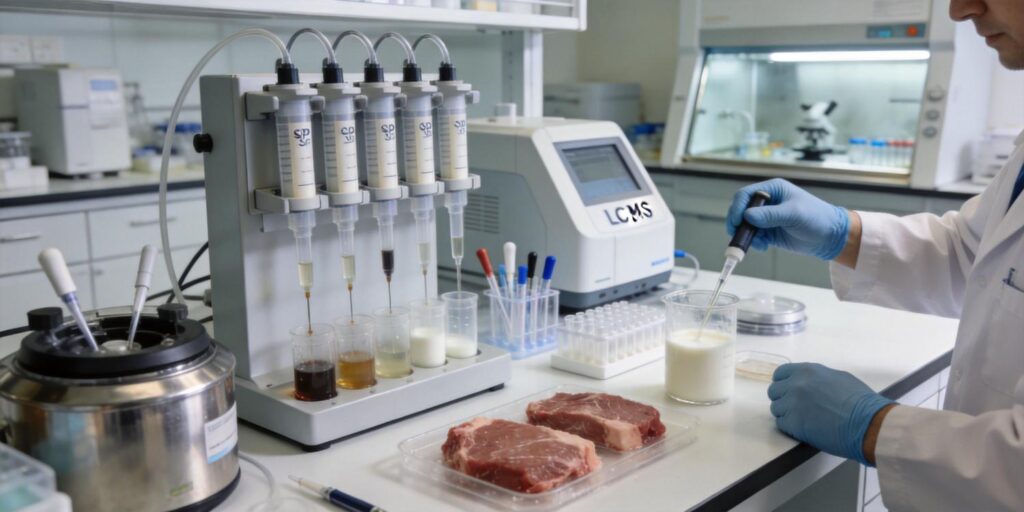
Research demonstrates that SPE significantly increases gas chromatography (GC) and liquid chromatography (LC) column life while reducing downtime on sensitive instruments like GC-MS and LC-MS for source cleaning. Unlike liquid-liquid extraction, which typically achieves 60-80% recovery at best, properly optimized SPE methods can deliver recoveries exceeding 90% with excellent reproducibility—a critical requirement for regulatory compliance testing.
Major Pesticide Classes and Their Analytical Challenges
Modern pesticide residue analysis must address a diverse range of chemical classes, each presenting unique extraction challenges:
Organochlorine Pesticides
These persistent organic pollutants, including DDT, lindane, and endosulfan, require specialized cleanup to remove co-extracted lipids and waxes. Florisil solid-phase extraction cartridges have been specifically developed for cleanup of organochlorine pesticide residues in foods, providing selective retention of these non-polar compounds while removing interfering matrix components.
Organophosphorus Pesticides
Compounds like chlorpyrifos, malathion, and diazinon are moderately polar and often require mixed-mode SPE approaches. The analysis of chlorpyrifos in water by SPE and GC-ECD demonstrates how C18 cartridges can effectively extract and concentrate these compounds from aqueous matrices prior to chromatographic analysis.
Carbamates and Ureas
These polar pesticides, including carbaryl and diuron, often require ion-exchange or mixed-mode SPE phases. Research shows that solid-phase extraction cleanup methods have been successfully applied to N-methylcarbamate insecticides in vegetables, fruits, and foods, providing the necessary selectivity for these challenging analytes.
Triazines and Phenylureas
Herbicides like atrazine and linuron benefit from reversed-phase SPE with careful pH control. Studies have demonstrated the determination of nine acidic herbicides in water and soil by gas chromatography using solid-phase extraction for sample preparation.
SPE Cleanup Strategies Before GC-MS Analysis
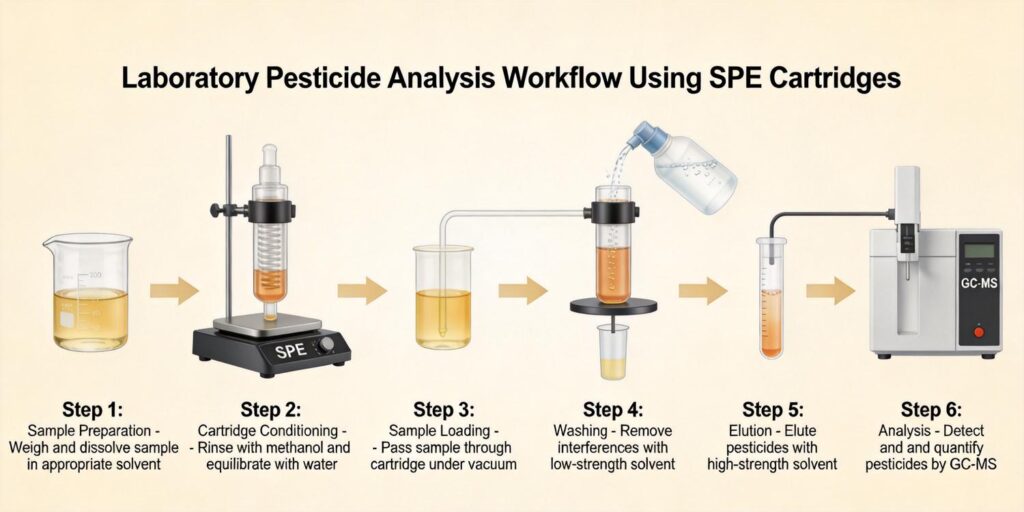
Gas chromatography-mass spectrometry (GC-MS) remains the gold standard for pesticide residue analysis due to its excellent sensitivity, selectivity, and confirmatory capabilities. However, GC-MS is particularly susceptible to matrix effects and contamination from non-volatile compounds. Proper SPE cleanup is essential for successful GC-MS analysis.
Matrix-Specific SPE Approaches
Different food matrices require tailored SPE strategies:
- High-Fat Matrices: For oils, dairy products, and fatty meats, initial fat removal using gel permeation chromatography or freezing-out techniques followed by SPE cleanup on silica or Florisil cartridges provides optimal results.
- High-Water Content Samples: Fruits, vegetables, and beverages benefit from direct loading onto reversed-phase cartridges (C18, C8, or HLB) after appropriate pH adjustment and dilution.
- Complex Matrices: Spices, herbs, and processed foods often require multi-cartridge approaches or mixed-mode SPE phases to address their diverse interference profiles.
SPE Phase Selection for Pesticide Residues
The choice of SPE phase significantly impacts method performance:
- Reversed-Phase (C18, C8, HLB): Ideal for non-polar to moderately polar pesticides from aqueous samples. HLB (Hydrophilic-Lipophilic Balance) phases offer superior water wettability and capacity for a broader range of pesticides.
- Normal-Phase (Silica, Florisil, Alumina): Excellent for lipid removal and cleanup of non-polar pesticides from organic extracts.
- Mixed-Mode (MCX, MAX, WCX, WAX): Provide both reversed-phase and ion-exchange interactions, offering superior selectivity for acidic, basic, or neutral pesticides in complex matrices.
Example Workflows for Different Food Matrices
Workflow 1: Multi-Residue Analysis in Fruits and Vegetables
A comprehensive study exploring the extraction of a large range of pesticides from fruit and vegetable matrices demonstrates the effectiveness of combined LLE and SPE approaches. The typical workflow involves:
- Sample Homogenization: Representative sample preparation with appropriate subsampling.
- Initial Extraction: Acetonitrile or ethyl acetate extraction with salting-out (QuEChERS approach) or traditional solvent partitioning.
- SPE Cleanup: Passage through appropriate SPE cartridges—often Florisil for non-polar pesticides or graphitized carbon black for pigment removal.
- Concentration and Solvent Exchange: Evaporation to appropriate volume and solvent exchange to GC-compatible solvents.
- GC-MS Analysis: Injection with appropriate internal standards and quality controls.
Workflow 2: Organochlorine Pesticides in Fatty Foods
For analyzing persistent organochlorine pesticides in high-fat matrices like dairy products or meats:
- Fat Extraction: Hexane or petroleum ether extraction of lipids.
- Gel Permeation Chromatography: Size-based separation to remove bulk lipids.
- Florisil SPE Cleanup: Further purification using Florisil cartridges with gradient elution.
- Concentration: Careful evaporation to avoid loss of volatile compounds.
- GC-ECD or GC-MS Analysis: Electron capture detection provides excellent sensitivity for halogenated compounds.
Workflow 3: Polar Pesticides in Water Samples
For monitoring pesticide contamination in water sources:
- Sample Preservation: Immediate cooling and pH adjustment if necessary.
- SPE Concentration: Direct loading onto HLB or C18 cartridges for trace enrichment.
- Cartridge Drying: Complete removal of water under vacuum.
- Elution: Using minimal volumes of appropriate organic solvents.
- Derivatization (if needed): For compounds requiring derivatization for GC analysis.
- GC-MS or LC-MS/MS Analysis: Depending on pesticide polarity and detection requirements.
Advanced SPE Techniques and Future Directions
The field of SPE for pesticide analysis continues to evolve with several advanced approaches gaining prominence:
96-Well Plate Formats
High-throughput analysis using 96-well SPE plates enables simultaneous processing of multiple samples, significantly increasing laboratory productivity. This format is particularly valuable for regulatory laboratories handling large sample volumes.
On-line SPE-GC-MS
Fully automated systems that couple SPE directly to GC-MS provide excellent reproducibility and reduced manual intervention. These systems are ideal for routine monitoring programs where consistent performance is critical.
Molecularly Imprinted Polymers (MIPs)
Emerging MIP-based SPE phases offer unprecedented selectivity for specific pesticide classes, potentially reducing or eliminating the need for additional cleanup steps.
Quality Control and Method Validation
Successful implementation of SPE methods for pesticide residue analysis requires rigorous quality control:
- Recovery Studies: Must demonstrate consistent recovery across the analytical range, typically 70-120% with RSD < 20%.
- Matrix-Matched Standards: Essential for compensating for matrix effects in quantitative analysis.
- Process Blanks and Controls: Regular monitoring to detect contamination or carryover.
- Cartridge Lot Verification: Testing new SPE cartridge lots to ensure consistent performance.
Conclusion
Solid Phase Extraction has revolutionized pesticide residue analysis, providing the cleanup and concentration capabilities necessary for modern food safety testing. By selecting appropriate SPE phases and optimizing extraction conditions, laboratories can achieve the sensitivity, selectivity, and reproducibility required by increasingly stringent global regulations. As analytical challenges continue to evolve with new pesticide formulations and complex food matrices, SPE technologies will undoubtedly adapt, maintaining their essential role in protecting the global food supply.
For laboratories seeking to implement or optimize SPE methods for pesticide analysis, careful consideration of matrix characteristics, pesticide properties, and analytical requirements will ensure successful method development and regulatory compliance. The continued advancement of SPE materials and formats promises even greater capabilities for the future of food safety analysis.