
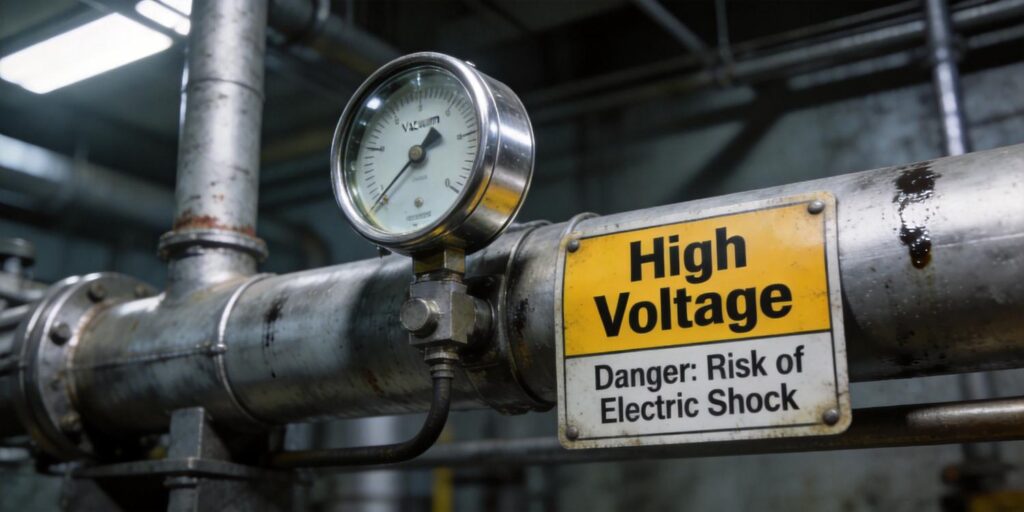
High Voltage Ionization Principle in Cold Cathode Gauges
Cold cathode vacuum gauges measure pressure in the high-vacuum regime (10−3 Torr to 10−7 Torr) using the Penning discharge principle rather than a heated filament. In the Poseidon Scientific VG-SM225 Cold Cathode Vacuum Gauge, a strong electric field (starting at −2500 V, then stabilizing at −2000 V) combined with an axial magnetic field (~100 gauss from an enclosed neodymium magnet) traps electrons in extended spiral paths. This dramatically increases the probability of ionizing residual gas molecules through collisions, producing a self-sustained avalanche of ions and electrons. The resulting positive-ion current collected at the cathode is directly proportional to gas density—and therefore pressure—in the linear operating range.
This design eliminates the burnout risk of hot-cathode gauges and avoids X-ray limits that restrict measurement below 10−10 Torr in thermionic systems. The VG-SM225’s traditional positive-magnetron (“工”-shaped) geometry keeps the sensor compact and field-serviceable, while the Penning mechanism ensures stable operation even at extremely low pressures where molecule density is sparse. Engineers familiar with vacuum metrology recognize that the extended electron path length (effectively kilometers at 10−7 Torr) is what enables reliable ionization without external electron sources.
The companion VG-SP205 Pirani Vacuum Transmitter handles the rough-to-medium vacuum range (atmosphere to 10−3 Torr) using thermal-conductivity principles, creating a seamless dual-gauge system for full-range monitoring in industrial applications.
Safety Precautions When Working with High-Voltage Cold Cathode Gauges
The VG-SM225 operates at kilovolt potentials, so safety is non-negotiable. Always power down the gauge and confirm zero voltage at the connector before any handling. Never open the electronics housing while powered; the internal DC-DC converter can retain charge for several seconds after shutdown. Use insulated tools and wear appropriate PPE (safety glasses, voltage-rated gloves) when troubleshooting or cleaning.
Mount the gauge so that the KF flange and sensor head are accessible yet shielded from accidental contact. Keep the unit at least 10 cm from personnel and sensitive electronics—the enclosed magnet produces negligible external field, but high-voltage arcs must be prevented. In the user manual, Poseidon explicitly warns against operating the gauge with the casing removed or in environments exceeding the 15 °C–50 °C rating. If reagents or conductive liquids contact the housing, immediately disconnect power and consult an authorized service engineer.
These precautions align with industrial electrical safety standards and have proven effective in thousands of field installations. Proper training and lock-out/tag-out procedures eliminate virtually all high-voltage incidents.
Enable/Disable Logic: Intelligent High-Voltage Control
The VG-SM225 incorporates dual-layer protection—software and hardware—to prevent electrode contamination and extend lifetime. When power is applied, the microcontroller first checks chamber pressure via the companion VG-SP205 Pirani signal (or external analog input). If pressure exceeds 10−3 Torr, the high-voltage supply is immediately disabled. This logic is critical because operating a Penning discharge above this threshold causes excessive ion bombardment and rapid carbon or oxide buildup on the electrodes.
Once pressure drops below the threshold, the gauge applies the starting voltage of −2500 V for ignition, then automatically steps down to the operating voltage of −2000 V once discharge current stabilizes. Hardware over-current and arc-detection circuits provide independent backup, shutting down the supply in milliseconds if an abnormal event occurs. This enable/disable strategy, combined with the removable sensor head, allows the VG-SM225 to achieve 3–5 year service life in clean environments and 1–2 years in moderately contaminated service.
The same logic supports seamless integration with PLCs: the 0-10 V analog output and customizable RS232 protocol both report high-voltage status in real time, enabling automated interlocks that prevent unsafe operation during roughing or venting cycles.
Indicator Behavior: Instant Status at a Glance
A single multi-color LED on the VG-SM225 provides clear, unambiguous feedback without requiring a meter or laptop:
- Steady green: High voltage is enabled and the Penning discharge is stable. The gauge is actively measuring and delivering accurate data to both analog and digital outputs.
- Flashing red: High voltage is intentionally disabled (pressure >10−3 Torr or during safe standby). This is normal during initial pump-down and serves as a visual reminder that the system is protected.
- Steady red: Ignition failure or persistent fault—typically electrode contamination. The gauge has applied maximum starting voltage but cannot sustain discharge.
This simple visual system allows operators on the production floor to assess gauge health in seconds. The RS232 protocol supplements the LED with detailed status and error codes for supervisory SCADA systems, enabling predictive maintenance before a steady-red condition halts production.
Industrial Compliance and Certification Considerations
The VG-SM225 meets essential industrial safety and EMC requirements for vacuum instrumentation. Its design incorporates galvanic isolation on both analog and digital outputs, low electromagnetic emissions from the enclosed magnet, and built-in protection circuits that comply with general machinery directives for high-voltage equipment. The stainless-steel electrodes, PEEK insulators, and KF-compatible seals ensure broad chemical compatibility while maintaining vacuum integrity (leak rate ≤10−11 Pa·m³/s).
For OEMs and end users in regulated sectors, Poseidon provides supporting documentation including material certificates, RoHS compliance statements, and test reports for ripple, temperature stability, and startup behavior. The gauge’s low self-pumping speed (~0.01 L/s) and field-serviceable construction further support compliance with quality-management systems that emphasize maintainability and traceability. When integrated with the VG-SP205 Pirani, the pair satisfies the full-range monitoring needs of ISO 9001 and SEMI-compliant production lines without requiring additional safety barriers or expensive enclosures.
Practical Tips for Safe and Reliable High-Voltage Operation
To maximize performance and safety:
- Use the VG-SP205 Pirani as the primary interlock sensor—never bypass it manually.
- Keep cable runs ≤10 m with shielded twisted-pair wiring to minimize noise coupling into the high-voltage circuit.
- Perform preventive electrode cleaning (500-mesh or 200-mesh sandpaper) at scheduled intervals rather than waiting for steady-red indications.
- Log both LED status and RS232 error codes for trend analysis; sudden increases in startup time are early warnings of contamination.
- Verify power-supply ripple remains below 500 mV peak-to-peak at the gauge connector to prevent false protection trips.
These practices, validated across hundreds of Poseidon installations, keep the VG-SM225 operating within published specifications (±20 % accuracy) while minimizing downtime.
Ready to Master Safe High-Voltage Vacuum Measurement?
Understanding the high-voltage ionization principle, built-in protection logic, and clear indicator behavior of the VG-SM225 Cold Cathode Vacuum Gauge gives engineers and procurement teams the confidence to deploy reliable high-vacuum monitoring in demanding industrial environments. Paired with the maintenance-free VG-SP205 Pirani Vacuum Transmitter, the system delivers full-range coverage, intelligent safety features, and easy integration—at a cost structure that improves ROI without compromising performance.
Explore the complete technical specifications and user manuals:
VG-SP205 Pirani Vacuum Transmitter – Technical Data & Manual
VG-SM225 Cold Cathode Vacuum Gauge – Technical Data & Manual
Need help reviewing your high-voltage interlock logic, selecting the right power supply, or requesting a custom protocol for seamless PLC integration? Our applications engineers specialize in safe cold-cathode deployment and can deliver a tailored proposal—including sample wiring diagrams and safety checklists—within 48 hours. Contact us today for a free system review or to request evaluation units for your next vacuum tool build.
Safe high-voltage operation. Intelligent protection. Predictable vacuum performance. That’s the Poseidon Scientific advantage.


