Wastewater Epidemiology: A Window into Community Drug Use
Wastewater-based epidemiology (WBE) has emerged as a powerful, non-invasive tool for monitoring community-level consumption of illicit drugs and pharmaceuticals. By analyzing specific biomarkers—typically drug metabolites excreted in urine—in influent wastewater, researchers can estimate drug use trends in near real-time. This approach complements traditional survey methods, offering objective, population-wide data that is difficult to obtain otherwise. WBE has been successfully applied to track cocaine, amphetamines, opioids, cannabis, and new psychoactive substances (NPS) across cities worldwide.
Target Drug Metabolites and Their Stability
Selection of appropriate biomarkers is critical. Common targets include benzoylecgonine (cocaine metabolite), 6-acetylmorphine (heroin metabolite), amphetamine, methamphetamine, MDMA, and 11-nor-9-carboxy-Δ⁹-THC (THC-COOH). These compounds are chosen for their stability in wastewater, specificity to the parent drug, and consistent excretion rates. For instance, benzoylecgonine is preferred over cocaine itself due to its longer half-life and higher concentration in urine. Metabolite stability during sample transport and storage is ensured by acidification (pH 2) and freezing.
Sampling and Filtration Procedures
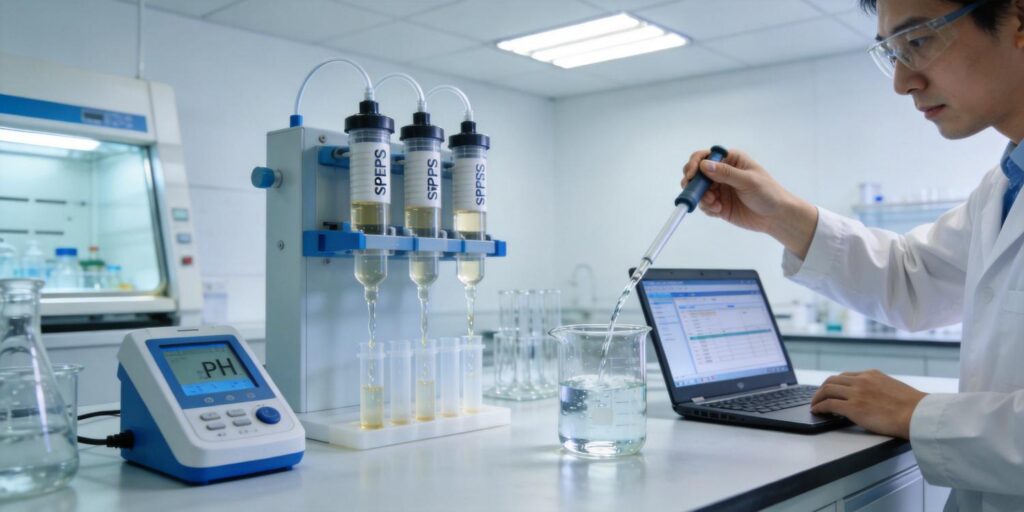
Representative sampling is the first step. Composite samplers collect 24-hour flow-proportional samples at wastewater treatment plant inlets. Upon arrival at the lab, samples are filtered through 0.7–1.0 μm glass fiber filters to remove particulate matter and bacteria. Filtration prevents clogging of SPE cartridges and reduces matrix effects. For more challenging matrices, additional centrifugation or sequential filtration may be employed.
HLB SPE Extraction Workflow
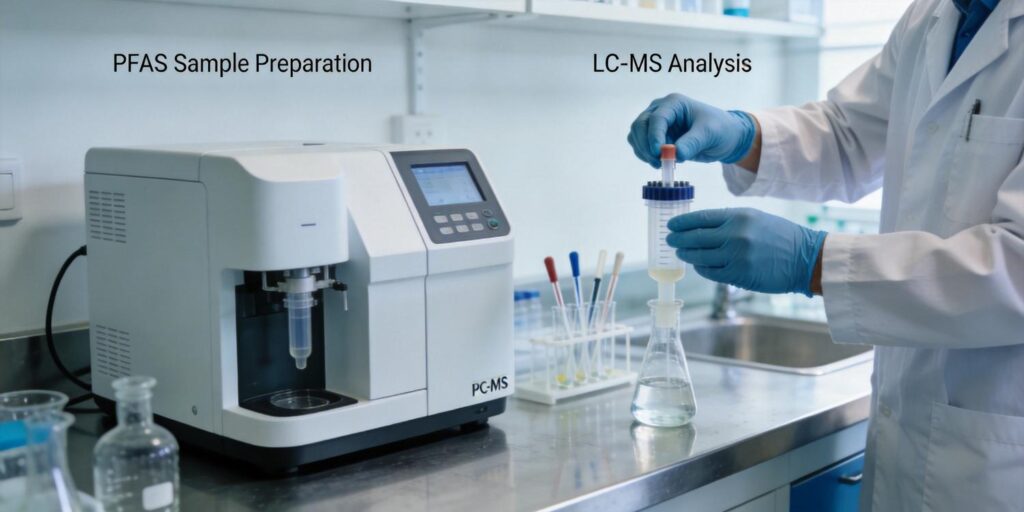
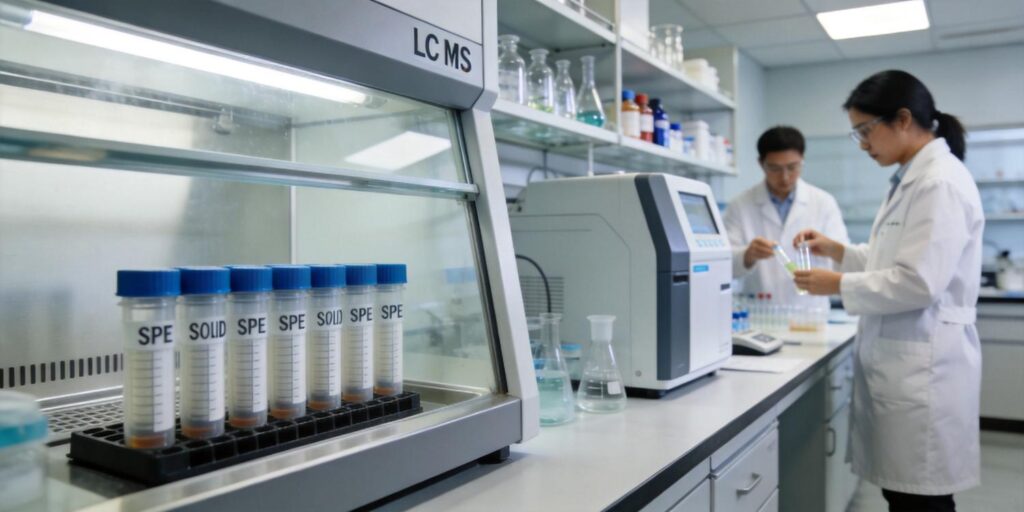
Solid-phase extraction (SPE) using hydrophilic-lipophilic balance (HLB) sorbents, such as those offered by Poseidon Scientific’s HLB SPE Cartridges, provides excellent recovery for a wide polarity range of drug metabolites. The workflow typically involves:
- Conditioning: 3 mL methanol followed by 3 mL deionized water.
- Loading: 50–100 mL of filtered, acidified wastewater (pH 2) passed through at 5–10 mL/min.
- Washing: 3 mL 5% methanol in water to remove polar interferences.
- Elution: 3 mL pure methanol or acetonitrile, sometimes with 0.1% formic acid for basic drugs.
For higher throughput, 96-well SPE plates enable parallel processing of many samples.
Washing and Elution Conditions for Clean Extracts
Optimizing wash and elution steps is key to removing matrix components like humic acids and salts. A common wash uses 5% methanol in water (pH 2 for acidic compounds). For neutral drugs, a wash with 5% methanol/95% water (v/v) suffices. Elution is typically performed with 2 × 3 mL methanol. For acidic metabolites (e.g., THC-COOH), elution with 2% ammonia in methanol improves recovery. Basic drugs may require 0.1% formic acid in methanol. Drying the extract under nitrogen and reconstituting in mobile phase is standard before LC-MS/MS analysis.
LC-MS/MS Detection and Quantification
Liquid chromatography-tandem mass spectrometry (LC-MS/MS) in multiple reaction monitoring (MRM) mode offers the sensitivity and selectivity needed for trace-level detection. Common columns include C18 reverse-phase with acidic mobile phases (e.g., 0.1% formic acid in water/acetonitrile). Isotope-labeled internal standards (e.g., benzoylecgonine-d8) correct for matrix effects and recovery losses. Method detection limits typically range from 0.1 to 10 ng/L, enabling quantification of even low-consumption drugs.
Data Normalization Strategies
Back-calculation of drug consumption requires normalization to population size and flow rate. The standard equation is:
Load (mg/day/1000 people) = (Concentration (ng/L) × Flow rate (L/day) × Correction factor) / (Excretion rate × Population)
Correction factors account for metabolite stability in-sewer degradation and sorption to solids. Flow-proportional sampling and corrections for population dynamics (e.g., using daily variations in ammonia or chemical oxygen demand) improve accuracy.
Public Health and Forensic Applications
WBE data informs public health agencies about geographical and temporal trends in drug use, early warning of NPS emergence, and evaluation of intervention policies. For example, a decrease in cocaine metabolites post-raid can indicate supply reduction effectiveness. During the COVID-19 pandemic, WBE showed shifts from party drugs to increased use of alcohol and benzodiazepines. Law enforcement agencies have also used WBE to monitor drug consumption in specific communities. With robust SPE methods and reliable SPE products from suppliers like Poseidon Scientific, laboratories can generate accurate, reproducible data to support these critical applications.