Cosmetic products present a significant analytical challenge due to their complex formulations containing oils, surfactants, fragrances, pigments, and active ingredients. These matrices can severely interfere with the accurate quantification of preservatives such as parabens, phenoxyethanol, formaldehyde releasers, and isothiazolinones. Solid-phase extraction (SPE) provides an effective cleanup strategy to isolate target preservatives while removing interfering components, enabling reliable HPLC analysis. This blog outlines a robust SPE method tailored for preservative analysis in cosmetics, with emphasis on sorbent selection, sample preparation, and quality control.
1. Cosmetic Formulation Complexity
Cosmetic products range from simple aqueous solutions to complex emulsions (oil-in-water or water-in-oil), anhydrous balms, and powder suspensions. Typical interfering substances include triglycerides, fatty alcohols, silicones, polysorbates, and essential oils. For instance, a moisturizing cream may contain up to 30+ ingredients, many of which co-elute or aggregate during analysis. Without proper cleanup, these components can cause column fouling, poor peak resolution, and inaccurate results. SPE specifically targets the removal of hydrophobic oils and non-polar fragrances while retaining preservatives of interest.
2. Target Preservatives
Common preservatives regulated in cosmetics include methylparaben, propylparaben, ethylparaben, butylparaben, phenoxyethanol, benzyl alcohol, 2-phenoxyethanol, methylisothiazolinone (MIT), methylchloroisothiazolinone (MCT), benzalkonium chloride, and formaldehyde-donors like DMDM hydantoin. These compounds exhibit a wide range of polarities (log P from -0.7 to 3.5), necessitating a sorbent that balances retention and elution. For example, parabens are moderately polar, while isothiazolinones are more water-soluble. A mixed-mode or polymeric SPE phase is often ideal.
3. Sample Dilution Strategy
Most cosmetic samples require dilution to reduce viscosity and minimize matrix load. A typical protocol: weigh 1.0 g of sample into a 10 mL volumetric flask, add 5 mL of methanol (or acetonitrile), vortex for 2 min, sonicate for 10 min, then dilute to volume with water or buffer (pH 3–5). For emulsions, adding 1% formic acid can break the emulsion and improve recovery. Final dilution factor should ensure that the organic solvent content in the loading solution does not exceed 10% (v/v) to prevent breakthrough during SPE. For oily samples (e.g., lip balms), a liquid-liquid extraction (LLE) using hexane may precede SPE to remove bulk oils.
4. SPE Sorbent Selection
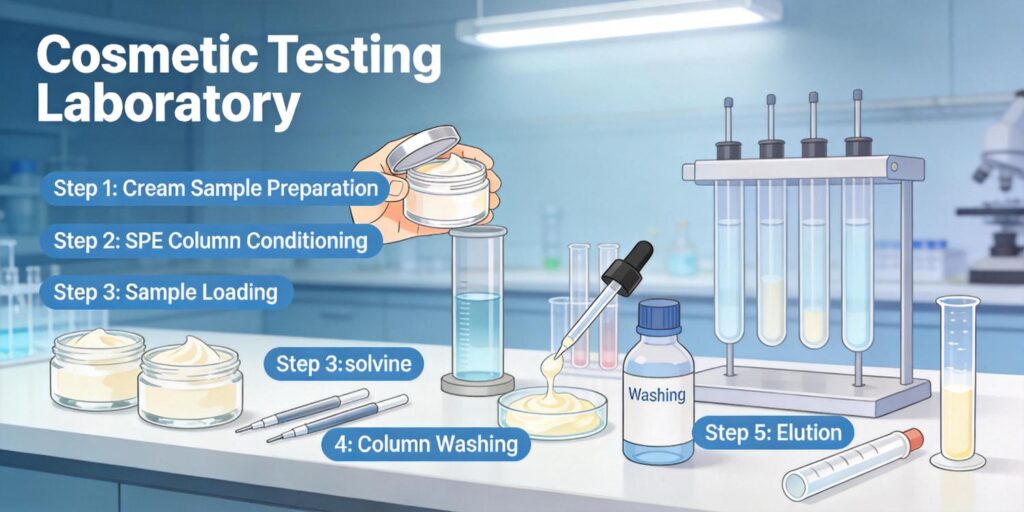
For the wide polarity range of preservatives, a polymer-based reversed-phase sorbent such as a polystyrene-divinylbenzene (PS-DVB) or a mixed-mode reversed-phase/weak anion exchange (WAX) sorbent is recommended. Polymeric sorbents (e.g., HLB, Poseidon HLB SPE Cartridges) offer high surface area and retention for both polar and non-polar analytes. For samples containing acidic preservatives like benzoic acid, a mixed-mode anion exchange (MAX) can provide additional selectivity. A typical 200 mg/6 mL cartridge is sufficient for 100–250 mg of sample matrix. Conditioning: 3 mL methanol, then 3 mL water (or pH 3 buffer).
5. Washing Steps Removing Oils and Fragrances
After sample loading, a washing step removes neutral interferences. Use 3 mL of 5% methanol in water (v/v) to elute polar interferences like sugars and salts. For oils and non-polar fragrances, add a hexane wash (2 × 3 mL) — this selectively elutes triglycerides and essential oils while preservatives remain retained. If the sorbent is a mixed-mode with ion exchange, a pH-adjusted wash (e.g., 0.1% formic acid in water) can also remove acidic/basic interferences. The washing step must be optimized: too aggressive may cause premature elution of target analytes; too weak may leave co-extractives.
6. Elution Conditions
Elute preservatives with 3–5 mL of methanol (or acetonitrile) containing 0.1% formic acid or ammonium acetate (pH 5). For complete elution of all target compounds, a two-step elution may be used: first with ethyl acetate (for non-polar compounds like butylparaben), then with methanol (for polar ones). Collect both fractions and combine. Evaporate to dryness under nitrogen at 40 °C and reconstitute in 1 mL of mobile phase (e.g., water:methanol 1:1). Ensure final solvent matches HPLC initial conditions to avoid peak distortion.
7. HPLC Detection
Analysis is performed using reversed-phase HPLC with C18 column (150 × 4.6 mm, 5 μm) and diode array detection (DAD) at 254 nm (parabens) and 280 nm (phenoxyethanol, isothiazolinones). Mobile phase: gradient of 0.1% formic acid in water (A) and 0.1% formic acid in acetonitrile (B): 0–2 min 20% B, 2–12 min 20–60% B, 12–15 min 60% B, 15–17 min 60–20% B, hold 3 min. Flow rate 1.0 mL/min, injection volume 20 μL. LC-MS/MS can be used for confirmation at low levels (ppb). Chromatographic resolution between target peaks and any remaining matrix peaks is typically >1.5.
8. Quality Control Testing
Validation should include recovery studies using spiked matrix at three concentrations (e.g., 0.5, 1.0, 2.0 × regulatory limit). Acceptable recovery range: 70–120% with RSD ≤ 15%. Include blank matrix, method blank, and solvent blank. Assess matrix effects by comparing post-extraction spiked samples to neat standards. Carryover should be < 0.1% by analyzing a blank after the highest standard. For complex matrices (e.g., sunscreens containing UV filters), use internal standards (e.g., butylparaben-d4) to correct for variability. Long-term stability: extracts stable for 48 h at 4 °C.
In conclusion, SPE cleanup is indispensable for reliable preservative analysis in cosmetics. By selecting the appropriate sorbent (e.g., HLB or mixed-mode), optimizing washing/elution, and implementing rigorous QC, analysts can achieve accurate quantification even in challenging formulations. For more details on compatible SPE consumables, visit Poseidon HLB SPE Cartridges, MCX SPE Cartridges, or the 96-Well SPE Plate for high-throughput applications.