The Challenge of Phenolic Compounds in Plant Extracts
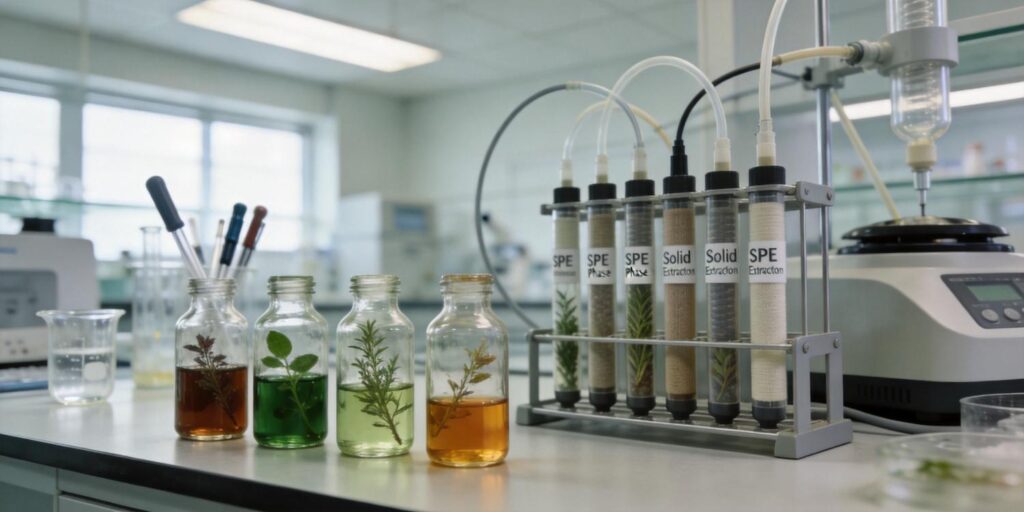
Phenolic compounds are secondary metabolites widely distributed in plants, recognized for their antioxidant, anti-inflammatory, and antimicrobial properties. They play critical roles in human health, contributing to the prevention of cardiovascular diseases, cancers, and neurodegenerative disorders. However, their extraction from complex plant matrices—which contain sugars, organic acids, pigments, and proteins—poses a significant analytical challenge. Solid-phase extraction (SPE) has emerged as the preferred technique for selective enrichment and cleanup of phenolics prior to HPLC analysis. Among available sorbents, polymeric reversed-phase cartridges, particularly HLB (Hydrophilic-Lipophilic Balanced) phases, offer superior performance due to their balanced retention of both polar and nonpolar analytes.
Sample Preparation: From Plant Material to Crude Extract
The first step involves extracting phenolic compounds from dried or fresh plant tissue. Typically, 0.5–2 g of ground sample is extracted with 10–20 mL of aqueous methanol (70–80% v/v) or ethanol under sonication or agitation for 30–60 minutes. After centrifugation and filtration, the crude extract contains phenolics alongside high concentrations of sugars and other co-extractives. Direct injection of this extract into HPLC would quickly contaminate the column and cause poor peak resolution. Therefore, a robust SPE cleanup is essential.
Why HLB SPE Is the Gold Standard for Phenolics
Phenolic compounds range from simple phenolic acids (e.g., gallic, caffeic, ferulic) to complex flavonoids (e.g., quercetin, kaempferol, catechins) and anthocyanins. Their log P values vary widely, making them ideally suited for HLB sorbents, which are composed of a specific ratio of hydrophilic N-vinylpyrrolidone and lipophilic divinylbenzene. The Poseidon HLB SPE cartridges provide high surface area and excellent wetting properties, enabling reproducible retention of phenolic compounds across a broad pH range. Unlike silica-based C18 phases, HLB does not suffer from silanol activity or pH limitations, and it can be operated in reversed-phase mode without requiring a conditioning step for drying.
Conditioning and Loading Protocol
For optimal retention, the HLB cartridge is first conditioned with 3 mL of methanol to activate the sorbent, followed by 3 mL of acidified water (pH 2–3, using formic acid or phosphoric acid). Acidification ensures that weakly acidic phenolics (pKa ~8–10) remain in their neutral, more hydrophobic form, enhancing retention. The crude plant extract (typically 1–5 mL) is loaded at a flow rate of 1 mL/min. A slow loading rate is crucial to avoid breakthrough. After loading, the cartridge is air-dried for 2–5 minutes under vacuum to remove residual aqueous phase.
Washing to Remove Sugars and Polar Interferences
Sugars, organic acids, and polar pigments are removed by washing the cartridge with 2–3 mL of 5–10% methanol in water (v/v). A slightly higher methanol percentage may be used if the phenolics of interest are more polar, but care should be taken not to elute early-eluting phenolics. For anthocyanin-rich extracts, a wash with acidified water (0.1% HCl) can help retain stability.
Elution Optimization
Elution is performed with a small volume of methanol or acetonitrile containing 0.1% formic acid or HCl. Typically, 2–3 mL of acidified methanol recovers over 95% of phenolic compounds. For polyphenols with high molecular weight (e.g., tannins), a 50:50 mixture of methanol:acetone with 0.1% formic acid may improve recovery. The eluate is evaporated under nitrogen and reconstituted in the HPLC mobile phase for injection.
HPLC Analysis of Purified Phenolics
The cleaned extract is analyzed using reversed-phase HPLC with a C18 column (e.g., 250 × 4.6 mm, 5 μm) and a gradient mobile phase of water with 0.1% formic acid (solvent A) and acetonitrile (solvent B). Detection is typically performed with a diode array detector (DAD) at 280 nm (phenolic acids), 320 nm (hydroxycinnamic acids), 360 nm (flavonols), and 520 nm (anthocyanins). MS detection in negative ionization mode provides structural confirmation. Representative chromatograms should show sharp, well-resolved peaks free from interfering sugars or pigments.
Method Validation Parameters
A validated SPE-HPLC method for phenolic compounds should include the following performance criteria: linearity (R² > 0.999 over the expected concentration range), limit of detection (LOD, typically 0.1–1 μg/mL), limit of quantification (LOQ, 0.5–5 μg/mL), intra-day and inter-day precision (RSD < 5%), and spike recovery (85–115%). The matrix effect is assessed by comparing standards prepared in mobile phase versus post-extraction spiked matrix. The 96-well SPE plate format is highly recommended for high-throughput analysis, allowing simultaneous processing of 96 samples with consistent flow rates and reduced solvent consumption.
Practical Tips for High Recovery
- pH control: Maintain sample pH at least two units below the pKa of the most acidic phenolic to ensure neutral form retention.
- Salt addition: Adding 0.5–1% NaCl to the loading solvent can reduce ionic interactions and improve recovery of certain flavonoids.
- Sorbent mass: Use 200 mg HLB cartridges (3 mL reservoir) for samples with moderate phenolic content; 500 mg cartridges for high-fat or high-pigment extracts.
- Breakthrough monitoring: Always collect and analyze the load flow-through to verify that less than 5% of target compounds are lost.
Alternative Sorbent Chemistries
While HLB is the first choice, other polymeric sorbents may be considered for specific applications. For example, WAX (Weak Anion Exchange) cartridges can be used to selectively isolate acidic phenolics at high pH, while MCX (Mixed-Mode Cation Exchange) may be advantageous for basic nitrogen-containing phenolics. Explore the full range of MAX, MCX, WAX, and WCX SPE cartridges from Poseidon Scientific to tailor your method to specific phenolic classes.
Conclusion
SPE using HLB cartridges provides a robust and efficient method for the extraction and cleanup of phenolic compounds from plant extracts. With careful attention to pH, solvent composition, and sorbent selection, analysts can achieve high recovery, excellent reproducibility, and clean chromatograms. This approach is indispensable for quality control of herbal products, functional foods, and nutraceuticals.