Drug Discovery Workflow Overview
The drug discovery pipeline is a complex, multi-stage process that begins with target identification and validation, followed by hit discovery, lead optimization, preclinical testing, and clinical trials. Throughout these stages, scientists generate thousands of samples that require robust analysis to identify promising candidates. Bioanalytical support is critical for pharmacokinetic (PK), pharmacodynamic (PD), and toxicokinetic (TK) studies. Solid-phase extraction (SPE) has become the gold standard for sample cleanup in bioanalysis due to its efficiency in removing matrix interferences and concentrating analytes.
Need for High-Throughput Sample Preparation
Traditional SPE using individual cartridges is labor-intensive and time-consuming, creating a bottleneck in high-throughput screening (HTS) environments. Pharmaceutical companies routinely screen hundreds of compounds per week, each requiring multiple time points and replicates. To keep pace with modern LC-MS/MS systems that can analyze a sample every minute, sample preparation must match this throughput without compromising quality. The 96-well SPE plate addresses this need by parallel processing 96 samples simultaneously.
Advantages of 96-Well SPE Plates
96-well SPE plates offer several key advantages over traditional cartridge-based SPE:
- Parallel Processing: All 96 wells are processed simultaneously, dramatically increasing throughput.
- Reduced Solvent Consumption: Lower bed masses (10–100 mg) require less conditioning and elution solvent.
- Automation Compatibility: Designed for use with liquid handlers and positive pressure manifolds.
- Direct Elution: Eluates can be collected directly into 96-well plates for LC-MS injection.
- Improved Reproducibility: Consistent packing and flow characteristics across wells minimize well-to-well variability.
Plate Conditioning and Automation
Proper conditioning of the 96-well SPE plate is essential for reproducible results. A typical procedure involves:
- Solvent Activation: Pass methanol or acetonitrile through each well to wet the sorbent.
- Equilibration: Follow with water or buffer at the sample pH to prepare the sorbent for analyte retention.
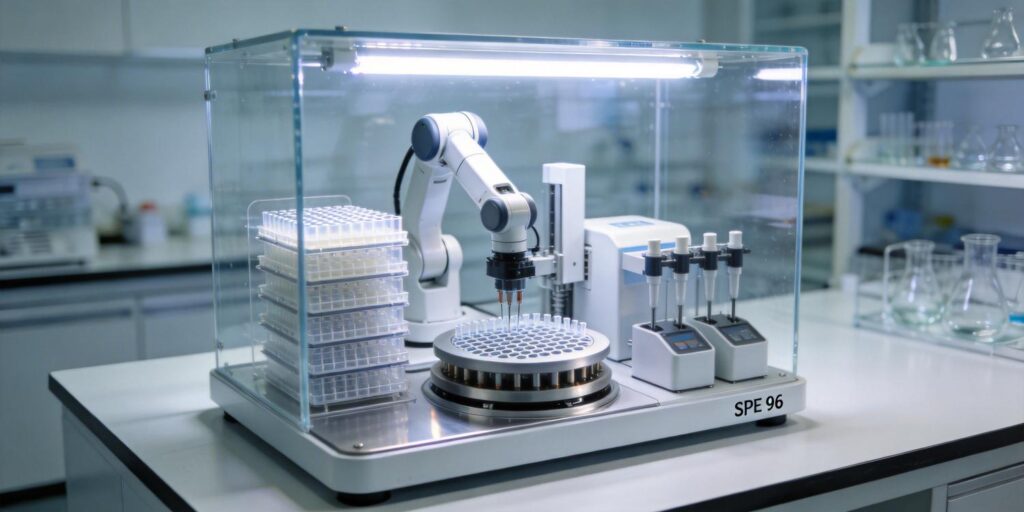
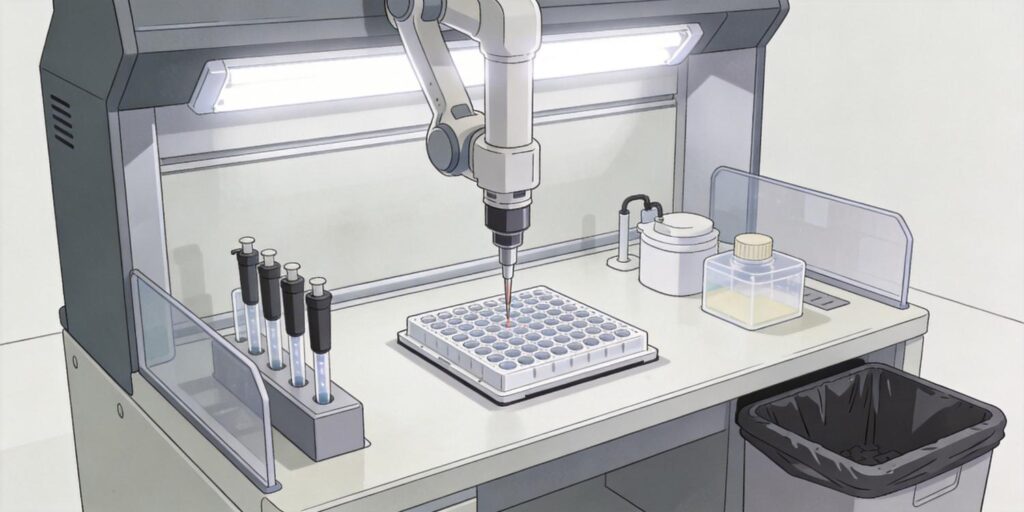
For automated workflows, a liquid handler (e.g., Hamilton STARlet, Tecan Freedom EVO) or a positive pressure manifold is used to control flow rate. The HLB, MAX, MCX, WAX, and WCX sorbent chemistries are available in plate formats, allowing method transfer from cartridge methods.
Sample Loading Strategies
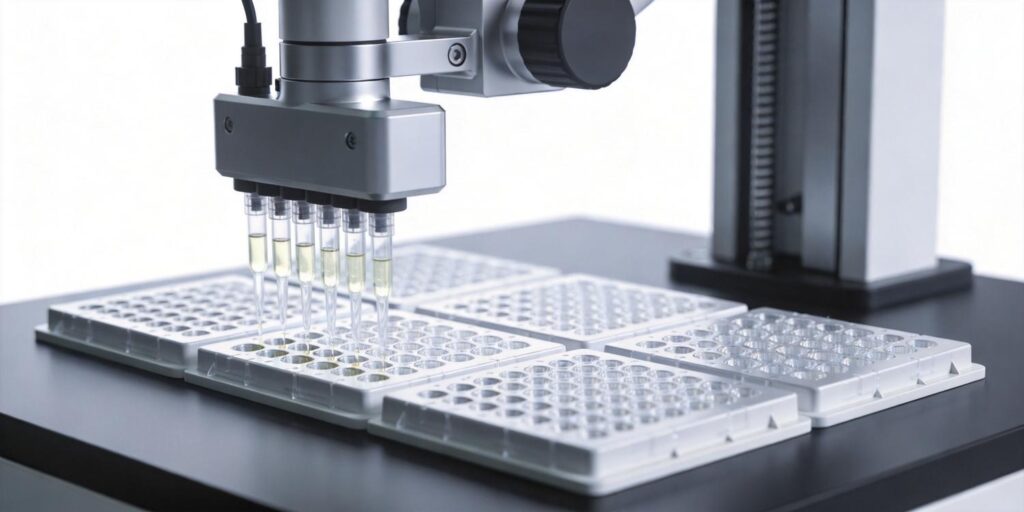
Sample loading is a critical step. For 96-well plates, the sample (typically plasma, serum, or urine) is often pre-treated with internal standard and diluted with buffer to reduce viscosity and improve flow. Loading volumes typically range from 50–500 μL per well. It is important to avoid cross-contamination: use disposable tips or wash probes between rows. The flow rate during loading should be controlled (1–2 mL/min) to ensure adequate contact time with the sorbent.
Washing and Elution Steps
After loading, a washing step removes interfering matrix components. Typical wash solutions include 5% methanol in water or 0.1% formic acid in water for reversed-phase sorbents. For ion-exchange sorbents, pH-adjusted washes are used. Elution is performed with a small volume (100–300 μL) of organic solvent such as methanol or acetonitrile, often containing additives like 5% ammonia (for basic analytes) or 5% formic acid (for acidic analytes). The eluate is collected directly into a 96-well collection plate and can be evaporated or injected directly after dilution.
Integration with LC-MS Autosamplers
Modern LC-MS systems (e.g., Agilent 1290, Waters Xevo) support 96-well plates directly in the autosampler. This seamless integration eliminates the need for vial transfer, reducing sample handling errors and contamination risks. The collection plate is simply sealed with a pierceable foil or silicone mat and placed in the autosampler tray. Injection volumes of 1–10 μL are typical. The direct elution approach is preferred over evaporative reconstitution for higher throughput, although sensitivity-sensitive assays may require concentration.
Throughput and Reproducibility Improvements
Adopting 96-well SPE plates can improve throughput by 5–10× compared to cartridge-based methods. With automation, a single operator can prepare 384 samples (four plates) in under two hours, including conditioning, loading, washing, and elution. Reproducibility is enhanced by consistent packing and controlled flow; %RSD for peak areas across wells is typically <10%. The design of Poseidon Scientific’s 96-well SPE plates ensures low well-to-well carryover (<0.1%) and high recoveries (85–115%) for a wide range of drug-like compounds. For method transfer guidance, our HLB, MAX, MCX, WAX, and WCX product pages provide detailed sorbent specifications and application notes.