The Critical Role of Metabolomics in Cell Culture Research
Metabolomics provides a functional readout of cellular states by profiling small-molecule metabolites in biological systems. In cell culture studies, analyzing the metabolome from conditioned media offers non-invasive access to extracellular metabolic activity, drug metabolism, and biomarker discovery. However, the complex matrix of cell culture media—rich in salts, amino acids, vitamins, sugars, and serum components—presents significant challenges for direct LC-MS analysis. Matrix effects, ion suppression, and column fouling are common pitfalls. Solid-phase extraction (SPE) has emerged as the preferred sample preparation technique to clean up and concentrate metabolites prior to LC-MS, with HLB SPE cartridges offering a balanced, reproducible solution for a wide range of metabolite polarities.
Understanding Culture Media Matrix Complexity
Cell culture media are formulated to support cell growth and typically contain high concentrations of inorganic salts (e.g., NaCl, KCl, CaCl2), glucose, amino acids (glutamine, serine, etc.), vitamins (B-group, folate), and often fetal bovine serum (FBS) or serum replacements. The protein content from serum alone can exceed 10 mg/mL, while salts can exceed 100 mM. This environment poses a triple threat to LC-MS metabolomics: (1) high salt loads cause ion suppression and adduct formation; (2) proteins precipitate in organic solvents and clog columns; (3) abundant media components mask low-abundance metabolites. A robust SPE method must remove these interferences while retaining metabolites of interest—a task for which HLB SPE cartridges are particularly well-suited due to their hydrophilic-lipophilic balanced polymer sorbent.
Why HLB SPE Is Ideal for Metabolite Extraction
The HLB (Hydrophilic-Lipophilic Balance) sorbent, typically a copolymer of N-vinylpyrrolidone and divinylbenzene, provides a water-wettable polymer with both hydrophilic (pyrrolidone) and lipophilic (divinylbenzene) functional groups. This dual retention mechanism allows HLB to capture a broad spectrum of metabolites from polar organic acids to non-polar lipids. Unlike C18 silica, HLB does not require a pre-wetting step and tolerates drying out, making it robust for high-throughput workflows. For metabolomics, the MAX SPE cartridges (mixed-mode anion exchange) or MCX SPE cartridges (mixed-mode cation exchange) may be chosen for targeted ionic metabolites, but HLB remains the first choice for broad metabolomic profiling due to its unbiased retention behavior across a wide pH range.
Sample Preparation Workflow for Cell Culture Media
A typical workflow begins with harvesting conditioned media (1–5 mL) and centrifuging at 10,000 × g for 10 min at 4°C to remove cells and debris. The supernatant is then mixed with an equal volume of cold methanol (to precipitate proteins) and centrifuged again. The resulting supernatant is diluted with water to reduce organic solvent content to <5% (v/v) before loading onto the SPE cartridge. This step is critical to ensure proper retention—high organic content can break through polar analytes. For samples with high protein content, an alternative approach is to acidify with 2% formic acid (v/v) and load directly onto the HLB cartridge, which can retain metabolites while proteins wash through.
Step-by-Step SPE Extraction with HLB Cartridges
Conditioning and Equilibration
Poseidon Scientific recommends conditioning 3 mL/60 mg HLB cartridges with 3 mL methanol followed by 3 mL water (or 2% formic acid in water for acidic metabolites). Do not allow the sorbent to dry completely after conditioning—though HLB is forgiving, best practice is to maintain a solvent layer.
Sample Loading
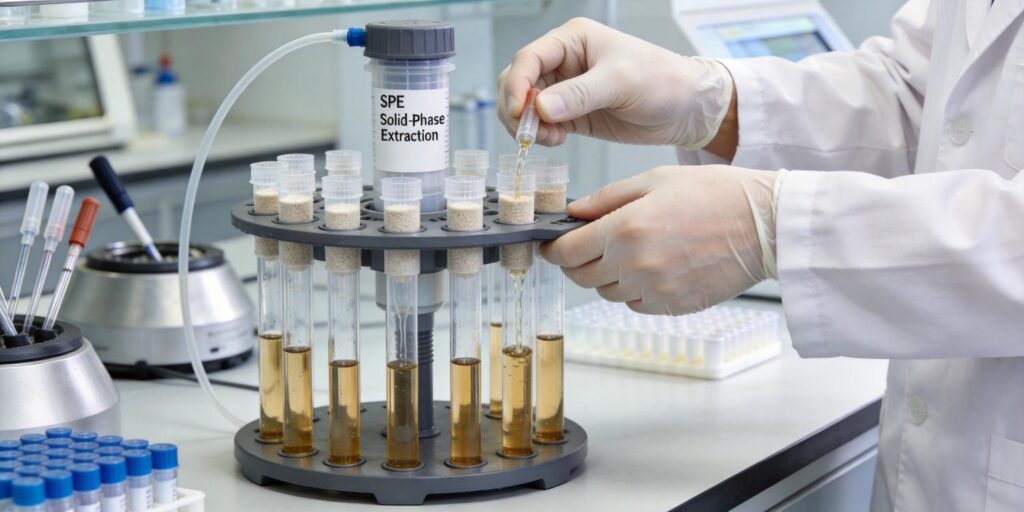
Load the pre-treated media sample (typically 1–5 mL) at a flow rate of ~1 mL/min. For large volumes (e.g., 10–50 mL), a vacuum manifold such as the 96-well SPE plate format can improve throughput. Collect the flow-through if recovery needs to be assessed.
Washing
Wash with 3 mL of 5% methanol in water (v/v) to remove salts and polar interferences. For more stringent cleanup, a wash with 2% formic acid in water can help remove proteins and charged species without eluting neutral metabolites. A second wash with 3 mL of 50% methanol in water may remove some lipids but will also elute medium-polarity metabolites—use only if targeted analysis permits.
Elution Optimization
Elute retained metabolites with 2–3 mL of methanol (for neutral and hydrophobic metabolites) followed by 2 mL of 2% formic acid in methanol (for acidic metabolites) or 2% ammonium hydroxide in methanol (for basic metabolites). A stepwise elution can fractionate metabolite classes. For example, elute with 100% methanol (fraction 1), then 2% NH4OH in methanol (fraction 2), then 2% formic acid in methanol (fraction 3). Pool fractions or analyze separately based on the metabolomics scope.
Linking SPE to LC-MS Metabolomics Analysis
After SPE, eluates are evaporated to dryness under nitrogen or in a SpeedVac and reconstituted in a suitable solvent (e.g., 50% acetonitrile/water). For reversed-phase LC-MS, a C18 column with a gradient of 0.1% formic acid in water (A) and 0.1% formic acid in acetonitrile (B) is typical. Hydrophilic interaction liquid chromatography (HILIC) is often paired with SPE for polar metabolites. The WAX SPE cartridges (weak anion exchange) can be used to selectively enrich acidic metabolites like nucleotides and organic acids, complementing HLB for targeted metabolomics workflows.
Ensuring Data Reproducibility
Reproducibility in metabolomics SPE hinges on consistent sorbent mass, flow rate, and solvent volumes. Using isotopically labeled internal standards (e.g., 13C-glutamine, d3-methionine) spiked into the sample before SPE allows correction for recovery variability. Batch-to-batch variability of SPE cartridges is minimized by using products from a single lot; Poseidon Scientific provides lot-specific QC data upon request. For large studies, employing a 96-well SPE plate with robotic liquid handling ensures identical processing across all samples. Always include solvent blanks and pooled quality control (QC) samples injected every 10–15 runs during LC-MS analysis to monitor drift and carryover.
Conclusion
HLB SPE remains the backbone of untargeted metabolomic sample preparation from cell culture media, effectively removing salts and proteins while retaining a comprehensive set of metabolites. By optimizing wash and elution conditions, researchers can achieve high recovery and reproducibility essential for robust LC-MS metabolomics. For laboratories transitioning to high-throughput formats, Poseidon Scientific offers scalable solutions from individual cartridges to plate formats, enabling seamless integration into any metabolomics pipeline.