Types of Synthetic Food Colorants
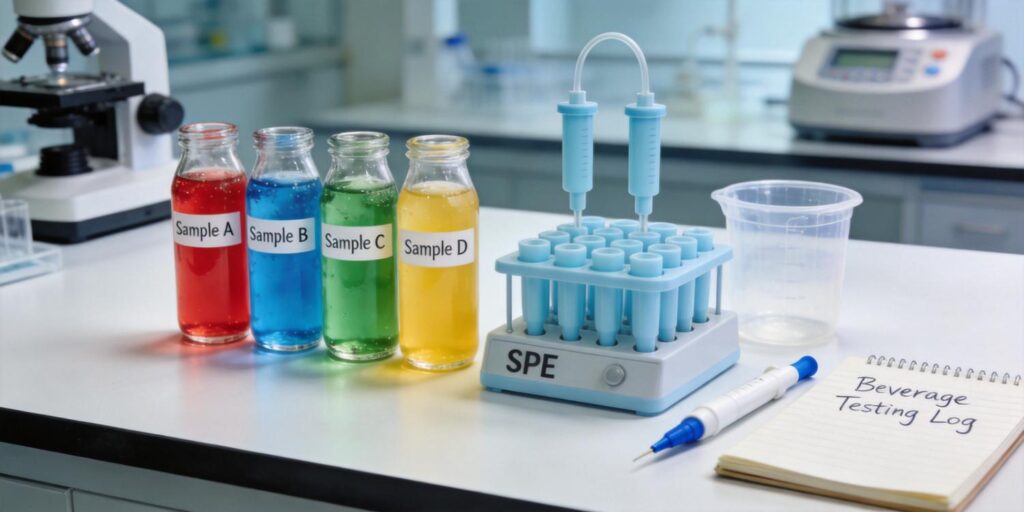
Synthetic food colorants are widely used in beverages to enhance visual appeal and ensure product consistency. Common examples include Tartrazine (E102), Sunset Yellow (E110), Allura Red (E129), Brilliant Blue (E133), and Ponceau 4R (E124). These azo dyes and triarylmethane compounds are regulated by agencies like the FDA and EFSA, with strict maximum allowable limits. Detecting trace levels of these colorants in complex beverage matrices is critical for food safety compliance and label verification.
Beverage Matrix Challenges
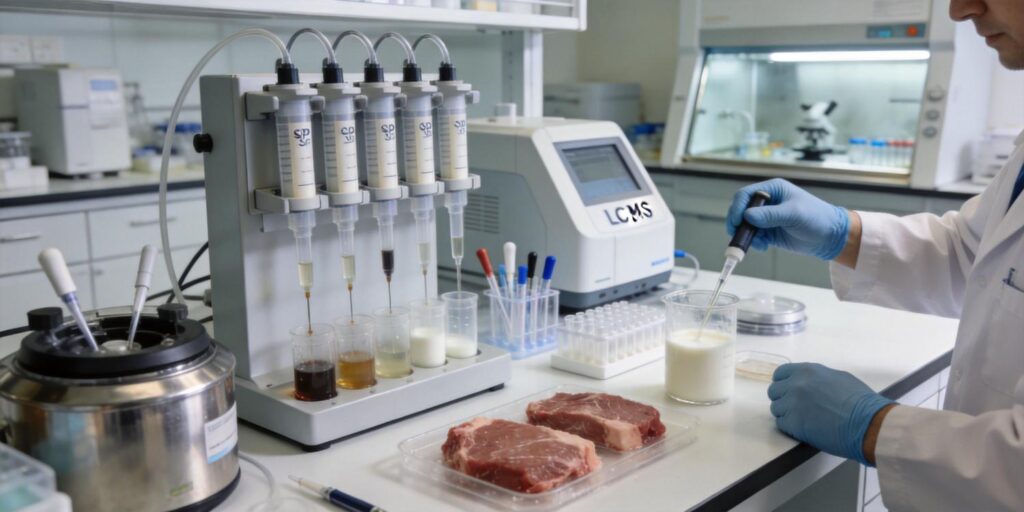
Beverages present a challenging matrix for colorant analysis due to high levels of sugars (e.g., glucose, fructose, sucrose), organic acids (e.g., citric, malic, ascorbic), natural pigments, and preservatives. These components can interfere with chromatographic separation and cause ion suppression in mass spectrometry. Additionally, carbonated beverages may release CO2 during sample handling, altering pH and affecting analyte stability. A robust cleanup method is essential to remove matrix interferences while retaining target colorants.
Sample Dilution and pH Control
Prior to solid-phase extraction (SPE), beverage samples are typically diluted with deionized water to reduce viscosity and matrix load. A dilution factor of 1:5 to 1:10 (sample:water) is common. pH adjustment is critical: synthetic food colorants are ionizable compounds, and their retention on SPE sorbents depends on the pH of the loading solution. For mixed-mode sorbents, a slightly acidic pH (e.g., pH 3-4) ensures that sulfonic acid groups on the sorbent are protonated, maximizing ionic interactions with the anionic sulfonate groups of the colorants. Using a buffer such as citrate or phosphate helps maintain pH consistency.
SPE Sorbent Selection
For the cleanup of synthetic colorants, mixed-mode reversed-phase/strong anion-exchange (MAX) SPE cartridges are highly recommended. These sorbents combine hydrophobic (C18-like) retention with anion-exchange functionality, allowing selective capture of anionic dyes while allowing neutral and cationic interferences to pass through. Alternative options include WCX (weak cation-exchange) for cationic dyes, but for most sulfonated azo dyes, MAX provides optimal selectivity. Cartridge formats (e.g., 3 mL, 60 mg) are suitable for sample volumes of 1-5 mL. For high-throughput workflows, 96-well SPE plates with the same sorbent chemistry can be used.
Cleanup Steps Removing Sugars and Acids
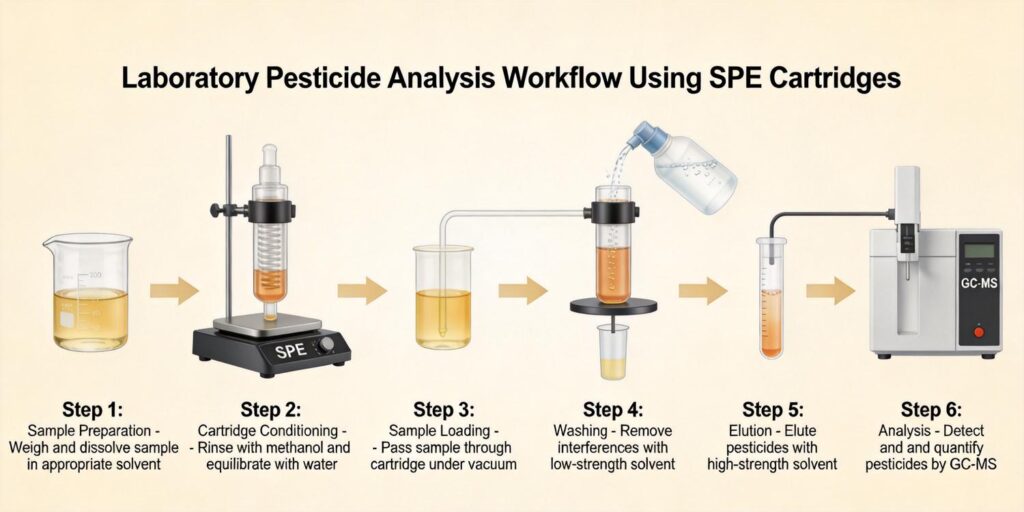
The SPE protocol begins with cartridge conditioning using methanol followed by water. After loading the pH-adjusted sample, a washing step is performed using a mixture of water and methanol (e.g., 95:5, v/v) to remove weakly retained matrix components such as sugars, organic acids, and polar interferences. For more stringent cleanup, a second wash with 2% ammonia in water can be employed to elute acidic interferences while colorants remain retained. This step significantly reduces co-extracted matrix compounds, improving chromatographic resolution and detector sensitivity.
Elution Protocol
Target colorants are eluted using a solution that disrupts both hydrophobic and ionic interactions. A common elution solvent is methanol containing 2-5% ammonium hydroxide (NH4OH). The basic pH deprotonates the sorbent’s anion-exchange groups, releasing the anionic dyes. Typical elution volume is 1-2 mL, collected in a glass tube. The eluate is then evaporated under nitrogen and reconstituted in mobile phase or water for HPLC analysis. For direct injection, the eluate can be diluted with water to match the initial mobile phase composition.
HPLC Analysis
Separation of synthetic colorants is typically achieved using a C18 reversed-phase column (e.g., 150 × 4.6 mm, 5 µm) with a mobile phase gradient consisting of ammonium acetate buffer (pH 4.5) and acetonitrile or methanol. Detection is performed with a diode array detector (DAD) at wavelengths specific to each dye (e.g., 425 nm for Tartrazine, 485 nm for Sunset Yellow, 520 nm for Allura Red, 620 nm for Brilliant Blue). LC-MS/MS in negative ion mode can be used for confirmation and quantification at sub-ppm levels. The cleanup provided by SPE ensures that matrix effects are minimized, yielding clean chromatograms with baseline separation of colorants.
Food Safety Compliance
Regulatory agencies such as the U.S. FDA (21 CFR Part 74) and the European Commission (Regulation (EC) No 1333/2008) set maximum permitted levels for synthetic colorants in beverages, typically ranging from 50 to 500 mg/L depending on the dye and product category. Accurate quantification of these colorants is essential for compliance verification, especially for imported goods and private-label products. The SPE method described here, using MAX SPE cartridges from Poseidon Scientific, provides a reliable and reproducible cleanup approach suitable for routine quality control and regulatory testing. By effectively removing sugars and acids, the method ensures robust HPLC analysis and helps manufacturers meet food safety standards, protecting consumer health and avoiding costly recalls.