Environmental Relevance of NSAIDs in Aquatic Systems
Nonsteroidal anti-inflammatory drugs (NSAIDs) such as ibuprofen, diclofenac, and naproxen are among the most commonly detected pharmaceuticals in surface waters worldwide. These compounds enter aquatic environments primarily through wastewater effluent, agricultural runoff, and improper disposal. Even at trace concentrations (ng/L to µg/L), NSAIDs can cause adverse effects on aquatic organisms, including endocrine disruption and oxidative stress. Consequently, robust analytical methods are essential for monitoring these contaminants in environmental matrices like river water.
Acidic Properties of Common NSAIDs
Ibuprofen (pKa ~4.9), diclofenac (pKa ~4.2), and naproxen (pKa ~4.2) are weak acids with carboxyl functional groups. In their neutral form (pH pKa), they carry a negative charge. This pH-dependent ionization is exploited in weak anion exchange (WAX) solid-phase extraction, where the sorbent retains ionized analytes via electrostatic interactions while neutral compounds pass through.
Sample Collection and Filtration
River water samples should be collected in pre-cleaned amber glass bottles, stored at 4°C, and processed within 48 hours. Prior to extraction, each sample is vacuum-filtered through a 0.45 µm glass fiber filter to remove suspended solids and microorganisms that could clog the cartridge or interfere with analysis. Filtered samples are then measured for pH and adjusted as described below.
pH Adjustment to Promote Anion Exchange Retention
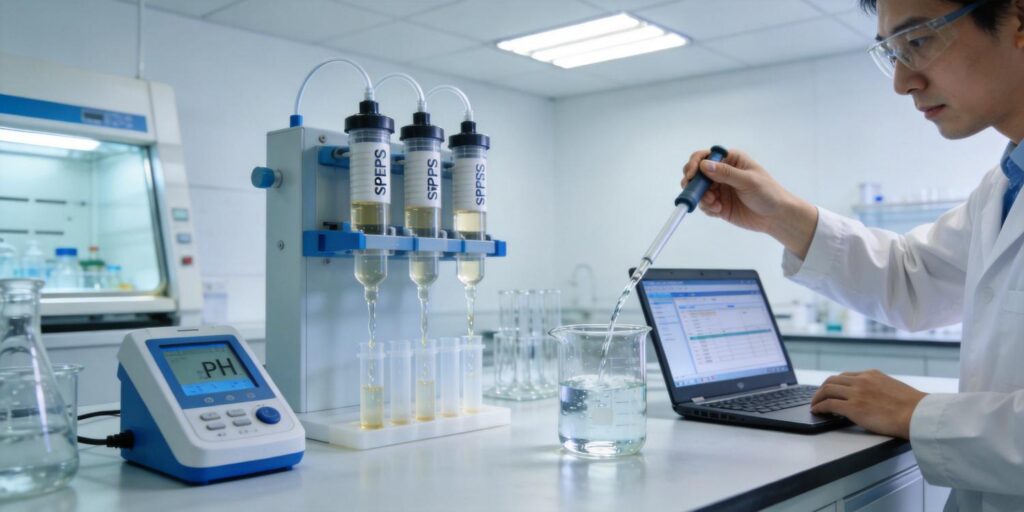
To ensure NSAIDs are in their anionic form, the sample pH must be adjusted to at least 2 units above the highest pKa. For these three NSAIDs, a target pH of ~7.0 is sufficient. This is achieved by adding dilute ammonium hydroxide or sodium hydroxide dropwise while stirring. A pH meter is used to verify the final pH, as over-adjustment can lead to hydrolysis or precipitation of humic substances.
WAX SPE Cartridge Conditioning and Equilibration
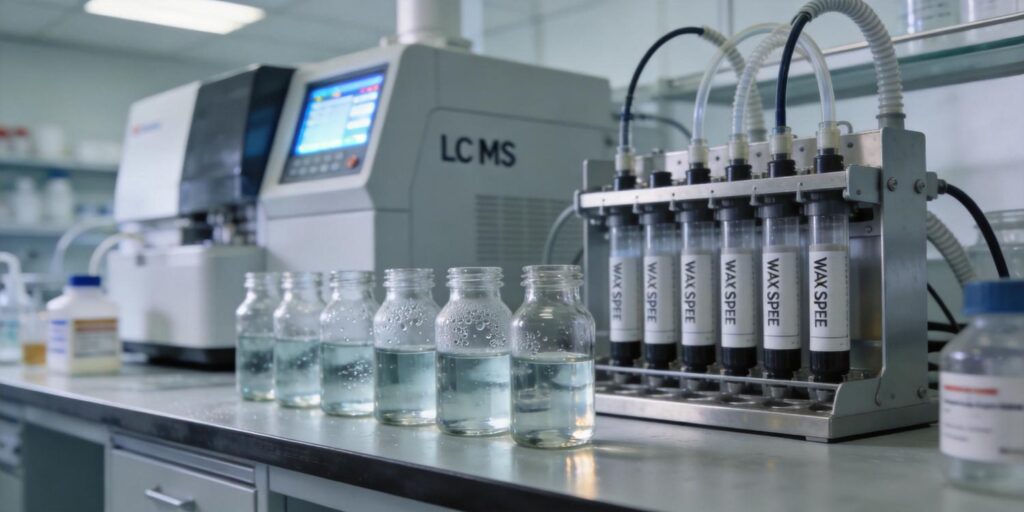
Weak anion exchange cartridges, such as the Poseidon WAX SPE Cartridges, are conditioned with 3 mL of methanol followed by 3 mL of deionized water (or 5 mM ammonium acetate buffer at pH 7). The cartridge should not be allowed to dry between conditioning and sample loading. Equilibration with buffer ensures a consistent ionic environment for reproducible retention.
Loading Large Sample Volumes (500–1000 mL)
A key advantage of WAX SPE is the ability to process large volumes (500–1000 mL) of clean river water without breakthrough, owing to the strong ionic interaction between the negatively charged analytes and the positively charged sorbent. The sample is loaded at ~5–10 mL/min using a vacuum manifold or positive pressure system. For high turbidity samples, pre-filtration is critical to avoid clogging.
Washing with Aqueous and Organic Solvents to Remove Humic Substances
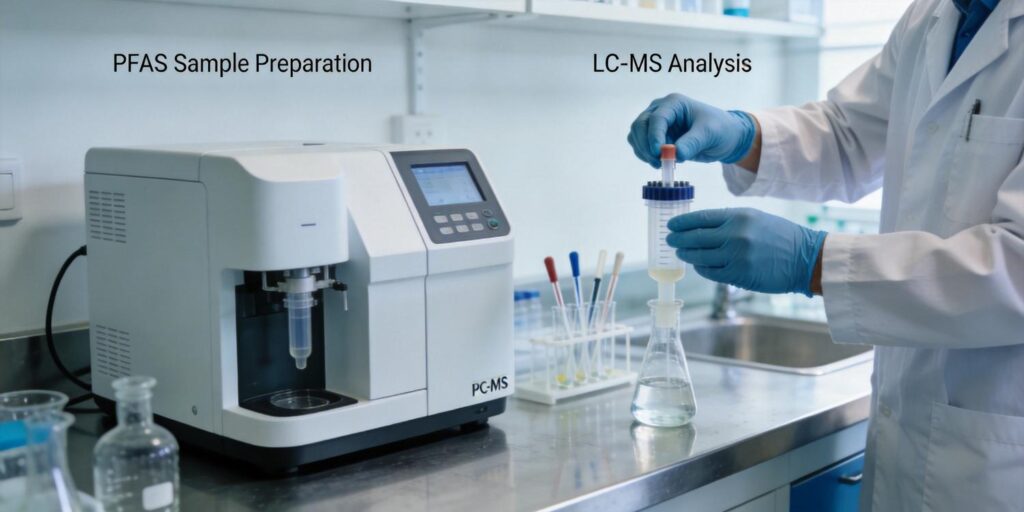
After loading, the cartridge is washed with 3 mL of deionized water (pH 7) to remove salts and weakly retained interferences, followed by 3 mL of 40% methanol in water to elute humic acids and other organic matter. This step is crucial for reducing matrix effects in LC-MS/MS. The wash solvent composition can be optimized to maximize cleanup while retaining the target NSAIDs.
Elution with Acidified Methanol
To disrupt the ionic interaction, the retained NSAIDs are eluted with 3 mL of methanol containing 2% formic acid (v/v). The acid protonates the analytes, neutralizing their charge and allowing them to be released from the sorbent. The eluate is collected in a glass tube, evaporated to dryness under a gentle nitrogen stream at 40°C, and reconstituted in 200–500 µL of mobile phase (e.g., 50:50 methanol:water).
LC-MS/MS Detection and Method Validation
Separation is achieved on a C18 reversed-phase column (e.g., 2.1 × 100 mm, 1.7 µm) using a gradient of 0.1% formic acid in water and acetonitrile at 0.3 mL/min. Detection is performed in negative electrospray ionization (ESI-) mode with multiple reaction monitoring (MRM) for transitions: ibuprofen 205→161, diclofenac 294→250, naproxen 229→170. Recoveries should range between 85–110% with RSD <15%. The method detection limits (MDLs) typically reach 1–5 ng/L, adequate for environmental monitoring.
For reliable results, include surrogate standards (e.g., ibuprofen-d3) to correct for losses. Matrix-matched calibration curves and spike-recovery experiments at three concentration levels are recommended for validation. The described WAX SPE protocol is readily implemented using commercial cartridges like the HLB or WAX series from Poseidon Scientific, offering a cost-effective solution for routine NSAID analysis in surface waters.