1. Overview of Beta-Blocker Drugs and Pharmacokinetic Monitoring
Beta-blockers (e.g., propranolol, metoprolol, atenolol) are widely prescribed for hypertension, angina, and arrhythmias. Therapeutic drug monitoring (TDM) in plasma is essential to ensure efficacy and avoid toxicity, requiring robust cleanup methods for accurate LC-MS/MS analysis.
2. Chemical Properties of Beta-Blockers as Basic Compounds
Most beta-blockers contain secondary amines (pKa ~9–10) and are basic, ionizable under acidic conditions. At low pH, they exist as cations, enabling strong retention on mixed-mode cation exchange sorbents like MCX.
3. Plasma Sample Pretreatment via Protein Precipitation
Plasma (200 µL) is mixed with acetonitrile (800 µL) containing internal standard (e.g., propranolol-d7). After vortexing and centrifugation (10,000 g, 10 min), the supernatant is collected and acidified with 10 µL of 10% phosphoric acid to pH ≤ 3.
4. Acidification Strategy to Enhance Cation Exchange Retention
Adjusting the sample to pH 2–3 ensures beta-blockers are fully protonated. This maximizes electrostatic interaction with the sulfonic acid groups of the MCX sorbent, while neutral interferences pass through or wash away.
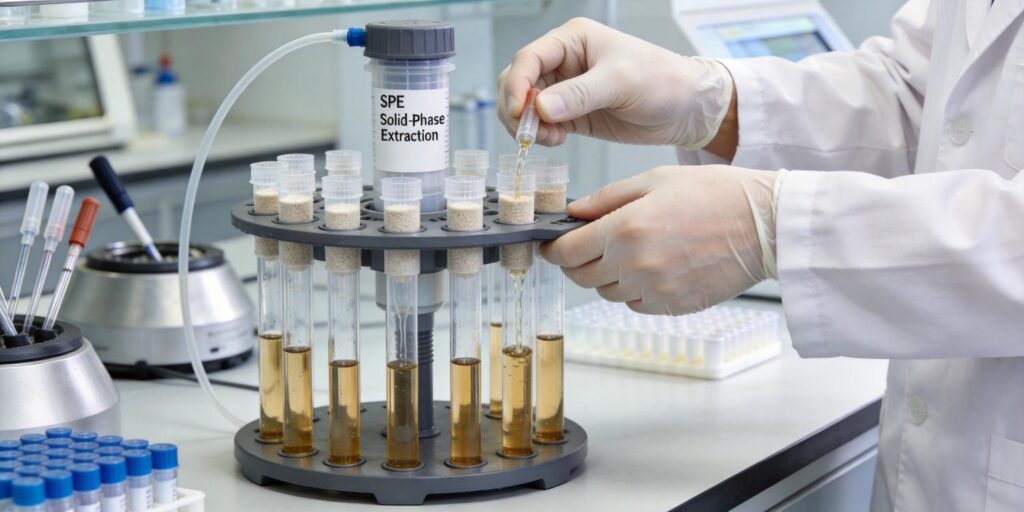
5. MCX SPE Conditioning and Loading Protocol
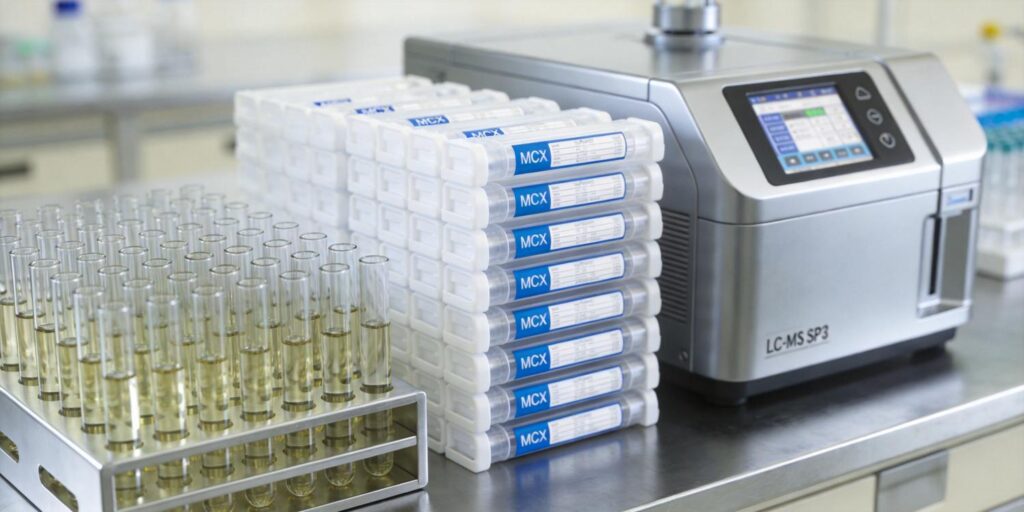
The MCX SPE cartridge (30 mg / 3 mL) is conditioned with 3 mL methanol and 3 mL 0.1 M HCl. The acidified plasma extract is loaded at 1 mL/min, followed by a 1 mL 0.1 M HCl wash to remove residual matrix.
6. Washing with Aqueous Acid and Organic Solvents
To eliminate hydrophobic interferences, wash with 3 mL 0.1 M HCl / methanol (80:20, v/v). This step removes proteins, salts, and phospholipids without eluting the protonated analytes.
7. Elution Using Ammoniated Methanol
Beta-blockers are eluted with 2 mL of 5% ammonium hydroxide in methanol (freshly prepared). The basic eluent neutralizes the sorbent, breaking the ionic interaction and releasing the analytes.
8. LC-MS/MS Quantification Workflow
The eluate is evaporated under nitrogen at 40°C, reconstituted in 100 µL mobile phase (0.1% formic acid / acetonitrile, 80:20), and injected onto a C18 column (e.g., 50 × 2.1 mm, 1.7 µm). MRM transitions are monitored for each analyte.
9. Validation Parameters Including Recovery and Matrix Effect
Method validation shows >85% recovery for all beta-blockers at three QC levels (10, 100, 500 ng/mL). Matrix effect is <15%, and accuracy ranges 90–110% with intra-/inter-day RSD <10%.
For high-throughput needs, explore our 96-well SPE plates for parallel processing. For complementary sorbents, see WCX or MAX options.