Veterinary Drug Classes in Residue Analysis
Veterinary drug residue analysis encompasses a diverse range of therapeutic classes that require specialized SPE approaches. According to Simpson and Wynne (2000), the primary drug classes targeted in veterinary screening include:
Non-Steroidal Anti-Inflammatory Drugs (NSAIDs)
Common NSAIDs like phenylbutazone, flunixin, and ketoprofen represent one of the most frequently encountered drug classes in veterinary medicine. These acidic compounds require specific pH optimization during SPE extraction to achieve optimal recovery.
Anabolic Steroids and Corticosteroids
Steroidal compounds present unique challenges due to their hydrophobic nature and structural similarities. The same region of the steroid molecule responsible for efficient retention on silica phases is also likely to be recognized by specific antibodies in immunoaffinity approaches.
Basic Drugs
This broad category includes β-blockers, β-agonists (such as salbutamol and clenbuterol), opiates (morphine and etorphine), narcotic analgesics (fentanyl and dextromoramide), alkaloidal drugs (quinine and strychnine), and basic diuretics (amiloride, triamterene, and clopamide). Mixed-mode SPE cartridges combining SCX and non-polar interactions have proven particularly effective for these compounds.
Antibacterial Agents
Antibacterial drugs, including sulfonamides and tetracyclines, require specialized extraction approaches. Research demonstrates successful SPE applications for sulfadimethoxine, N-acetyl metabolites, and multiple sulfonamide compounds in various animal tissues.
Other Therapeutic Classes
The veterinary drug landscape also includes cardiac glycosides (like digoxin), benzodiazepines, xanthines (including caffeine), and various hormones and natural products. Each class presents unique physicochemical properties that dictate specific SPE strategy requirements.
Sample Matrices in Veterinary Analysis
Veterinary drug residue analysis encounters diverse biological matrices, each presenting unique challenges for SPE cleanup:
Urine
Equine and other animal urine presents particular challenges due to its comparative viscosity, which may result from polymucosaccharides or proteoglycans causing clotting on SPE frits or sorbent beds. Horse urine from grazing animals often contains endogenous urinary acids and plant phenolics that can interfere with analysis if not properly removed during SPE.
Blood and Plasma
Equine blood analysis faces the challenge of relatively high-packed cell volume compared to other species, resulting in lower plasma yields. This limitation typically requires larger sample collection volumes. Plasma samples generally yield cleaner extracts than urine due to lower matrix complexity.
Tissue Samples
Adipose tissue, muscle, liver, and other solid tissues require specialized approaches. Traditional SPE necessitates sample liquefaction or analyte solubilization from the solid matrix. Matrix Solid Phase Dispersion (MSPD) has emerged as a simpler and more broadly applicable technique for solid samples compared to pre-extraction work-up followed by cartridge SPE.
Other Biological Matrices
Veterinary analysis may extend to fecal matter, stomach contents, postmortem samples, feed, pharmaceutical preparations, and various industry samples. Meconium analysis, for instance, provides a historical record of fetal exposure to compounds in the mother’s bloodstream during development.
Milk and Dairy Products
Dairy matrices present unique challenges due to their complex composition of proteins, fats, and carbohydrates. MSPD has been successfully applied to milk sample preparation for immunoassay and HPLC screening of drug residues.
SPE Cleanup Strategy for Veterinary Drug Residues
Effective SPE strategy for veterinary drug residues requires a systematic approach considering drug properties, matrix characteristics, and analytical requirements:
Mixed-Mode SPE Approaches
Mixed-mode cartridges combining hydrophobic and ion-exchange interactions have revolutionized veterinary drug analysis. SCX/non-polar mixed-mode cartridges allow extraction of basic drugs at neutral pH, enabling isolation of compounds that might be unstable at extreme pH conditions. These cartridges facilitate rapid recovery of diverse drug groups without requiring back-extraction or lengthy clean-up procedures.
pH Optimization Strategy
pH control represents a critical parameter in veterinary SPE. Basic drugs can be isolated from urine at neutral pH, protecting pH-sensitive compounds. For acidic drugs like NSAIDs, appropriate pH adjustment ensures optimal retention and recovery. The ability to extract compounds at their stable pH ranges represents a significant advantage over traditional liquid-liquid extraction methods.
Matrix-Specific Method Development
Different matrices require tailored SPE approaches. For viscous urine samples, dilution or enzymatic treatment may be necessary to prevent cartridge clogging. Tissue samples often benefit from MSPD, which achieves disruption and extraction in a single step using bonded silicas as both dispersing agents and extraction media.
Selective Elution Strategies
Fractional elution using solvents of increasing strength or different pH allows separation of drug classes within a single extraction. This approach is particularly valuable for multi-residue methods targeting drugs with diverse physicochemical properties.
Method Validation Considerations
Veterinary SPE methods must account for species-specific metabolism, as urinary excretion products often differ from parent drugs and may include metabolites with limited reference data. Method development should consider potential interferences from diet-derived compounds, especially in grazing animals.
Automation and Throughput
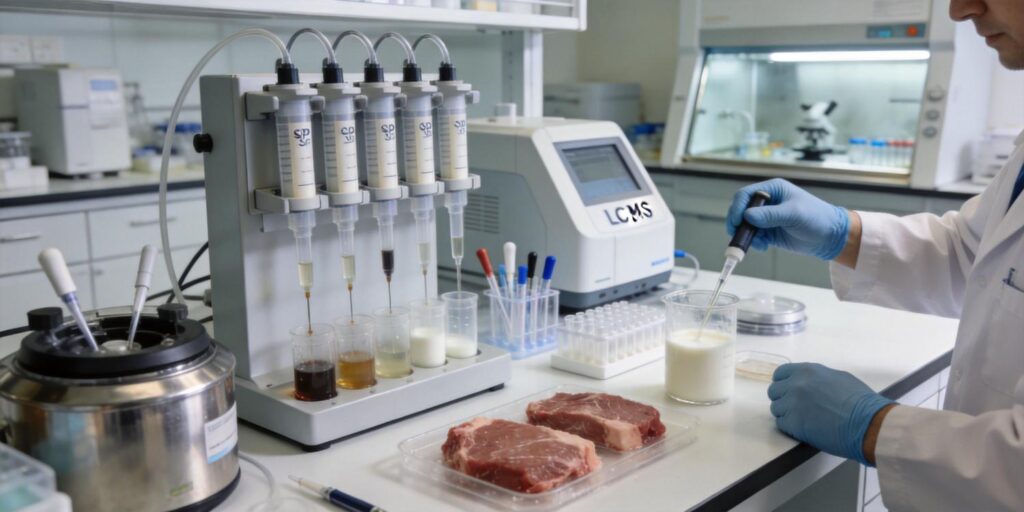
SPE technology lends itself well to automation, significantly reducing labor requirements and minimizing analyst exposure to hazardous solvents. Automated systems can handle the variable viscosity of animal urine samples more consistently than manual methods.
Quality Control Measures
Given the forensic implications of many veterinary drug tests, SPE methods must include appropriate controls for recovery, matrix effects, and potential interferences. The use of stable isotope-labeled internal standards has become increasingly important for accurate quantification.
Practical Applications and Case Studies
Successful Extraction Examples
Research demonstrates numerous successful SPE applications in veterinary analysis. Mixed-mode extraction of β-blockers and their acidic and basic metabolites shows excellent recovery and selectivity. The isolation of highly water-soluble drugs and metabolites, compounds sensitive to pH extremes, and zwitter-ionic compounds has been achieved through optimized SPE protocols.
Limitations and Compromises
Certain compounds present challenges for generic SPE approaches. Caffeine extraction from hydrolyzed urine on C18 or mixed-mode cartridges co-extracts endogenous urinary acids and plant phenolics, potentially interfering with chromatography. In such cases, traditional solvent extraction may remain preferable despite the general advantages of SPE.
Future Directions
The field continues to evolve with developments in immunoaffinity SPE, molecularly imprinted polymers, and on-line SPE-LC systems. These advancements promise improved selectivity, reduced sample manipulation, and enhanced sensitivity for veterinary drug residue analysis.
Conclusion
SPE has established itself as a cornerstone technology in veterinary drug residue analysis, offering significant advantages over traditional extraction methods in terms of selectivity, reproducibility, and safety. The technology’s flexibility allows adaptation to diverse drug classes and complex biological matrices encountered in veterinary medicine. As analytical requirements continue to evolve toward lower detection limits, broader compound coverage, and increased throughput, SPE methodologies will undoubtedly play an increasingly important role in ensuring animal health, food safety, and racing integrity.
For laboratories seeking to implement or optimize veterinary drug residue analysis, Poseidon Scientific offers a comprehensive range of HLB SPE cartridges, MCX mixed-mode cation exchange cartridges, and WAX weak anion exchange cartridges specifically designed to address the unique challenges of veterinary sample preparation.