
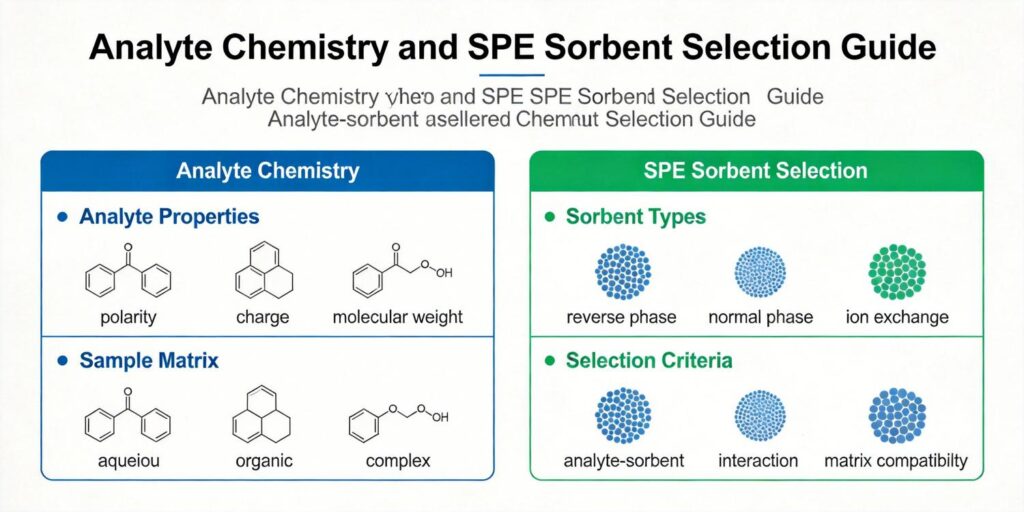
Analyte Polarity Considerations
The foundation of SPE sorbent selection begins with understanding analyte polarity. Polarity determines which intermolecular forces will dominate retention on the sorbent surface. Non-polar analytes like hydrocarbons, fat-soluble vitamins, triglycerides, steroids, aflatoxins, and phthalates primarily interact through van der Waals forces or hydrophobic interactions. These compounds are best retained on non-polar sorbents such as C18, C8, C2, C1, CN-E, CH, and PH when extracted from water or water/polar organic mixtures.
For polar analytes including steroids, dioxins, amides, carbohydrates, and esters, dipole-dipole interactions and hydrogen-bonding become the dominant retention mechanisms. These compounds require polar sorbents like silica (SI), cyanopropyl (CN-U), diol (20H), alumina, or Florisil, particularly when extracted from hydrocarbons, chlorinated solvents, or non-polar/polar organic mixtures.
The polarity of chain configuration also significantly impacts recovery and extract cleanliness. For instance, cyclohexyl and phenyl sorbents, both six-membered rings with nearly identical organic loading, demonstrate that the more polar phenyl retains more matrix interferences while not holding acidic and neutral analytes as effectively.
Acid/Base Functionality
Acid-base properties fundamentally alter SPE strategy through ionization control. Weak acids and bases require careful pH manipulation to achieve optimal retention. The general rule is to maintain the sample pH at least two units away from the analyte’s pKa to ensure complete ionization or neutralization.
For acidic compounds (organic acids, strong acids, halides), retention occurs best when the analyte is ionized (pH > pKa + 2). These anionic species are effectively retained on anion exchange sorbents like SAX (strong anion exchange), NH2 (weak anion exchange), PSA, or DEA from aqueous buffers at pH 5-8.
Basic compounds (organic bases, strong bases, metals) require protonation for optimal retention (pH < pKa – 2). These cationic species bind effectively to cation exchange sorbents including SCX (strong cation exchange), PRS, or CBA (weak cation exchange) from aqueous buffers at pH 4-8.
Counter-ion selectivity plays a crucial role in ion exchange SPE. Different ionic species show varying affinities for ion exchange sorbents, with two general trends: selectivity increases as ion charge increases (divalent ions are generally more retentive than monovalent ones), and aqueous solubility and selectivity vary approximately inversely. For example, well-solvated F⁻ is a low selectivity ion while poorly solvated I⁻ has high selectivity.
Ion Exchange vs Reversed Phase
The choice between ion exchange and reversed-phase mechanisms depends on analyte characteristics and sample matrix. Reversed-phase SPE (typically using C18, C8, C2, or phenyl phases) relies on hydrophobic interactions and is ideal for non-polar to moderately polar compounds from aqueous matrices. This mechanism offers higher capacity generally than ion-exchange columns and works best when both analyte and sorbent are uncharged.
Ion exchange SPE utilizes coulombic interactions and is specifically designed for ionic compounds. Strong ion exchangers (SAX for anions, SCX for cations) maintain their charge over a wide pH range, while weak ion exchangers (NH2, DEA for anions; CBA for cations) have pH-dependent charge. Ionic bonds are strong enough to allow analytes to remain bound while interferences are washed away with high percentages (up to 100%) of polar or nonpolar organic solvents.
Mixed-mode sorbents combine both mechanisms, offering simultaneous hydrophobic and ionic interactions. These are particularly valuable for compounds with both polar and non-polar characteristics or for extracting multiple analyte classes with different properties from complex matrices.
Decision Tree for Sorbent Selection
A systematic approach to sorbent selection begins with analyte characterization. Ask these key questions:
- What functional groups are present?
- Does the analyte have ionizable groups and what are their pKa values?
- Is it soluble or insoluble in various solvents?
- Is it free or protein-bound in biological matrices?
Follow this decision framework:
Step 1: Determine Analyte Ionization State
If the analyte is ionizable, decide whether to use ion exchange or manipulate pH for reversed-phase extraction. For ion exchange: anions require anion exchange sorbents (SAX, NH2, PSA, DEA), cations require cation exchange sorbents (SCX, PRS, CBA).
Step 2: Assess Polarity
For non-polar, non-ionic compounds: Choose reversed-phase sorbents (C18, C8, C2, phenyl, cyclohexyl). For polar, non-ionic compounds: Consider normal phase sorbents (silica, CN, diol, alumina, Florisil).
Step 3: Consider Molecular Weight
For large molecules (>2000 Da): Biopolymers like proteins, polynucleotides, and polysaccharides often require specialized sorbents (C18, C8, C4) with appropriate pore sizes to accommodate their size.
Step 4: Evaluate Sample Matrix
The matrix significantly influences sorbent choice. Competitive interactions from matrix components can reduce capacity. Solutions include increasing bed size, changing to a higher-loaded polymeric sorbent, switching to a different mechanism, or using coupled columns to filter out unwanted material.
Example Case Studies
Case Study 1: Herbicide Metabolite Extraction
When extracting polar degradation products of atrazine and simazine (including desethylatrazine, hydroxyatrazine, desisopropylatrazine, ammelide, ammeline, cyanuric acid, and their derivatives), conventional C18 and polystyrene-divinylbenzene (PSDVB) sorbents show weak binding ability. Porous graphitic carbon (PGC) demonstrates superior retention for these highly polar compounds due to residual acidic and basic functional groups at its surface. This case emphasizes the importance of experimenting with alternative sorbents when conventional methods show poor capacity and recovery for highly polar compounds.
Case Study 2: Forensic Drug Analysis
In forensic toxicology, copolymeric extraction columns combining hydrophobic and ionic interactions are particularly effective. For example, extracting acidic and neutral drugs from complex biological matrices like decomposed autopsy samples often requires additional cleanup steps even after SPE. The solution involves using washes of high organic strength to remove interferences retained by hydrophobic interactions while maintaining ionic binding for target analytes. When analytes are also capable of hydrophobic binding, polar interferences can be removed using aqueous or weak aqueous/organic washes while disrupting ionic binding through pH and ionic strength adjustments.
Case Study 3: Pharmaceutical Compound Recovery
Marko and Radova (1991) demonstrated how solvent selection impacts recovery from conventional C18 sorbents. For tertiary nitrogen bases like pentacaine and stobadin, methanol (eluotropic value 0.95) provided recoveries up to 98%, while acetonitrile (eluotropic value 0.65) showed no elution power. This highlights the presence of analyte-sorbent polar interactions in C18 sorbents, which are interrupted by more polar methanol. Such findings emphasize that even within a single sorbent class, secondary interactions significantly influence method optimization.
Practical Implementation Tips
When developing SPE methods, consider these practical aspects:
- Conditioning: Hydrophobic sorbents need solvation with methanol or acetonitrile (1.5 mL per 100 mg sorbent) followed by water to remove excess solvent.
- pH Control: For ion exchange, apply buffer after flushing to ensure optimal sorbent pH for desired interactions.
- Flow Rates: Apply sample at approximately 1 mL/min for optimal retention.
- Wash Optimization: Use the strongest solvent that won’t elute your analyte to remove interferences.
- Elution Strategy: Choose solvents based on analyte polarity and consider adding 10-30% proton donor solvent (like methanol) to disrupt hydrogen-bonding when using non-polar elution solvents.
By systematically applying these principles—starting with analyte characterization, following the decision tree framework, and learning from practical case studies—analysts can optimize SPE sorbent selection for any application, achieving the 90%+ absolute recovery that defines a well-optimized method.


