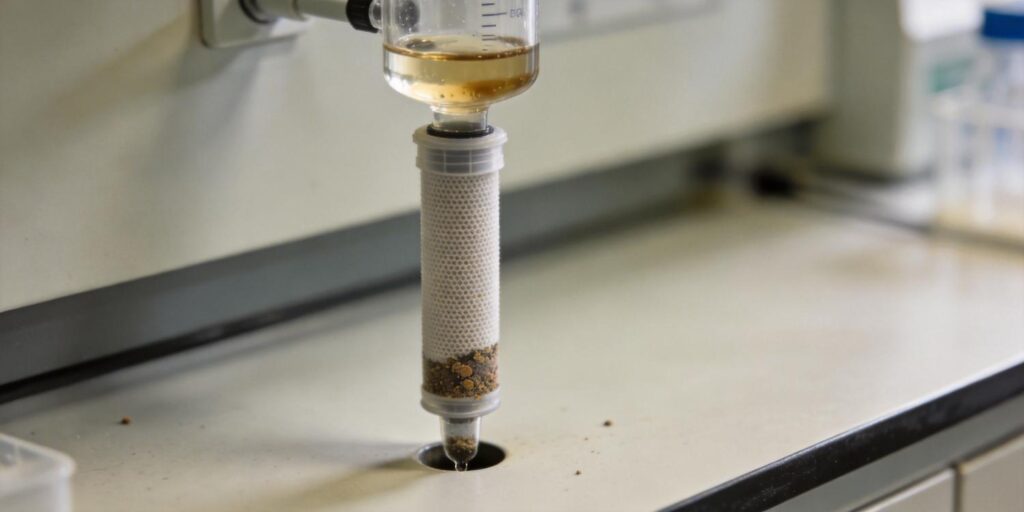
Understanding SPE Recovery Challenges
Solid Phase Extraction (SPE) has revolutionized sample preparation across analytical laboratories, offering significant advantages over traditional liquid-liquid extraction methods. However, achieving consistent, high recovery rates (ideally exceeding 90%) can sometimes prove challenging. As a product manager at Poseidon Scientific specializing in SPE products, I’ve encountered numerous scenarios where recovery issues arise. Understanding the root causes and implementing systematic troubleshooting approaches is essential for maintaining analytical integrity and reproducibility.
Causes of Poor Analyte Recovery
Recovery problems in SPE can be frustrating, but they typically stem from identifiable sources. According to forensic extraction literature, recovery issues generally fall into four categories: flow problems, contamination problems, recovery problems, and nonextraction problems. When recovery falls below expectations, the fundamental question becomes: “Where did the analyte go?” There are limited possibilities: the analyte was unretained during sample application and lost with the matrix (breakthrough), unretained during wash steps, retained during elution and remains bound to the sorbent, or bound to sample containers or pre-extractants.
A systematic approach to troubleshooting involves performing a mass balance – a quantitative accounting for all known concentrations of analyte applied to the SPE column. This involves collecting and analyzing every liquid fraction exiting the column to determine where analyte loss occurs. Remember that SPE should be a “stop-and-go” chromatography where samples are totally retained and totally released. If you’re not achieving 90% absolute recovery, your method likely needs optimization.
Sorbent Mismatch
Selecting the wrong sorbent chemistry is one of the most common causes of poor recovery. The SPE triangle diagram illustrates the constraints between analyte recovery/concentration, sorbent mechanism, and matrix cleanup. An ideal sorbent choice for maximizing recovery may not be compatible with your sample type, while optimum cleanup might require a sorbent incompatible with your matrix.
Key sorbent considerations include:
- Mechanism mismatch: Hydrophobic phases retain analytes better from polar solvents, while normal phase adsorbents extract better from nonpolar solvents
- Chain length effects: Depending on analyte polarity or ionic character, increasing chain length (C2 to C30) may significantly affect recovery
- Organic loading: Higher carbon loading generally increases capacity but may affect selectivity
- Secondary interactions: Silanol groups on silica-based sorbents can cause irreversible binding of basic compounds
- Bed size and geometry: Capacity depends on bed mass, not bed height – a 100 mg bed in a 6-mL tube has the same capacity as in a 1-mL tube but offers better flow characteristics
Comparative studies reveal significant recovery variations between manufacturers’ C18 products, with recoveries ranging from 56% to 98% for the same compounds. This underscores the importance of thorough sorbent evaluation during method development.
Solvent Issues
Solvent selection and handling profoundly impact SPE recovery. The five fundamental SPE steps – conditioning, sample application, wash, dry, and elution – each require careful solvent optimization.
Critical solvent considerations:
- Conditioning solvents: Proper conditioning solvates the SPE column, normalizes the column environment to the sample, removes microparticulates, and blocks silanol sites. Methanol or another polar organic effectively washes away impurities
- Sample application solvents: Hydrophobic phases retain analytes better from polar solvents, while polar sorbents favor organic matrices. High ionic strength buffers can impede mass transfer
- Elution solvent strength: For efficient elution, retention factors should be less than 2, allowing recovery in approximately three interparticle volumes. The general aim is to find a solvent where retention factor is minimal
- Solvent purity: Old or impure derivatization reagents can introduce interferent peaks. Fresh reagents minimize these problems
- Solvent compatibility: Some sympathomimetic amines are less soluble in ethyl acetate than in ethyl acetate-isopropanol mixtures (80:20) due to increased polarity preferences
When dealing with samples in methanol or other polar solvents, dilution (20:1 with water) improves retention and allows reconcentration as the sample moves through the column.
Matrix Effects
The sample matrix represents perhaps the most significant variable in SPE recovery. Matrix components can compete with analytes for sorbent binding sites, reducing effective capacity through competitive interactions. This occurs frequently in biological samples containing acidic, neutral, and basic compounds.
Matrix-related challenges include:
- Competitive binding: High levels of compounds with similar interaction mechanisms reduce analyte capacity
- Protein binding: Analytes significantly bound to plasma proteins may never reach extraction columns
- Endogenous interferents: Varying concentrations of endogenous compounds in biological samples can compromise analysis
- pH and ionic strength: Proper pH conditions (usually matching sample and sorbent pH) facilitate optimal binding. Un-ionized compounds favor retention in reversed phase systems
- Volume and mass overload: Applying more sample than column capacity leads to inconsistent recovery
Solutions to matrix effects include increasing bed size to overcome competitive interactions, changing to higher-loaded polymeric sorbents, switching to different mechanisms (ion exchange or normal phase), or using coupled columns to filter out interfering material.
Step-by-Step Troubleshooting
When facing recovery problems, follow this systematic troubleshooting approach:
1. Perform Mass Balance Analysis
Collect and analyze all fractions (sample waste, washes, eluates) to determine where analyte loss occurs. This identifies whether breakthrough is happening during sample application, wash steps, or if analytes remain bound during elution.
2. Evaluate Sorbent Selection
Test neat standards on various phases to determine maximum extraction efficiency under ideal conditions. If a phase doesn’t extract your sample under ideal conditions, it won’t perform better in real matrices. Consider:
- Switching from monomeric C18 to higher-loaded polymeric versions
- Changing extraction mechanisms (ion exchange for hydrophilic compounds)
- Using ion pairing agents for very hydrophilic analytes (10 mM tetrabutyl ammonium hydroxide can substantially increase recovery)
3. Optimize Flow Parameters
Flow rates significantly impact recovery, especially with ion-exchange mechanisms. Excessive flow rates cause breakthrough through inadequate mass transfer. Optimal flow ensures adequate contact time for partitioning between mobile and stationary phases.
4. Address Secondary Interactions
For basic compounds experiencing irreversible binding to silanol sites, add competing bases to elution solvents. Triethylamine in methanol has boosted recoveries from 56% to 91% in comparative studies.
5. Consider Physical Parameters
Evaluate bed geometry – if samples flow poorly through a 100 mg bed in a 1-mL tube, try 100 mg in a 6-mL tube for improved flow through increased cross-sectional area.
6. Verify Detection Parameters
Before assuming extraction problems, ensure your instrumentation can adequately detect neat standards at required concentrations. Check derivative stability, reconstitution solvent compatibility, and evaporative conditions.
7. Implement Quality Controls
Keep columns from original validation lots for comparison. Test multiple lot numbers during validation to ensure reproducibility. Don’t overlook manufacturer technical support – sample preparation is their expertise.
Practical Solutions for Common Recovery Problems
Based on extensive literature and practical experience, here are targeted solutions for specific recovery challenges:
For hydrophilic analytes difficult to retain on reversed-phase silica: Use ion pairing agents in dilution buffers. Addition of 10 mM tetrabutyl ammonium hydroxide to buffers has shown substantial recovery increases across pH intervals.
When recovery drops in specific elution solvents: Try alternative solvent combinations. If recovery drops in methylene chloride-isopropanol-ammonium hydroxide, test ethyl acetate-hexane, and vice versa.
For samples in polar organic solvents: Dilute 20:1 with water to improve retention and allow reconcentration during column passage.
When dealing with competitive matrix effects: Increase bed size, change sorbent nature, switch mechanisms, or use coupled columns (C18 coupled to ion exchanger filters organic material that can poison ion exchange surfaces).
For heat-labile compounds during evaporation: Decrease temperature and/or add keeper solvents with relatively high boiling points to absorb heat energy and prevent evaporative loss.
Conclusion
SPE recovery optimization requires balancing sensitivity (recovery) with selectivity (cleanliness). Evaluate method performance based on required signal-to-noise ratios rather than absolute percent recovery. Sometimes 30% recovery with excellent selectivity outperforms 90% recovery with interfering compounds.
Remember that properly developed and validated SPE methods are extremely robust. Problems that arise can be systematically identified and eliminated through careful attention to sorbent selection, solvent optimization, flow parameters, and matrix considerations. At Poseidon Scientific, our HLB SPE cartridges, MAX SPE cartridges, MCX SPE cartridges, and 96-well SPE plates are designed with these principles in mind, offering consistent performance across diverse applications.
By understanding the fundamental causes of low SPE recovery and implementing systematic troubleshooting approaches, analysts can achieve the 90%+ absolute recovery that represents optimized method performance. The key lies in methodical problem-solving, careful parameter optimization, and leveraging available technical resources to overcome extraction challenges.