
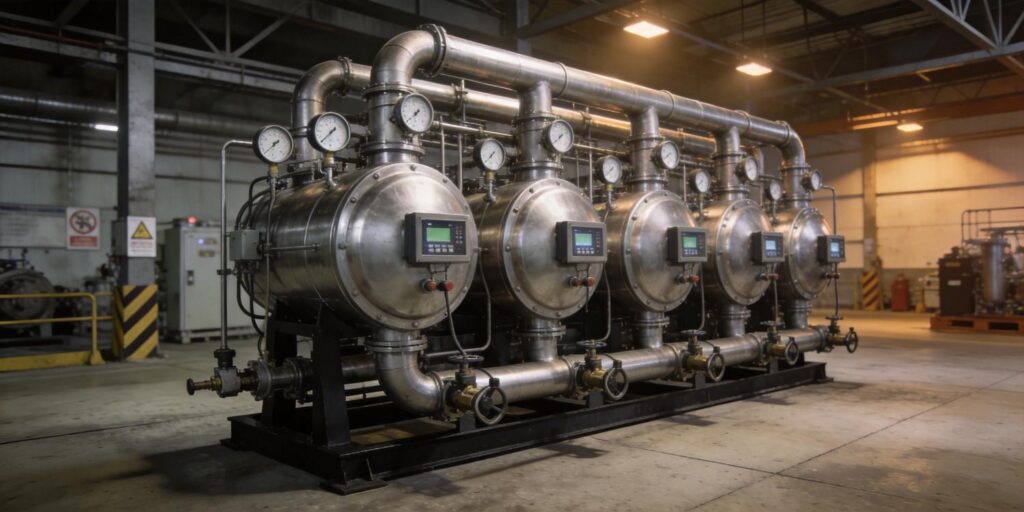
In multi-chamber vacuum systems—whether load-locked PVD coaters, multi-stage mass spectrometers, or vacuum heat-treatment furnaces—pressure varies dramatically from atmosphere in the load lock to high vacuum in the process chamber. A single-gauge approach quickly fails: Pirani sensors lose accuracy below 10⁻³ Torr, while cold-cathode gauges cannot start or survive exposure to atmosphere. Poseidon Scientific’s complementary pair—the VG-SP205 Pirani Vacuum Transmitter (atmosphere to 10⁻³ Torr) and VG-SM225 Cold Cathode Vacuum Gauge (10⁻³ to 10⁻⁷ Torr)—delivers a complete, cost-effective strategy that engineers and procurement teams trust for reliable control, central monitoring, and seamless data integration.
Multiple Chamber Control
Modern vacuum systems rarely operate as a single pressure envelope. A typical load-lock design isolates the process chamber from atmosphere during substrate exchange, while foreline and roughing stages manage pump-down and venting. Each chamber or zone requires independent pressure monitoring to enforce interlocks, sequence valves, and protect sensitive components.
The challenge is threefold: (1) wide dynamic range across chambers, (2) fast response during transitions, and (3) fault-tolerant operation when one chamber is at atmosphere and another at 10⁻⁶ Torr. Using two sensor technologies in tandem solves this. The VG-SP205’s thermal-conductivity principle excels in the rough vacuum regime where gas molecules efficiently conduct heat from the platinum filament. Its response time remains under 100 ms even near atmosphere. The VG-SM225’s Penning-discharge principle, with its positive magnetron structure and ~100 gauss neodymium field, provides stable ion-current output from 10⁻³ Torr down to 10⁻⁷ Torr, immune to the X-ray limit that constrains hot-cathode gauges.
Because both transmitters share identical mechanical footprints (KF16/KF25 flanges) and electrical interfaces (0–10 V analog plus RS232), engineers can deploy them interchangeably across chambers without redesigning panels or PLC code. For systems with more than two chambers, the same pair repeats: Pirani on every roughing line and load lock, cold cathode on every high-vacuum process zone. This modular strategy keeps spare-part inventory to a minimum while guaranteeing full-range coverage.
Central Monitoring
Centralized oversight is essential for 24/7 production or multi-user research facilities. A single PLC or SCADA station must display, log, and alarm on every chamber’s pressure simultaneously. Poseidon transmitters support both analog (0–10 V, effective 2–8 V) and digital RS232 outputs, enabling hybrid architectures that match any control philosophy.
Analog wiring suits legacy PLCs: one pair of wires per gauge, 0–10 V scaled to pressure. Digital RS232 allows up to 32 gauges on a single multi-drop bus when using our optional RS485 board spin (available on request). The 9600 baud, 8-N-1 protocol transmits a compact 9-byte frame every 100 ms, including status bits, error codes, and software version. This low-bandwidth stream fits comfortably inside any modern industrial network without taxing scan times.
Central monitoring also simplifies trending. Operators see the entire pump-down curve—from atmosphere through crossover to base pressure—on one screen. Alarm thresholds can be set independently per chamber (for example, “load lock > 10 Torr = vent complete” and “process chamber < 5×10⁻⁶ Torr = process start permitted”). The result is fewer false trips, faster diagnostics, and documented process traceability required by ISO 9001 and semiconductor audit standards.
Sensor Allocation
Strategic placement maximizes performance and minimizes cost. The following allocation table reflects field-proven practice across analytical instruments and industrial furnaces:
| Chamber / Zone | Recommended Gauge | Pressure Range | Reason |
|---|---|---|---|
| Load lock / vent chamber | VG-SP205 Pirani | Atmosphere – 10⁻³ Torr | Survives repeated atm exposure; fast roughing response |
| Roughing / foreline | VG-SP205 Pirani | Atmosphere – 10⁻³ Torr | Monitors pump performance; immune to oil backstreaming |
| Process / analysis chamber | VG-SM225 Cold Cathode | 10⁻³ – 10⁻⁷ Torr | High sensitivity; no filament burnout risk |
| Transfer / intermediate chamber | VG-SP205 (if >10⁻³ Torr) or VG-SM225 (if lower) | Application dependent | Ensures safe crossover without over-range damage |
Install the VG-SM225 cold cathode with its high-voltage protection logic: software automatically disables the –2000 V supply if pressure exceeds 10⁻³ Torr, preventing sputtering and carbon buildup. The VG-SP205 requires no such protection—its platinum filament is inherently robust. Both gauges mount in any orientation, simplifying mechanical design in crowded multi-chamber layouts. For systems with more than four chambers, duplicate the pair rather than mixing technologies within a single zone; this preserves identical calibration curves and reduces operator training.
Data Integration
Raw pressure numbers are useless without integration into the plant’s digital backbone. Poseidon transmitters ship with a fully documented, open RS232 protocol that customers of five units or more can customize at the firmware level—free of charge. Need Modbus RTU, EtherCAT mapping, or custom floating-point scaling? Our three-person engineering team implements it in two weeks.
Analog integration is equally straightforward: the 0–10 V output drives any PLC analog input card directly. Temperature compensation (circuit + algorithm) keeps drift below 1 % across 15–50 °C, matching or exceeding semiconductor-grade competitors at a fraction of the price. For high-channel-count systems, the digital route offers additional value: each frame contains a sensor-health byte (filament open on Pirani, discharge failure on cold cathode) that feeds directly into predictive-maintenance dashboards.
Data logging is simplified by the 100 ms update rate and built-in checksum. SCADA packages such as Ignition, Wonderware, or Siemens WinCC parse the stream in minutes. Engineers routinely export CSV logs for process validation, yielding traceable records for every batch run—critical for medical-device or aerospace heat-treatment certification.
Industrial Example: Multi-Zone Vacuum Heat-Treatment Furnace
A leading Chinese vacuum-furnace OEM recently standardized on Poseidon gauges for a new line of multi-chamber annealing systems serving automotive and tooling customers. The furnace features three distinct zones:
- Load lock (atmosphere to 10⁻² Torr) – two VG-SP205 units monitor roughing and venting.
- Intermediate transfer chamber (10⁻² to 10⁻⁵ Torr) – one VG-SM225 ensures safe crossover.
- Process hot zone (10⁻⁵ to 10⁻⁷ Torr) – two VG-SM225 units (front and rear) maintain uniformity.
All six gauges feed a single Siemens S7-1500 PLC via RS232-to-Ethernet gateway. The PLC enforces the sequence: load lock must reach < 5 Torr before the transfer valve opens; process zone must be < 5×10⁻⁶ Torr before heaters energize. Total hardware cost per furnace dropped 38 % versus imported INFICON/MKS equivalents while maintaining identical performance. Maintenance is equally simple: Pirani gauges are “fit-and-forget” (3–5 year life), while cold-cathode sensors are cleaned in-house with 500-grit sandpaper in under 15 minutes—zero downtime.
The OEM now offers the same gauge package to its retrofit customers, proving the strategy scales from new designs to brownfield upgrades.
Choosing the Right Vacuum Measurement Strategy
Multi-chamber systems demand more than just accurate gauges—they require a complete strategy that balances range, cost, size, and integration. The VG-SP205 Pirani and VG-SM225 Cold Cathode combination delivers exactly that: full coverage from atmosphere to 10⁻⁷ Torr, identical footprints, customizable digital protocols, and field-proven durability at a price point that protects margins without sacrificing reliability.
Whether you are designing the next-generation mass spectrometer, scaling a PVD coating line, or modernizing legacy heat-treatment furnaces, this sensor-allocation approach will simplify your architecture and strengthen your competitive edge.
Ready to optimize your multi-chamber vacuum system? Explore the VG-SP205 Pirani Vacuum Transmitter and VG-SM225 Cold Cathode Vacuum Gauge today. Need help mapping sensors to your chamber layout, customizing the protocol, or running a cost-comparison analysis? Contact our applications team directly—we respond within 24 hours and have helped dozens of OEMs and end users implement this exact strategy with zero commissioning surprises.


