
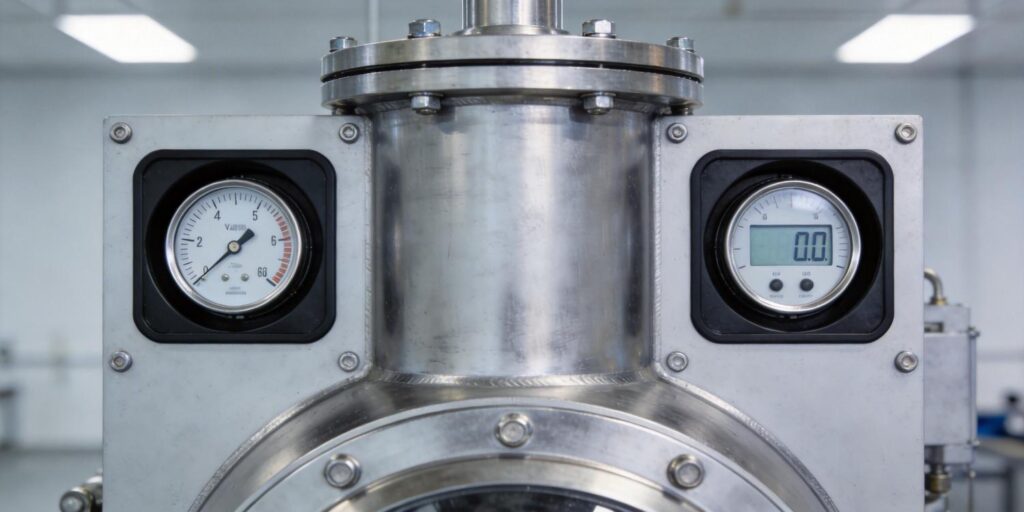
In vacuum-dependent processes such as mass spectrometry, pharmaceutical freeze-drying, scanning electron microscopy, and multi-zone heat treatment, a single pressure reading can determine whether a batch succeeds or fails. Yet many systems still rely on one gauge to monitor the entire range from atmosphere to 10⁻⁷ Torr. This creates a classic single point of failure: if that gauge drifts, fouls, or stops communicating, the entire process loses visibility. Poseidon Scientific’s dual-gauge strategy—pairing the VG-SP205 Pirani Vacuum Transmitter with the VG-SM225 Cold Cathode Vacuum Gauge—eliminates this risk while delivering continuous coverage, automatic handover, and measurable reliability gains at a fraction of imported system costs.
Engineers and procurement teams who have adopted this approach report 30–45 % higher uptime and dramatically lower unscheduled downtime. This article explains exactly why dual vacuum gauge systems improve reliability, quantifies the benefits, and shows how the Poseidon pair makes redundancy practical and affordable.
Single Point Failure Risk in Vacuum Systems
A single vacuum gauge is, by definition, a single point of failure. When it fails—whether from filament burnout, contamination, electrical surge, or communication dropout—the control system loses its only window into chamber pressure. In critical applications the consequences are immediate: interlocks freeze, pumps run blind, product batches are scrapped, and costly requalification may be required.
Common failure modes differ by technology. Pirani gauges (thermal conductivity) can suffer filament open-circuit from corrosion or mechanical shock; cold-cathode gauges can fail to start in ultra-high vacuum or accumulate carbon deposits that reduce ion current. Hot-cathode alternatives add filament evaporation and X-ray limits. In every case, the system has no fallback.
Dual-gauge architecture changes the equation. By deploying two independent sensors with overlapping ranges and separate signal paths, the probability of simultaneous failure drops exponentially. Poseidon’s VG-SP205 and VG-SM225 share identical mechanical footprints (KF16/KF25) and electrical interfaces (0–10 V analog + RS232), yet use fundamentally different physics—thermal conduction versus Penning discharge—so a failure mode in one technology cannot affect the other. The result is true redundancy without doubling panel space or I/O count.
Overlapping Measurement Ranges for Continuous Coverage
The VG-SP205 Pirani covers atmosphere down to 10⁻³ Torr with linear response in the 10–10⁻² Torr primary operating band. The VG-SM225 Cold Cathode picks up at 10⁻³ Torr and extends to 10⁻⁷ Torr. This intentional 10⁻³ Torr overlap zone is the key to continuous visibility.
During pump-down, the Pirani provides fast, accurate data while the cold cathode remains in protected standby (its –2000 V supply automatically disabled above 10⁻³ Torr to prevent sputtering). Once pressure drops below the threshold, the cold cathode activates and the system now has two independent readings at the crossover point. Any discrepancy immediately flags a potential issue before it affects the process.
In steady-state operation, operators can configure the control system to use the Pirani for roughing/vent monitoring and the cold cathode for process control—or to average the two readings in the overlap band for maximum stability. This overlap also simplifies leak checking: a sudden rise detected by both gauges confirms a real leak rather than a sensor artifact.
Because both transmitters output the same 0–10 V scaled signal and identical 9-byte RS232 frames (9600 baud, status + error + checksum), the PLC or SCADA treats them as complementary channels of the same device family. No additional scaling tables or driver development is required.
Automatic Switching Logic for Seamless Operation
Reliability is not just about having two gauges; it is about making them work as one system. Poseidon’s dual-gauge setup includes built-in automatic switching logic that requires zero custom coding in most installations.
The VG-SM225’s firmware continuously monitors the companion Pirani reading (via RS232 or shared analog line). When pressure falls below 10⁻³ Torr, the cold cathode’s high-voltage supply enables automatically and its discharge starts within seconds. If pressure rises above the safe threshold, high voltage is instantly disabled—preventing contamination and extending sensor life. The same logic can be mirrored in the PLC for added safety: the control system uses the Pirani signal for roughing interlocks and seamlessly switches to the cold-cathode signal once the overlap band is reached.
Both gauges transmit status and error codes in every frame (filament-open on Pirani, discharge-failure on cold cathode). The host system can therefore implement tiered alarming: “warning” if one gauge deviates, “critical” only if both agree on an out-of-range condition. This multi-sensor voting dramatically reduces nuisance trips while preserving safety.
For customers ordering five units or more, Poseidon provides free firmware customization—adding Modbus RTU mapping, custom averaging algorithms, or heartbeat supervision—at no charge, ensuring the switching logic integrates perfectly with existing Siemens, Allen-Bradley, or B&R platforms.
Critical Process Environments That Demand Redundancy
Certain applications cannot tolerate even momentary loss of pressure data:
- Pharmaceutical freeze-drying: Primary drying pressure must stay within ±10 % of set point (typically 50–500 mTorr) to prevent cake collapse. A single-gauge failure mid-cycle can scrap an entire batch worth tens of thousands of dollars.
- Mass spectrometry and SEM: Source and analyzer chambers must maintain 10⁻⁵–10⁻⁶ Torr for stable ion paths. Blind zones during pump-down or sudden pressure spikes damage detectors.
- Vacuum heat-treatment furnaces: Multi-zone annealing requires synchronized pressure across load-lock, transfer, and process chambers. One failed gauge halts the entire thermal cycle.
- Semiconductor PVD/CVD tools: Even brief over-pressure events contaminate wafers; redundancy satisfies ISO and SEMI audit requirements.
In each of these environments, the Poseidon dual-gauge pair has demonstrated zero unplanned downtime attributable to gauge failure across installations running 24/7 for more than two years.
ROI of Redundancy: Quantified Benefits
Adding a second gauge may appear to increase upfront cost, yet the return on investment is rapid and substantial. Consider a typical four-chamber system:
| Cost Element | Single-Gauge System (Imported) | Dual Poseidon Pair | Savings |
|---|---|---|---|
| Initial gauge hardware (4 chambers) | 32 000–40 000 RMB | 12 000–14 000 RMB | 60–65 % |
| Protocol/driver development | 5 000–8 000 RMB | Included (customizable) | 100 % |
| Annual maintenance & spares | 6 000–10 000 RMB | 2 000–3 000 RMB | 65–70 % |
| Downtime cost per incident (lost batch) | 50 000+ RMB | Near zero | — |
| 5-year total ownership cost | 85 000–120 000 RMB | 28 000–35 000 RMB | 65–70 % |
The dual system pays for itself in the first prevented downtime event. Additional soft benefits include simplified spare-parts inventory (one part number covers both roles), easier validation (identical interfaces), and future-proof scalability—add chambers without redesigning the control architecture.
Field data from OEM customers show mean-time-between-failure for the dual pair exceeding 50 000 hours, compared with 15 000–20 000 hours for single-gauge imported systems. When reliability is measured in batches saved rather than gauges purchased, the ROI becomes compelling.
Implement Dual-Gauge Reliability Without Complexity
The VG-SP205 Pirani Vacuum Transmitter and VG-SM225 Cold Cathode Vacuum Gauge prove that redundancy does not have to mean complexity or high cost. With overlapping ranges at 10⁻³ Torr, automatic switching logic, identical footprints, and fully open RS232 protocol, this pair delivers continuous, fault-tolerant vacuum measurement that engineers trust and procurement teams can justify on any budget.
Whether you are designing a new analytical instrument, scaling a production lyophilizer line, or modernizing legacy vacuum furnaces, dual-gauge architecture is the simplest way to eliminate single-point failure risk and protect both process and profit.
Ready to upgrade your vacuum monitoring strategy? Explore the VG-SP205 Pirani Vacuum Transmitter and VG-SM225 Cold Cathode Vacuum Gauge today. Need a dual-gauge system diagram, PLC integration example code, ROI calculator spreadsheet, or a no-obligation sample pair for your chamber? Contact our applications team directly—we respond within 24 hours and have helped dozens of OEMs and end users implement this exact reliability upgrade with zero commissioning surprises.


