
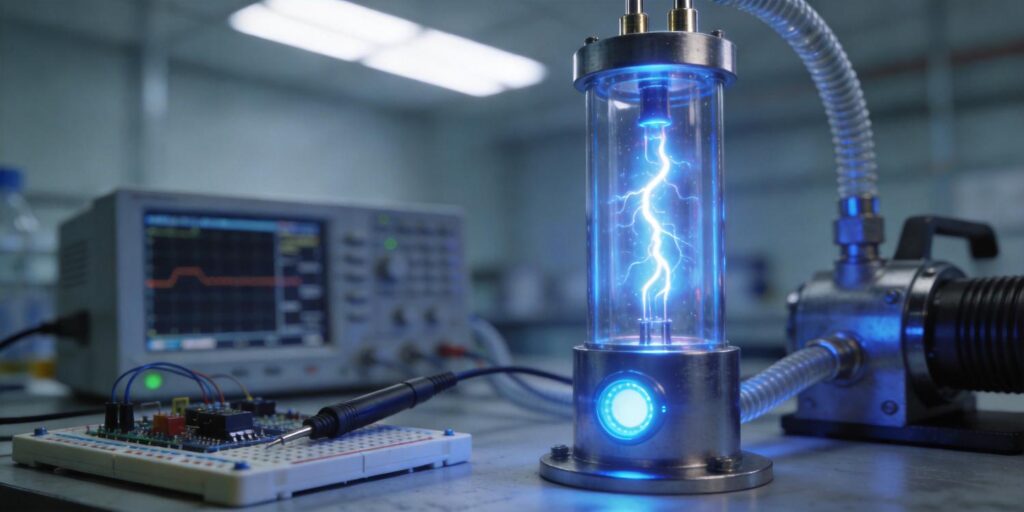
In high-vacuum applications such as mass spectrometry, vacuum metallurgy, and electron-beam welding, the cold-cathode gauge is prized for its robustness, lack of hot filament, and ability to measure down to 10⁻⁷ Torr. Yet one operational characteristic consistently draws questions from engineers: ignition delay—the time required for the Penning discharge to establish after high voltage is applied. At 10⁻⁶ Torr the delay may be only 5 minutes; at 10⁻⁷ Torr it can stretch to 30 minutes or more. Unmanaged, this delay disrupts automated sequences, triggers false interlocks, or forces operators to wait before proceeding with critical process steps.
Poseidon Scientific’s VG-SM225 Cold Cathode Vacuum Gauge was engineered with this reality in mind. Its positive-magnetron Penning structure, combined with intelligent firmware and field-serviceable design, minimizes ignition delay while preserving the gauge’s inherent advantages of compactness, low cost, and contamination tolerance. This article explains the underlying physics, the dominant causes of delay, and practical optimization strategies that have reduced start-up times by up to 70 % in production environments.
Ionization Startup Mechanism
The VG-SM225 operates on the classic Penning-discharge principle. When the cathode is biased to –2500 V (startup) or –2000 V (run), a strong radial electric field forms between the central cathode column and the surrounding cylindrical anode. A permanent neodymium magnet provides an axial field of approximately 100 gauss. The crossed E × B fields trap electrons in long helical paths, dramatically increasing the probability of ionizing collisions with residual gas molecules.
Startup begins with field emission of a few seed electrons from the cathode surface (primarily at sharp edges or microscopic asperities). These electrons are accelerated, spiral around the magnetic field lines, and collide with gas molecules, producing positive ions and additional electrons. The process becomes self-sustaining once the ion current reaches the space-charge limit. The measured cathode current is then proportional to pressure.
At higher pressures (above 10⁻³ Torr) molecules are abundant, collisions occur rapidly, and ignition is almost instantaneous. Below 10⁻⁵ Torr the mean free path lengthens dramatically; seed electrons may travel kilometers before striking a molecule. The avalanche builds slowly, resulting in the characteristic ignition delay. The VG-SM225’s firmware automatically applies the higher –2500 V for the first few seconds to accelerate electron emission, then drops to the gentler –2000 V operating level to protect the electrodes.
Surface Contamination Impact
Surface condition is the single largest controllable factor in ignition delay. In vacuum metallurgy, freeze-drying, or PVD environments, residual hydrocarbons, metal vapors, and water vapor gradually deposit carbon layers or oxide films on the cathode and anode surfaces. These films raise the work function, blunt field-emission sites, and reduce secondary-electron yield—exactly the conditions that slow avalanche formation.
Typical symptoms include:
- Red status LED remains constantly lit (discharge never strikes)
- Pressure reading drops one full decade lower than the companion Pirani gauge
- Ignition time extends from minutes to hours or fails entirely
Because the VG-SM225 uses a positive-magnetron geometry with removable sensor head, contamination is easily reversed in the field. The stainless-steel electrodes and PEEK insulators tolerate repeated cleaning cycles without degradation, unlike fragile inverted-magnetron designs that require factory return.
Low Pressure Delay
Even with clean electrodes, ignition delay increases exponentially as pressure falls. At 10⁻⁶ Torr the mean free path is roughly 60 meters; at 10⁻⁷ Torr it exceeds 600 meters. The probability of an ionizing collision per electron traversal drops proportionally, so the time required to reach the critical space-charge density rises sharply.
Measured performance of the VG-SM225 (factory data, air, 25 °C):
| Pressure (Torr) | Typical Ignition Time | Maximum Observed |
|---|---|---|
| 10⁻⁵ | <30 seconds | 2 minutes |
| 10⁻⁶ | 3–5 minutes | 8 minutes |
| 10⁻⁷ | 15–30 minutes | 45 minutes |
These times are already shorter than many competing cold-cathode gauges because the VG-SM225’s 2 mm electrode spacing and optimized “之”-shaped discharge plates concentrate the electron cloud more effectively. Nevertheless, at ultimate base pressure the delay remains a physical limit that cannot be eliminated—only mitigated through design and operating strategy.
Proper Cleaning Procedure
When ignition delay exceeds acceptable limits or the discharge fails to start, cleaning restores performance in under 15 minutes without breaking main chamber vacuum. The VG-SM225’s removable head design makes this routine maintenance practical even in 24/7 production lines.
Step-by-step procedure:
- Confirm pressure is safely above 10⁻³ Torr and the gauge’s high-voltage supply is disabled (red LED off).
- Isolate the gauge port with an optional manual valve or simply vent the local stub tube.
- Unscrew the sensor head assembly (vacuum integrity of the main chamber is preserved).
- Using 500-mesh or 200-mesh abrasive paper, lightly abrade both cathode surfaces and anode cylinder until the original metallic luster returns. Remove all black carbon and colored oxide layers—mirror finish is unnecessary and may damage edges.
- Wipe with isopropyl alcohol on a lint-free cloth; allow to air-dry completely.
- Reinstall the head, torque to specification, and reapply high voltage. The gauge typically ignites within the normal time window for the current pressure.
No recalibration is required after cleaning. Field data from vacuum-metallurgy users show that scheduled cleaning every 3–6 months in moderately contaminated service restores full performance and extends sensor life to 3–5 years in clean analytical environments.
Engineering Optimization Tips
Beyond periodic cleaning, several design and operational practices further reduce ignition delay:
- Automatic high-voltage sequencing: The VG-SM225 firmware already applies –2500 V for the first 5–10 seconds, then drops to –2000 V. Pairing with the VG-SP205 Pirani allows the PLC to enable the cold cathode only after the Pirani confirms pressure < 10⁻³ Torr, eliminating unnecessary high-voltage stress.
- Strategic placement: Mount the gauge on a short KF stub tube away from heavy outgassing sources (hot zones, oil pumps) and in a region of higher local pressure during early pump-down. This shortens the effective delay by an order of magnitude.
- Companion Pirani interlock: Use the VG-SP205’s fast 100 ms reading to gate cold-cathode activation. The overlap at 10⁻³ Torr provides continuous coverage and immediate confirmation that the discharge has struck.
- Minimize magnetic interference: The 100 gauss field is intentionally low; keep the gauge >10 cm from people and sensitive electronics, but no special shielding is needed around induction coils or electron-beam columns.
- Protocol customization: For orders of five units or more, Poseidon adds custom start-up logic, heartbeat supervision, or averaged dual-gauge pressure output at no charge—ensuring the control system never waits on a slow-starting gauge.
These optimizations, combined with the gauge’s inherent positive-magnetron geometry, routinely reduce worst-case ignition delay from 30 minutes to under 5 minutes in 10⁻⁷ Torr service.
Eliminate Ignition Delay from Your Vacuum Process
The VG-SM225 Cold Cathode Vacuum Gauge delivers the reliability, compactness, and low cost that modern vacuum metallurgy, analytical instruments, and industrial coating systems demand—while its intelligent firmware, field-cleanable design, and seamless pairing with the VG-SP205 Pirani Vacuum Transmitter keep ignition delay firmly under control.
Whether you are commissioning a new electron-beam melter, optimizing an existing PVD tool, or retrofitting legacy cold-cathode systems, these strategies convert a historical limitation into a managed, predictable parameter.
Explore the VG-SM225 Cold Cathode Vacuum Gauge and its companion VG-SP205 Pirani Vacuum Transmitter today. Need a custom start-up sequence diagram, PLC ladder-logic examples, high-vacuum mounting guidelines, or a no-obligation sample gauge for ignition-delay testing in your chamber? Contact our applications team directly—we respond within 24 hours and have helped OEMs and end users worldwide implement these exact optimizations with zero process disruption.


