
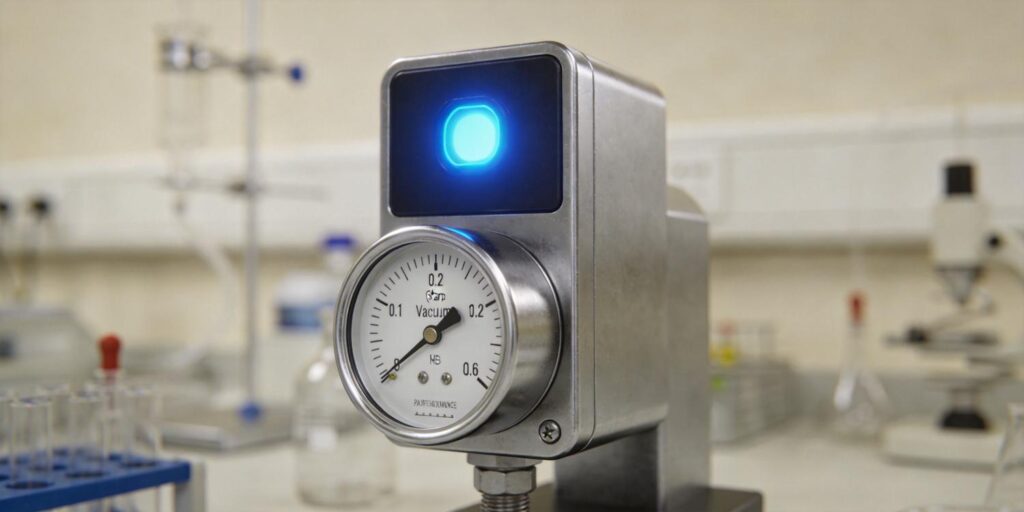
Understanding Vacuum Gauge Startup Indicators
Accurate interpretation of startup indicators is essential for reliable vacuum system operation in thin-film deposition, heat treatment, and analytical instruments. Poseidon Scientific’s VG-SM225 Cold Cathode Vacuum Gauge features clear LED feedback that instantly communicates system status, while the VG-SP205 Pirani Vacuum Transmitter operates without high-voltage circuitry and delivers immediate readings via its 0-10 V analog and RS232 outputs. Engineers and procurement teams who master these indicators reduce downtime, prevent unnecessary sensor cleaning, and maintain process repeatability.
This guide explains the LED behavior on the VG-SM225, the underlying high-voltage logic, expected startup timelines, warning signs of trouble, and proven troubleshooting steps—all drawn from real-world performance data and the gauge’s built-in protection features.
Green vs. Red LED Meanings on the VG-SM225
The VG-SM225 Cold Cathode Vacuum Gauge uses a single multi-color LED to convey operational status at a glance. Understanding its states eliminates guesswork during pump-down and daily checks.
- Steady green LED: High voltage is enabled and the Penning discharge is stable. The gauge is actively measuring in the 10−3 to 10−7 Torr range and delivering accurate ion-current data to both the 0-10 V analog output and RS232 interface.
- Flashing red LED: High voltage is intentionally disabled by the internal protection circuit. This occurs automatically when chamber pressure exceeds 10−3 Torr or during initial roughing. The flashing alerts operators that the gauge is in safe standby mode and will not attempt to ignite the discharge in a contaminating pressure regime.
- Steady red LED: Startup failure or persistent fault condition. The gauge has applied maximum starting voltage (–2500 V) but cannot sustain the self-maintained discharge. This is the most common indicator of electrode contamination and requires immediate attention.
The VG-SP205 Pirani Vacuum Transmitter has no high-voltage circuitry or multi-color LED; its power-on state is confirmed solely by stable 0-10 V output and RS232 data frames. This design simplicity makes the Pirani ideal for rough-to-medium vacuum monitoring where instant, maintenance-free operation is required.
High-Voltage Enable Logic Built into the VG-SM225
The VG-SM225 employs a traditional positive-magnetron (Penning) discharge that requires a controlled high-voltage environment. Poseidon’s engineers implemented a dual-layer protection strategy—software and hardware—to protect the electrodes and ensure long-term stability.
When the gauge is powered on:
- The microcontroller first reads the pressure signal from the companion VG-SP205 Pirani (or an external analog input).
- If pressure is confirmed below 10−3 Torr, the internal DC-DC converter ramps to the starting voltage of –2500 V for ignition, then automatically drops to the operating voltage of –2000 V once discharge current stabilizes.
- If pressure remains above 10−3 Torr, the software immediately disables the high-voltage output and sets the LED to flashing red. This prevents excessive ion bombardment that would accelerate carbon deposition or oxide growth.
- Hardware over-current and arc-detection circuits provide an independent backup layer, shutting down the supply within milliseconds if an abnormal current spike occurs.
This logic eliminates the risk of operating the cold cathode in the non-monotonic high-pressure region where ion current actually decreases with rising pressure. The result is extended electrode life and consistent calibration curves across thousands of operating hours.
Normal Startup Timeline for the VG-SM225
Because the Penning discharge relies on electron-molecule collisions to sustain itself, startup time increases as gas density drops. Poseidon’s published timelines (validated across production units at 20–28 V DC supply) are:
- At 10−4 Torr: 10–30 seconds
- At 10−5 Torr: 1–2 minutes
- At 10−6 Torr: approximately 5 minutes
- At 10−7 Torr: up to 30 minutes
During this period the LED remains flashing red until the discharge ignites, then switches to steady green. The 0-10 V analog output and RS232 data stream remain valid once green, with the gauge reporting the true pressure within the specified ±20 % accuracy band.
The VG-SP205 Pirani, by contrast, provides usable data within seconds of power-up across its entire atmosphere to 10−3 Torr range—no ignition delay, no voltage ramp. This complementary behavior allows the system controller to use Pirani data for safe high-voltage enable decisions on the VG-SM225.
When a Startup Delay Signals a Potential Issue
Any deviation from the expected timeline is an early warning. Common scenarios include:
- Startup time exceeds 45 minutes at 10−6 Torr or fails entirely (steady red LED): almost always electrode contamination reducing secondary-electron yield.
- Repeated flashing red after the chamber has reached high vacuum: indicates either a pressure measurement error from the Pirani or a loose cable causing false high-pressure readings.
- Green LED appears but pressure reading is one decade low: partial contamination shifting the calibration curve.
These conditions rarely indicate electronic failure; the VG-SM225’s robust design (stainless-steel electrodes, PEEK insulators, and neodymium magnet) makes circuit faults extremely rare. Instead, they point to preventable contamination that can be corrected in the field without returning the unit.
Troubleshooting Steps: Systematic Diagnosis and Resolution
Follow this field-proven sequence when the VG-SM225 shows abnormal startup behavior:
- Verify system pressure with the VG-SP205 Pirani. Confirm the chamber is truly below 10−3 Torr. If the Pirani reads higher, the cold cathode is correctly protecting itself—continue roughing.
- Check power supply and cabling. Confirm 20–28 V DC with <500 mV ripple at the RJ45 connector. Inspect for loose pins or damaged shielding.
- Power cycle the gauge. Wait 60 seconds, then reapply power. Many transient faults clear with a reset.
- Perform electrode cleaning if steady red persists (see detailed procedure in the user manual). Remove the sensor head, polish electrodes lightly with 500-mesh or 200-mesh sandpaper until metallic luster returns, wipe with isopropyl alcohol, and reinstall. No recalibration is required.
- Cross-check with a reference gauge after cleaning. The VG-SM225 should return to within 5 % of its original curve.
- Log RS232 status codes for long-term trending. The customizable protocol reports startup attempts, voltage states, and error flags—valuable data for predictive maintenance.
In 95 % of cases reported by Poseidon customers, cleaning restores full performance within 15 minutes. The removable-head design eliminates the costly downtime and replacement expense associated with sealed cold-cathode gauges from other manufacturers.
Preventive Practices for Consistent Startup Performance
Engineers who adopt these habits report the longest gauge lifetimes:
- Use the VG-SP205 Pirani as the interlock sensor to enable high voltage only after the chamber is confirmed below 10−3 Torr.
- Mount the VG-SM225 on a short extension tube away from direct line-of-sight to high-outgassing loads.
- Perform preventive electrode cleaning every 12–18 months in clean service (sooner with hydrocarbon process gases).
- Keep supply ripple and cable length within specifications to avoid false protection trips.
- Log both analog and digital outputs during every cycle; sudden increases in startup time are the earliest contamination indicator.
These practices keep the VG-SM225 delivering repeatable data across the full high-vacuum range while the VG-SP205 handles the rough-to-medium vacuum segment with zero maintenance.
Ready to Eliminate Guesswork in Your Vacuum Gauge Startup?
Clear LED indicators, intelligent high-voltage logic, and field-serviceable design make Poseidon Scientific gauges the practical choice for engineers who need dependable vacuum data without constant troubleshooting. Whether you run 24/7 production lines or R&D chambers, understanding these startup signals translates directly into higher uptime and lower operating costs.
Explore the complete technical specifications and downloadable user manuals:
VG-SP205 Pirani Vacuum Transmitter – Technical Data & Manual
VG-SM225 Cold Cathode Vacuum Gauge – Technical Data & Manual
Need help integrating the RS232 status codes into your PLC or SCADA, selecting the optimal mounting geometry, or reviewing your current startup logs? Our applications team has supported hundreds of installations and can provide custom protocol examples or a free system audit. Contact us today to request evaluation units or schedule a no-obligation consultation for your next vacuum tool build.
Clear indicators. Fast startups. Predictable vacuum. That’s the Poseidon Scientific advantage.


