
Contamination Sources in High Vacuum Measurement
In high-vacuum systems for thin-film deposition, heat treatment, and analytical instrumentation, contamination remains the leading cause of gauge drift, extended startup times, and premature failure. Understanding the sources is the first step toward prevention. Poseidon Scientific’s VG-SM225 Cold Cathode Vacuum Gauge and VG-SP205 Pirani Vacuum Transmitter are engineered for industrial durability, yet both benefit from proactive contamination control.
The primary sources fall into three categories. First, process-related contaminants: residual hydrocarbons from pump oil backstreaming, outgassing from chamber walls, or reactive process gases (argon, nitrogen, or trace oxygen) that form carbon deposits or oxide layers during ion bombardment. In cold-cathode gauges operating on Penning discharge, these deposits accumulate on electrodes, reducing secondary-electron yield and shifting the current-pressure curve by an entire decade. Second, installation-related contamination: fingerprints, skin oils, or airborne particulates introduced during handling or mounting. Even microscopic films increase outgassing rates and can cause field-emission spikes. Third, environmental factors: corrosive vapors or excessive moisture in poorly isolated systems that corrode filaments in Pirani gauges or accelerate electrode erosion in cold-cathode designs.
The VG-SP205 Pirani uses a chemically stable platinum filament specifically chosen to resist oxidation and corrosion, making it inherently more tolerant than tungsten-based competitors. The VG-SM225 employs stainless-steel electrodes in a traditional positive-magnetron geometry with automatic high-voltage shutdown above 10−3 Torr, preventing operation in contaminating rough-vacuum conditions. Yet both sensors still require disciplined handling to achieve the 3–5 year service life documented in clean environments.
Electrode Cleaning Methods for Cold Cathode Gauges
When contamination does occur in the VG-SM225—signaled by startup failure (steady red LED) or pressure readings offset by one full decade—the sensor head is fully removable without breaking the main vacuum seal. This field-serviceable design sets Poseidon gauges apart from sealed imported units that require complete replacement.
The approved cleaning procedure is straightforward and requires no special tools:
- Power down the gauge and confirm chamber pressure is at atmosphere.
- Unscrew the sensor head assembly using the integrated KF flange.
- Inspect the cathode (central “工”-shaped structure) and anode (cylindrical ring with perforations) for black carbon films or colored oxide layers.
- Lightly polish both electrodes with 500-mesh or 200-mesh emery paper until metallic luster returns. No mirror finish is needed—surface roughness actually aids electron emission stability.
- Wipe with isopropyl alcohol on a lint-free cloth and air-dry in a clean laminar-flow hood.
- Reinstall and perform a quick pump-down test; the gauge typically returns to within 5 % of original calibration.
This process takes under 15 minutes and restores full sensitivity. In typical heat-treatment or mass-spectrometer service, cleaning intervals exceed 12–18 months. The VG-SP205 Pirani, by contrast, is maintenance-free; its platinum filament operates without ion bombardment and shows no performance degradation from routine contamination in non-corrosive service.
Field data from Poseidon customers confirm that scheduled cleaning restores linearity across the 10−3 to 10−7 Torr range, eliminating the non-monotonic behavior that plagues contaminated cold-cathode gauges at higher pressures.
Proper Glove Handling and Contamination-Free Installation
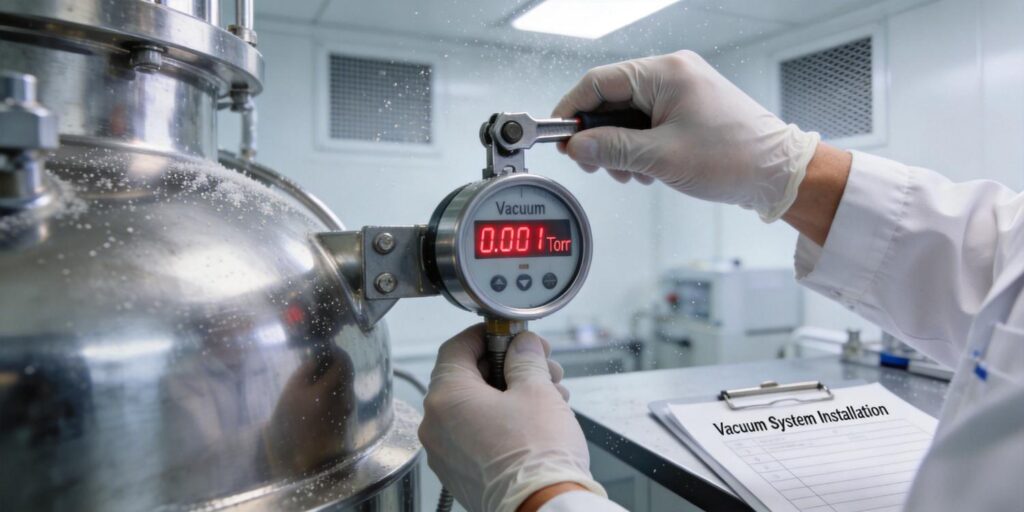
Human contact is the most preventable contamination vector. Poseidon recommends powder-free nitrile or cleanroom latex gloves (Class 100 compatible) for all gauge handling and installation. Avoid vinyl gloves, which outgas plasticizers, and never use bare hands—even after alcohol wipes.
Key handling rules:
- Touch only the outer KF flange and electronics housing; never contact electrode surfaces or the Pirani filament assembly.
- Remove protective caps immediately before mounting and install within 60 seconds to minimize airborne exposure.
- If the gauge must be set down, place it on a clean, grounded stainless-steel bench with the port facing upward.
- After installation, perform a 30-minute bake-out at 80 °C (if system allows) to drive off any residual moisture introduced during mounting.
These practices reduce initial outgassing by more than 90 % compared with unprotected handling, according to internal vacuum metrology tests aligned with principles in Foundations of Vacuum Science and Technology (Lafferty, 1998). The result: faster pump-down to base pressure and elimination of early-life pressure spikes.
Optimal Installation Environment for Maximum Gauge Longevity
Where and how you mount the gauges dramatically affects contamination rates. Both Poseidon models support KF16 or KF25 flanges and can be installed in any orientation—gravity does not affect Penning discharge or thermal conductivity measurements.
Recommended practices:
- Mount on short extension tubes (300–600 mm) or forelines when the chamber exceeds 50 °C to maintain the gauge head within the 15–50 °C operating window.
- Position away from direct line-of-sight to high-outgassing loads or electron-beam sources that can sputter material onto electrodes.
- Use all-metal or Viton-sealed vacuum connections; avoid rubber tubing or elastomers that outgas hydrocarbons.
- In systems with occasional corrosive backfill, install an isolation valve upstream of the gauge and keep it closed during venting.
The VG-SM225’s software protection automatically disables high voltage above 10−3 Torr, preventing electrode contamination during roughing. The VG-SP205’s platinum filament tolerates brief exposure to air without damage. These features, combined with proper location, keep both gauges operating within published accuracy (±5 % Pirani, ±20 % cold cathode) for years in production environments.
Environmental Compatibility Checklist
Before installation, verify:
- Chamber base pressure reaches 10−6 Torr or better within 2 hours (confirms low outgassing).
- No continuous exposure to halogenated or highly oxidizing gases without prior consultation.
- Magnetic field from the VG-SM225 (~100 gauss enclosed) is >10 cm from sensitive instrumentation.
Long-Term Stability Tips for Consistent Vacuum Readings
Beyond initial installation, five practices ensure years of drift-free performance:
- Periodic verification: Cross-check against a calibrated reference gauge every 6–12 months or after 500 operating hours. The removable VG-SM225 head makes this fast.
- Temperature compensation monitoring: Both gauges include built-in circuit and algorithm compensation valid from 15 °C to 50 °C; log ambient temperature to flag any excursions.
- Digital diagnostics: Use the RS232 output (customizable protocol) to monitor status codes and error flags—early warning of contamination before readings drift.
- Scheduled cleaning protocol: For the VG-SM225, establish a preventive maintenance interval based on process gas load rather than waiting for failure.
- Power-supply stability: Maintain ripple below 200 mV (Pirani) or 500 mV (cold cathode) to prevent false pressure noise that can be mistaken for contamination effects.
Customers following these guidelines routinely achieve >99.5 % uptime and measurement repeatability within 3 % across multi-year production campaigns. The low self-pumping speed of both gauges (~0.01 L/s) ensures they never disturb chamber equilibrium during long soaks.
Ready to Eliminate Contamination-Related Downtime in Your Vacuum Systems?
Contamination is not inevitable. With the right gauge design, disciplined handling, and simple maintenance procedures, high-vacuum measurement becomes predictable and cost-effective. Poseidon Scientific’s VG-SP205 Pirani Vacuum Transmitter and VG-SM225 Cold Cathode Vacuum Gauge combine low ownership cost, field-serviceable construction, and full-range coverage to deliver the reliability engineers demand.
Explore the full technical specifications and downloadable cleaning instructions:
VG-SP205 Pirani Vacuum Transmitter – Technical Data & Manual
VG-SM225 Cold Cathode Vacuum Gauge – Technical Data & Manual
Need a custom contamination-prevention checklist for your specific process, mounting recommendations, or evaluation units to test in your chamber? Our applications engineers have supported hundreds of installations and are ready to review your system layout or PLC integration needs. Contact us today for a free vacuum-audit consultation or to request a no-obligation trial of the Poseidon gauge pair.
Clean vacuum. Stable readings. Zero surprises. That’s the Poseidon Scientific advantage.


