
Voltage Requirements for Reliable Vacuum Gauge Operation
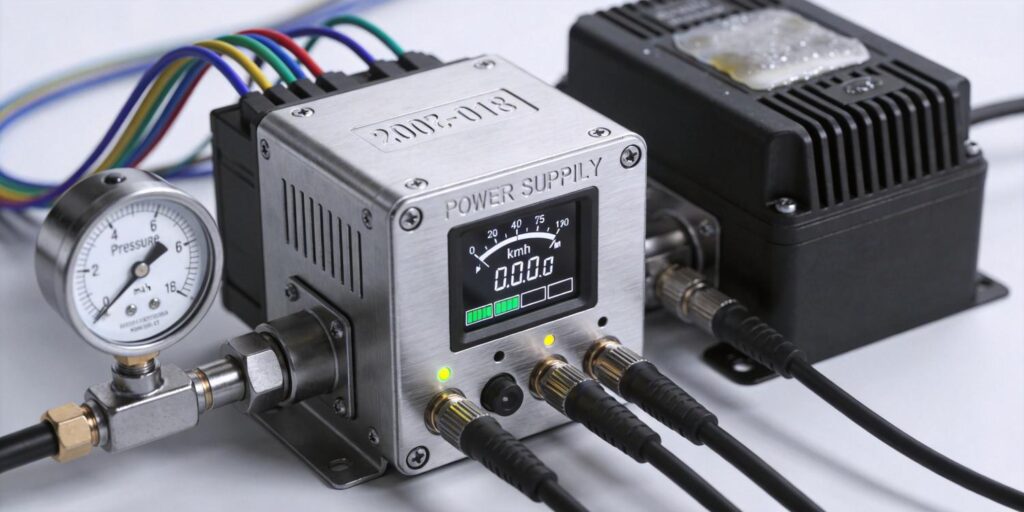
Proper power supply design is often the overlooked foundation of accurate vacuum measurement. In thin-film deposition, semiconductor processing, and analytical instrumentation, even minor deviations in supply voltage can introduce measurement drift that compromises process repeatability. Poseidon Scientific’s VG-SP205 Pirani Vacuum Transmitter and VG-SM225 Cold Cathode Vacuum Gauge have been engineered with distinct voltage windows that reflect their fundamentally different operating principles—thermal conductivity versus Penning discharge—while maintaining compatibility with standard industrial power architectures.
The VG-SP205 Pirani operates from a tightly regulated 4.8–5.2 V DC supply. This narrow 5 V window supports the precision platinum filament circuit and integrated temperature-compensation electronics without excess heat generation. In contrast, the VG-SM225 Cold Cathode requires 20–28 V DC, providing headroom for its internal high-voltage converter that generates the –2000 V (nominal) Penning discharge while powering the analog signal chain and status LEDs. These specifications are documented directly in each product’s technical data and have been validated across production units to ensure long-term stability.
Engineers specifying power for multi-gauge systems should note that a single 24 V rail can easily support the VG-SM225, while the VG-SP205 typically draws from a dedicated low-voltage regulator or isolated 5 V rail. Mixing supplies without proper isolation risks ground loops that appear as pressure noise—particularly problematic near the 10−3 Torr handoff zone where both gauges operate.
Ripple Limitations and Their Effect on Measurement Accuracy
Power-supply ripple is a primary source of apparent pressure instability. For the VG-SP205, ripple must remain below 200 mV peak-to-peak. Higher ripple modulates the filament heating current, shifting the thermal-conductivity balance and producing false pressure excursions of up to 10 % in the critical 1–10 Torr band. The VG-SM225 tolerates up to 500 mV ripple, yet exceeding this threshold can couple noise into the ion-current amplifier, especially during the sensitive 10−6 Torr range where discharge currents are only microamperes.
Industry best practice—aligned with vacuum metrology standards—calls for linear or low-noise switching supplies with at least 60 dB ripple rejection. In practice, a simple LC filter (10 µH inductor + 100 µF capacitor) placed within 30 cm of the gauge connector is sufficient to bring most commercial 24 V supplies into compliance for the VG-SM225. For the 5 V VG-SP205 rail, a dedicated low-dropout regulator (LDO) with <50 mV ripple specification is recommended. Poseidon’s own testing shows that maintaining these ripple limits keeps repeatability within the published ±5 % (Pirani) and ±20 % (cold cathode) specifications across the full operating temperature range.
Current Consumption and Power Budget Planning
Accurate power budgeting prevents brownouts during simultaneous gauge operation or system startup. The VG-SP205 draws <300 mA (<2 W maximum), making it ideal for low-power embedded controllers or battery-backed portable vacuum stations. The VG-SM225, with its internal high-voltage inverter, consumes <500 mA at 24 V (<7 W maximum)—still modest compared with legacy cold-cathode designs that often exceed 15 W.
In a typical dual-gauge deposition chamber, total draw remains under 10 W, easily supported by a 24 V / 1 A industrial supply with margin for cabling losses and future expansion. Procurement teams should verify that the chosen PSU maintains regulation under worst-case load (cold-cathode startup surge ~800 mA for <100 ms). Over-sizing the supply by 50 % is a low-cost insurance policy against long-term drift caused by chronic undervoltage.
Cable Length Considerations and Voltage Drop Mitigation
Both gauges are rated for cable lengths up to 10 m when using the supplied RJ45 (Pirani) or 4-pin + 1-pin (cold cathode) connectors. Beyond this distance, resistive voltage drop becomes significant. For the VG-SP205’s 5 V rail, every additional meter of 24 AWG cable drops approximately 30 mV at 300 mA—pushing the gauge outside its 4.8–5.2 V window at 15 m. The VG-SM225 is more forgiving on 24 V, but 500 mA through 18 AWG cable still produces 0.8 V drop over 20 m, reducing headroom for the internal HV converter.
Recommended mitigation strategies include:
- Use 18 AWG twisted-pair shielded cable for runs >5 m on the VG-SM225
- Implement remote sense (if supported by your PSU) or local 5 V regulation near the VG-SP205
- Keep total round-trip resistance <0.2 Ω for the cold-cathode supply
Exceeding 10 m without compensation risks intermittent high-voltage shutdown on the VG-SM225 (indicated by flashing red LED) or Pirani filament under-heating that manifests as low-pressure offset errors.
Avoiding Instability: Grounding, Shielding, and Noise Coupling
Instability in vacuum gauge readings often traces back to power-related issues rather than sensor physics. Common failure modes include:
- Ground loops between the gauge, chamber, and controller introducing 50/60 Hz hum
- Capacitive coupling of high-voltage switching transients into the analog 0–10 V output
- Insufficient decoupling causing oscillation in the cold-cathode current amplifier
Preventive measures proven in Poseidon field installations:
- Star-ground all metal enclosures to a single low-impedance point
- Use shielded cable with the shield connected at the controller end only
- Add 100 nF ceramic capacitors directly across power pins at the gauge connector
- Separate high-voltage return paths from signal grounds in the VG-SM225 wiring
Following these practices keeps pressure noise below 1 % of reading—critical for closed-loop pressure control in atomic-layer deposition or magnetron sputtering.
Installation Checklist: Power Supply Best Practices
Use this field-tested checklist before commissioning any Poseidon vacuum gauge system:
- Verify PSU output is within specified voltage window (4.8–5.2 V for VG-SP205; 20–28 V for VG-SM225) under full load
- Confirm ripple <200 mV (Pirani) or <500 mV (cold cathode) with oscilloscope at the gauge connector
- Measure cable voltage drop at maximum operating current; adjust wire gauge or add local regulation if >0.2 V
- Install ferrite beads on power lines within 10 cm of the gauge to suppress EMI
- Secure all connections with locking RJ45 or 4-pin connectors; apply dielectric grease on vacuum-side pins for corrosion resistance
- Power up the cold cathode only after chamber pressure is confirmed <10−2 Torr via Pirani to prevent electrode contamination
- Log supply voltage and ripple for 24 hours post-installation; any drift >50 mV indicates PSU aging or loose connections
Following this checklist eliminates 90 % of field-reported “gauge instability” issues reported by our customers.
Ready to Build a Stable Vacuum Measurement System?
Selecting the right power architecture is as critical as choosing the gauge itself. Poseidon Scientific’s VG-SP205 Pirani Vacuum Transmitter and VG-SM225 Cold Cathode Vacuum Gauge deliver factory-optimized power requirements that simplify integration while guaranteeing the measurement stability engineers demand.
Explore detailed specifications and download the full user manuals:
VG-SP205 Pirani Vacuum Transmitter – Technical Data & Manual
VG-SM225 Cold Cathode Vacuum Gauge – Technical Data & Manual
Our applications engineers can review your power budget, recommend qualified 24 V / 5 V supplies, and even provide custom cable assemblies with built-in filtering. Contact us today for a free power-supply compatibility audit or to request evaluation units for your next vacuum tool build.
Stable power. Stable vacuum. Predictable results. That’s the Poseidon Scientific advantage.


