What Are PFAS Contaminants?
Per- and polyfluoroalkyl substances (PFAS) represent a class of synthetic chemicals characterized by strong carbon-fluorine bonds, making them highly persistent in the environment and resistant to degradation. These compounds have been widely used since the 1940s in various industrial applications and consumer products due to their unique properties, including oil and water repellency, thermal stability, and surfactant capabilities.
PFAS encompass thousands of individual chemicals, with perfluorooctanoic acid (PFOA) and perfluorooctanesulfonic acid (PFOS) being the most extensively studied. These compounds are amphiphilic, containing both hydrophobic and hydrophilic regions, which contributes to their environmental mobility and bioaccumulation potential. The carbon-fluorine bond is one of the strongest in organic chemistry, explaining PFAS’s resistance to environmental degradation through natural processes.
Key Characteristics of PFAS:
- Extreme environmental persistence (often called “forever chemicals”)
- High mobility in aqueous environments
- Bioaccumulation in living organisms
- Resistance to heat, water, and oil
- Widespread environmental distribution
Environmental Concerns and Regulations
The environmental persistence and bioaccumulative nature of PFAS have raised significant concerns worldwide. These compounds have been detected in groundwater, surface water, soil, and even in remote Arctic regions, demonstrating their global transport potential. Human exposure occurs primarily through contaminated drinking water, food, and consumer products.
Health and Environmental Impacts:
- Linked to various health effects including liver damage, thyroid disease, decreased fertility, and increased risk of certain cancers
- Environmental persistence leads to long-term contamination
- Bioaccumulation in food chains poses risks to wildlife and humans
- Groundwater contamination affecting drinking water supplies
Regulatory Framework:
Global regulatory agencies have established increasingly stringent guidelines for PFAS monitoring and control. The U.S. Environmental Protection Agency (EPA) has set health advisory levels for PFOA and PFOS at 70 parts per trillion (ppt) individually or combined. The European Union has implemented restrictions under REACH regulations, while countries like Canada and Australia have established their own guidelines for PFAS in drinking water and environmental matrices.
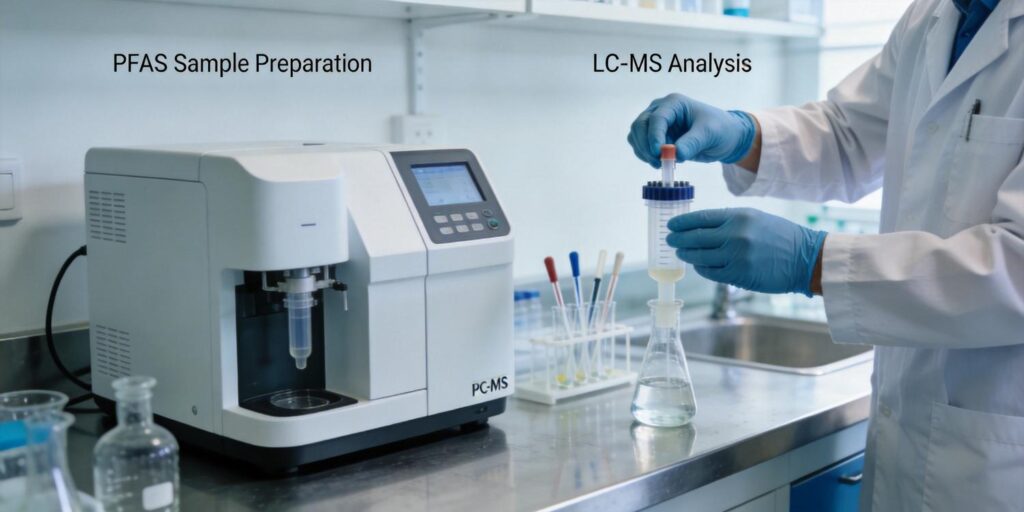
Standard analytical methods such as EPA Method 537.1 and 533 have been developed specifically for PFAS analysis in drinking water, emphasizing the need for reliable sample preparation techniques like SPE to meet regulatory requirements.
Why SPE is Used in PFAS Extraction
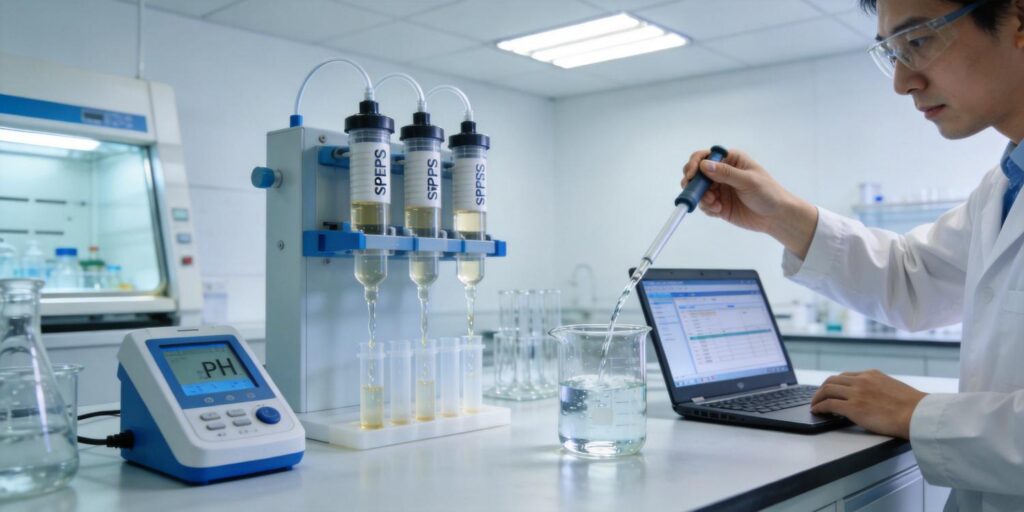
Solid Phase Extraction (SPE) has become the method of choice for PFAS analysis due to several critical advantages over traditional extraction methods. As noted in sample preparation literature, “SPE offers many advantages over traditional liquid extractions–including reduced sample and solvent volumes, prevention of emulsions, greater partition efficiency (improved recovery, selectivity, and precision), fewer steps, and shorter analysis time–and is amenable to automation” (Forensic and Clinical Applications of Solid Phase Extraction).
Technical Advantages of SPE for PFAS:
1. Enhanced Selectivity and Clean-up
PFAS compounds require specific sorbent chemistries for optimal recovery. Weak anion exchange (WAX) and mixed-mode sorbents provide the dual retention mechanisms necessary for capturing both anionic and neutral PFAS species. The SPE strategy generally comprises “the isolation (and concentration) of the analytes from a complex matrix by adsorption onto an appropriate sorbent, the removal of interfering impurities by washing with a suitable solvent system and then the selective recovery of the retained analytes” (Analysis of Pharmaceutical Creams).
2. Concentration Capability
SPE enables significant concentration factors, crucial for detecting PFAS at ppt levels. The trace enrichment aspect of SPE “lends itself very well to the extraction of liquids, especially clean samples such as drinking water or groundwater” (Solid Phase Extraction Principles).
3. Reduced Solvent Consumption
Compared to liquid-liquid extraction, SPE dramatically reduces organic solvent usage, addressing both environmental concerns and analytical costs. Traditional methods “generate more hazardous waste and pollution than they actually detect, monitor, or ameliorate” (Solid Phase Extraction Principles).
4. Automation Compatibility
SPE systems can be automated for high-throughput analysis, essential for monitoring programs requiring large sample volumes. Automated SPE workstations provide “more precise flow control and appear less prone to flow difficulties” (Forensic and Clinical Applications).
Recommended SPE Workflow for PFAS Analysis
Based on established methodologies and best practices, the following SPE workflow provides optimal results for PFAS extraction:
Step 1: Sample Preparation and Preservation
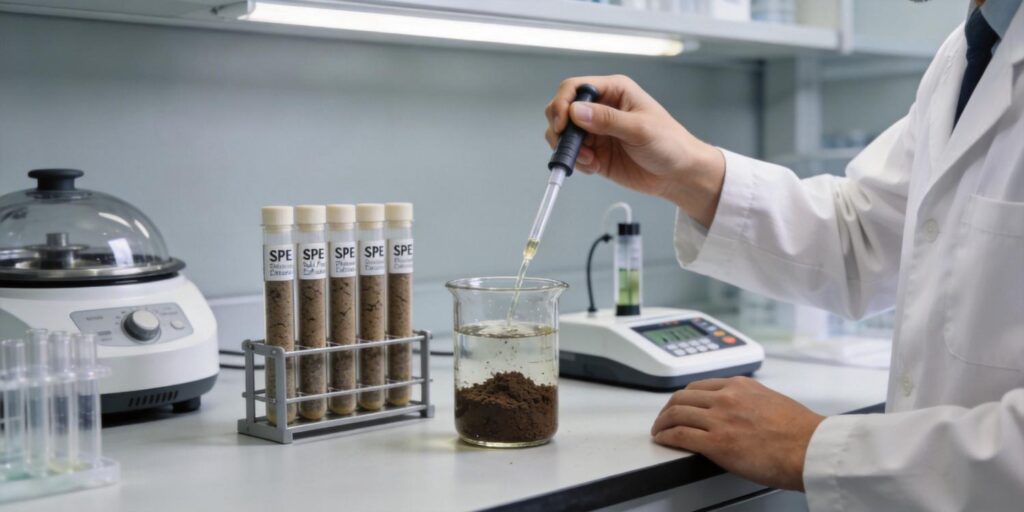
Proper sample handling is critical for PFAS analysis. Samples should be collected in polypropylene containers, as PFAS can adsorb to glass surfaces. Preservation with ammonium acetate buffer (pH 4-5) helps maintain analyte stability. For particulate-containing samples, “prefiltering samples prior to SPE in a standard manner to remove suspended solids is recommended” using glass-fiber filter discs without organic binders (Solid Phase Extraction Principles).
Step 2: SPE Cartridge Selection and Conditioning
For PFAS analysis, weak anion exchange (WAX) cartridges such as Poseidon Scientific’s WAX SPE cartridges are recommended. These provide mixed-mode retention through both hydrophobic interactions and anion exchange mechanisms. Conditioning typically involves:
- 5 mL methanol (or similar water-miscible organic solvent)
- 5 mL deionized water (pH adjusted if necessary)
- Maintain wetness of sorbent bed throughout process
As noted in SPE protocols, “Methanol wets the surface of the sorbent & penetrates bonded alkyl phases, allowing water to wet the silica surface efficiently” (Essential Guide to Sample Preparation).
Step 3: Sample Loading
Load samples at controlled flow rates (typically 1-5 mL/min) to ensure optimal analyte retention. For large volume samples, “an SPE disk is recommended for large volume samples, samples containing high amounts of particulates, or when a high flow rate is required during sampling” (Essential Guide). Maintain consistent flow rates as “slower flow gives better results” for compound recovery (The Secrets of SPE).
Step 4: Washing and Interference Removal
Use appropriate wash solvents to remove matrix interferences while retaining PFAS analytes. Common wash protocols include:
- 5 mL 25 mM ammonium acetate in water (pH 4)
- 5 mL methanol (for removal of neutral interferences)
Proper washing is essential as “the removal of interfering impurities by washing with a suitable solvent system” ensures cleaner extracts (Analysis of Pharmaceutical Creams).
Step 5: Elution and Concentration
Elute PFAS compounds using optimized solvent combinations:
- 5 mL methanol containing 2% ammonium hydroxide
- 5 mL methanol (for complete recovery)
Concentrate eluates under gentle nitrogen evaporation, avoiding complete dryness to prevent volatile PFAS losses. “When choosing eluent, consider ease of evaporation if reconstitution is needed” and “allow cartridge/plate to soak with eluent for 0.5 – 1 min” to improve recovery (The Secrets of SPE).
Tips for Avoiding Contamination in PFAS Analysis
Contamination control is paramount in PFAS analysis due to the ubiquity of these compounds in laboratory environments and consumables. Systematic approaches must be implemented to ensure data quality.
1. Laboratory Environment and Equipment
Establish dedicated PFAS-free zones with controlled air flow. Avoid using PTFE-containing materials, as these can leach PFAS. Regular cleaning with methanol and isopropanol helps reduce background contamination. As noted in troubleshooting guides, “analysis of a water blank can help rule out matrix effects or contribution” (Forensic and Clinical Applications).
2. Consumables Selection
Use PFAS-tested consumables whenever possible. Polypropylene and high-density polyethylene generally have lower PFAS background than other plastics. Glassware should be thoroughly cleaned and baked at 450°C to remove organic contaminants. SPE devices themselves can be sources of contamination, as “plasticizers/phthalates from the polypropylene cartridge or polyethylene frits” may interfere (Forensic and Clinical Applications).
3. SPE-Specific Contamination Control
Implement pre-washing protocols for SPE cartridges: “Prewash using the strongest eluotropic solution to be used…at 10–20 times the bed volume” followed by routine conditioning steps (Forensic and Clinical Applications). This removes potential contaminants from manufacturing and packaging processes.
4. Reagent and Solvent Quality
Use high-purity solvents specifically tested for PFAS background. Establish reagent blank protocols to monitor contamination sources. “Old reagents–near or past expiration, or ‘bottom of the barrel'” should be avoided, and “new reagents–improper strength, source, preparation” should be verified (Forensic and Clinical Applications).
5. Cross-Contamination Prevention
Implement strict sample handling protocols to prevent carryover between samples. In automated systems, “post-elution rinses should be placed into separate waste containers to essentially prevent cross-contamination problems” (Forensic and Clinical Applications). Regular system cleaning with appropriate solvents maintains fluid path integrity.
6. Quality Control Measures
Include method blanks, laboratory control samples, and matrix spikes in every analytical batch. Monitor recovery rates and background levels to identify contamination trends. Document all potential contamination sources systematically, as “you need to systematically isolate and eliminate these sources when tracking down a contamination” (Forensic and Clinical Applications).
7. Personnel Training and Protocols
Ensure all laboratory personnel follow standardized procedures for PFAS analysis. Avoid wearing waterproof clothing or using personal care products containing PFAS in the laboratory area. Regular training updates help maintain contamination awareness.
By implementing these comprehensive SPE workflows and contamination control measures, laboratories can achieve reliable, reproducible PFAS analysis that meets regulatory requirements and provides accurate environmental monitoring data. The selection of appropriate SPE products, such as Poseidon Scientific’s specialized SPE cartridges designed for challenging applications like PFAS analysis, further enhances method performance and data quality.
For laboratories seeking optimized solutions for PFAS analysis, exploring Poseidon Scientific’s WAX SPE cartridges and 96-well SPE plates can provide the technical advantages needed for successful implementation of these critical environmental monitoring methods.